
Magazine Current IssueMagazine Current Issue
Conflicted on concrete
From our Mag
May 1, 2025

Conflicted on concrete

How can something so bad be so good?

It's beastly to our environment and yet, as Japanese architects show us again and again, in the right hands, it’s breathtakingly beautiful. It also has the potential to last millennia. Concrete: it’s a complex conundrum.

Elizabeth Price
Writing:
Writing:
Elizabeth Price
Photography:
Photography:
Rory Gardiner
No items found.
Magazine Current IssueMagazine Current Issue
The After shot of the Floorplan
Before
before
after
After
Top
Arrow UpArrow Up

It's everywhere in Japan. In all the usual places: public and private buildings, bridges, roads; and tsunami-shielding sea walls. It's synonymous with Japan's most iconic architects and its architectural power moves (take a look at photos from Japan's 1964 Olympics when you have a spare minute). It's a century-long romance born from disaster: namely the Great Kanto earthquake of 1923. Some 447,000 wooden houses were destroyed in fires and an estimated 140,000 people perished. It's little surprise then that a nation ravaged and traumatised by natural disaster, sought and embraced the stability and assuredness of concrete at that particular point in its history. And then: World War II happened. "After that, concrete played a big role in the city's rebuilding," writes architect and author, Naomi Pollock. "Economical, efficient and durable, it was also an international and modern material that symbolically paved the way for Japan's rebirth."

In addition to writing a number of books on Japanese design and architecture, Naomi has curated Tokyo's finest examples of concrete architecture into the Tokyo Concrete Map¹. It's a beautifully designed physical map that captures many of the outputs of this rebirth in the 1950s and 1960s: iconic buildings designed by both international and local architects such as Le Corbusier, Toyo Ito and Kenzo Tange. And Ando, of course there's plenty Tadao Ando – for most of us, the personification of Japanese concrete architecture.

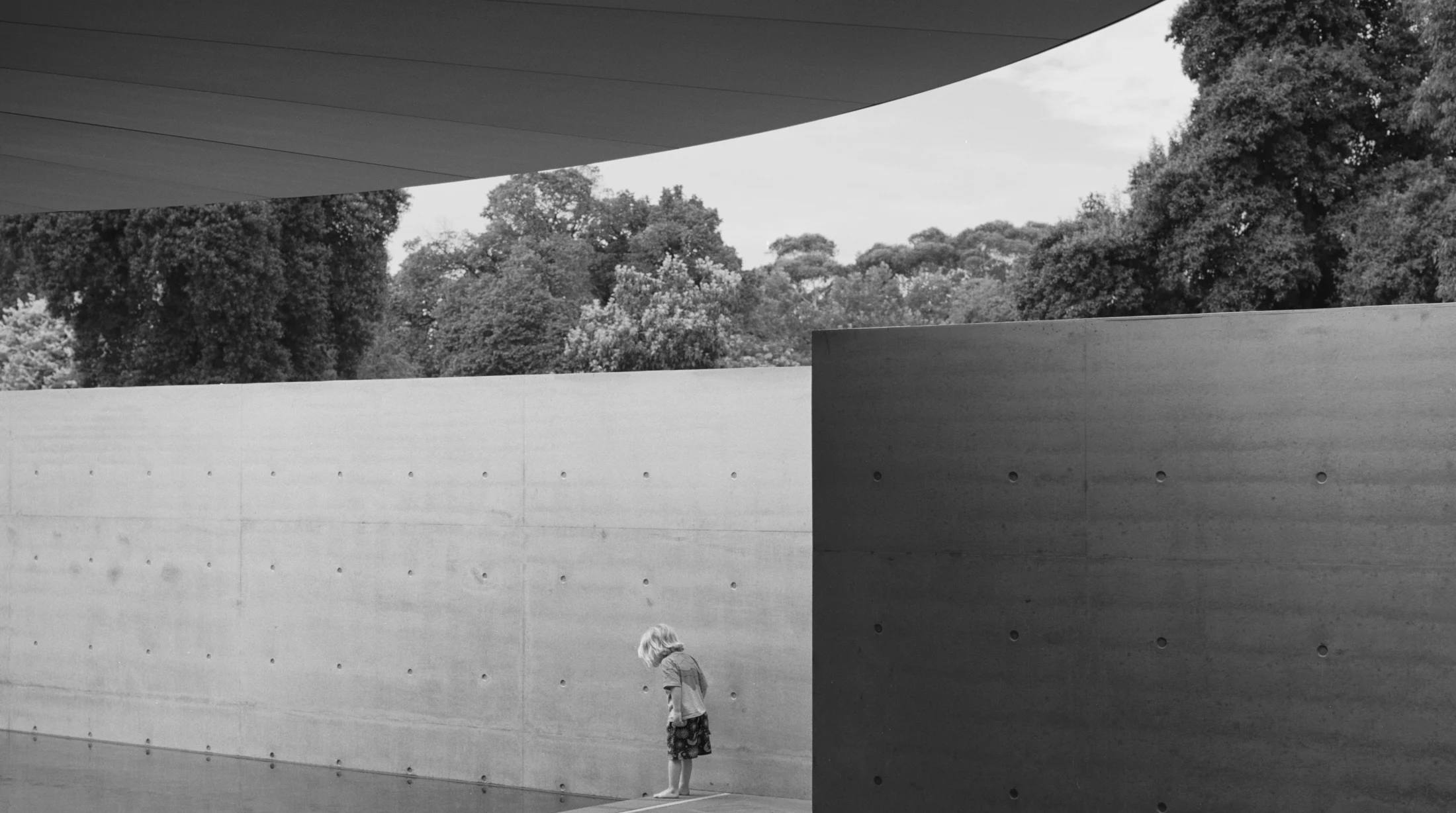
In 2023 it was announced that my home town of Melbourne would be gifted its own little piece of Tadao Ando magic. Melburnians were delighted. Not only would it be Australia's only example of Ando's architecture, but it would be the only example in the southern hemisphere. Japan's Pritzker Prize winning architect would be making his mark on Melbourne in the form of an open air community arts space we learned. So here was my opportunity to experience the transcendental qualities² of Ando's architecture in my own backyard, but I felt conflicted. A temporary arts structure made from concrete felt a little…tone deaf. Here we were, in a climate of post-pandemic 'green recovery'³, welcoming and celebrating concrete. As Ando's commissioner, the Naomi Milgrom Foundation proudly extolled, Ando is "known for his striking geometric interventions in nature and his precise, assured use of concrete."

The resulting design is a magnificent space and one that will be permanently relocated in coming years, which is excellent news, but my niggle of conflict has stayed put. When it comes to concrete in Japanese architecture, I am seeing more of it, not less of it. Encouragingly, in many cases it is existing concrete that's being exposed (there are several examples within these pages) – freed from its plasterboard mask, rather than new concrete being poured. But there are many new apartments we see being constructed from concrete too. Their architects and designers adore the freedom of form it offers them, its thermal mass properties, its longevity and its aesthetic charms. The aesthetics point is subjective, of course, but it's hard to argue with the others (the Pantheon and Colosseum in Rome being fairly solid case studies on the endurance point especially). Reducing the need for energy-hungry heating and cooling in a country that is known to become both extremely hot and extremely cold is surely at least a nod in the direction of being more sustainable. And a building that will be long lasting – particularly if that structure has been designed in such a way to be adaptable to a variety of use cases beyond being a home. Is this the more nuanced interpretation of sustainability and being green?

As far as the ugly facts are concerned, concrete remains the most widely used substance on the planet next to water⁴. Producing more and more of the stuff is inescapably bad and while demolished and no-longer-useful concrete can take on a logical and practical second life as an aggregate in new building materials, this second life is too rarely honoured.

There seems to be a general acceptance that as a civilisation, we're dependent on the stuff and we're unlikely to quit using it any time soon (given its been more than 4000 years since we started), but there is hope.

Carbon negative concrete and self repairing concrete are both being produced in Japan and in other parts of the world alongside a rapidly growing number of greener alternatives. So perhaps one day, as Ando and other pioneering Japanese architects have innovated with concrete as their muse; they will innovate in this direction also. And I will be able to have my cake and eat it too – experience and enjoy being transported by Ando's architecture without a niggle of conflict.

¹ Edited by Naomi Pollock, with photography by Jimmy Cohrssen, the bilingual (Japanese and English) Concrete Tokyo Map published by Blue Crow Media is a wonderful guide to Tokyo’s unique concrete architecture.

² Several of my friends have related near spiritual experiences and awakenings while visiting Ando’s Naoshima Contemporary Art Museum in Japan.

³ The notable fall in greenhouse gas emissions on account of reduced travel and economic productivity the COVID-19 pandemic prompted calls for a ‘green recovery’: economic growth that capitalised on this progress and supported accelerated climate action.

⁴ According to the Guardian's global environment editor, Jonathan Watts in a 2019 article called Concrete: The Most Destructive Material on Earth.

Writing:
Writing:
Elizabeth Price
Photography:
Photography:
Rory Gardiner
Back to Top
Arrow UpArrow Up
Top
Arrow UpArrow Up
The After shot of the Floorplan
Before
before
after
After
Businesses featured in this project
No items found.
Products featured in this project
No items found.
Magazine Current IssueMagazine Current Issue
Writing:
Rory Gardiner
Writing:
Elizabeth Price
Photography:
Photography:
Rory Gardiner
Back to Top
Arrow UpArrow Up