
Magazine Current IssueMagazine Current Issue
Zuzu's Cave of Dreams
From our Mag
May 1, 2026

Zuzu's Cave of Dreams

Enter the home of Italian visual artist ZUZU – where joy and inspiration line the walls, the shower is cloaked in sunny tulips and the floor is primed for dancing. And not a “horror rock” in sight.

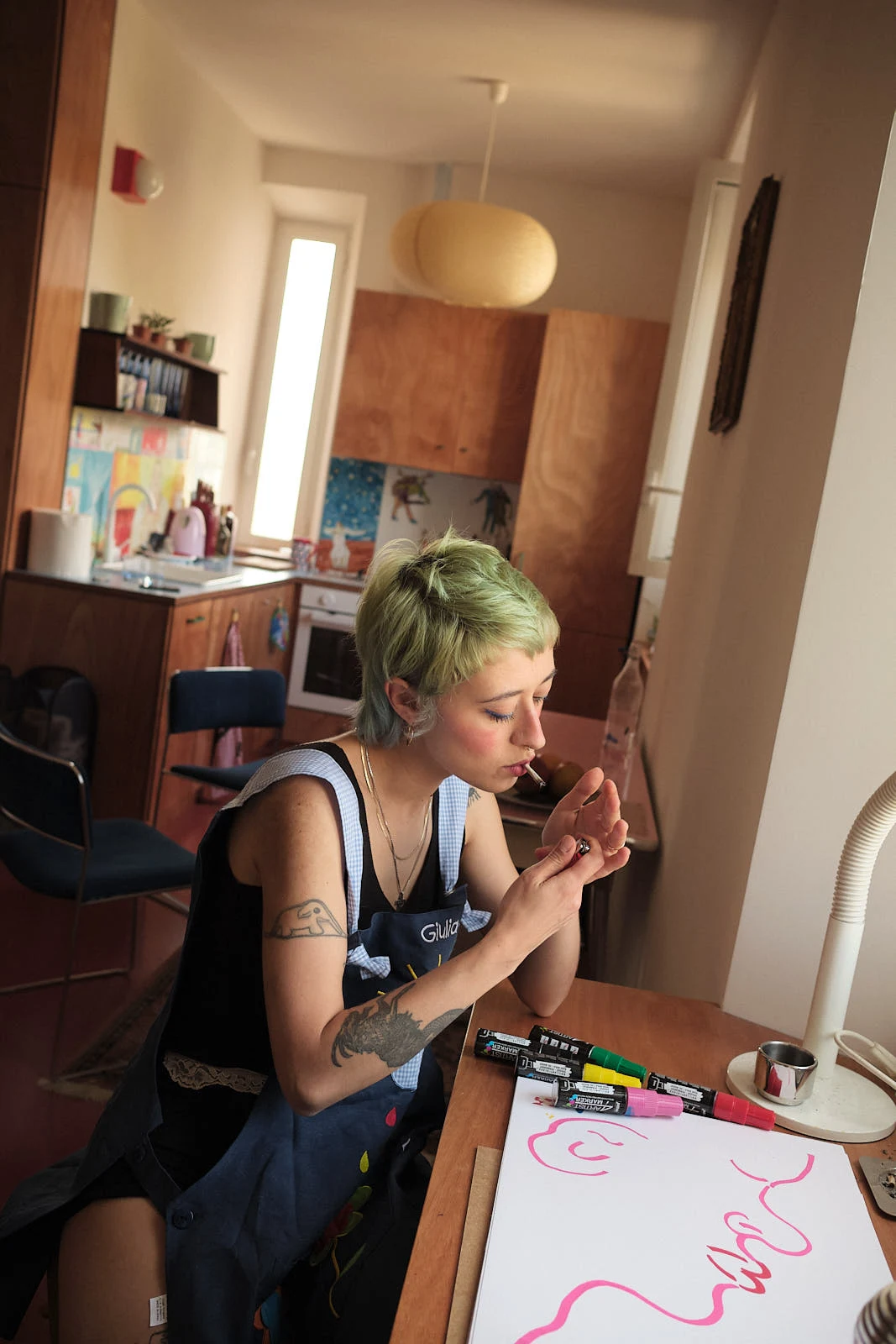
Giulia Spagnulo is an Italian visual artist who works under the pseudonym "ZUZU". She creates comics, illustrations and graphic novels, but sees herself as a storyteller above all else. Her debut book, Cheese – about bulimia and "being young in a small town and being so alive it hurts" – was published in 2019, when ZUZU was 23 years old. It was an immediate critical and commercial success. Since then, she has published two more graphic novels – Giorni Felici (2021) and Ragazzo (2025). She has also worked in animation and as a screen writer, and once had a "very funny" job on a TV show where she got to wear "wigs and strange outfits" while recommending comic books she thought people should read. ZUZU paints, too – but only for herself. Her art is playful, nostalgic, full of colour and feeling, and much of it is done from the desk in her very special home.

Kirsten Drysdale
Writing:
Writing:
Kirsten Drysdale
Photography:
Photography:
Maria Clara Macrì
No items found.
Magazine Current IssueMagazine Current Issue
The After shot of the Floorplan
Before
before
after
After
Top
Arrow UpArrow Up

ZUZU¹ was on a quest: to find the perfect apartment in Rome.

She was not having much luck. There weren't many flats available in her budget range, in the right neighbourhood, and crucially – with a terrace.

"I was desperate for a terrace!" she says. Who isn't? But she kept looking, going to inspections, scrolling past listing after listing on the internet, until one came up that made her pause. It was awful.

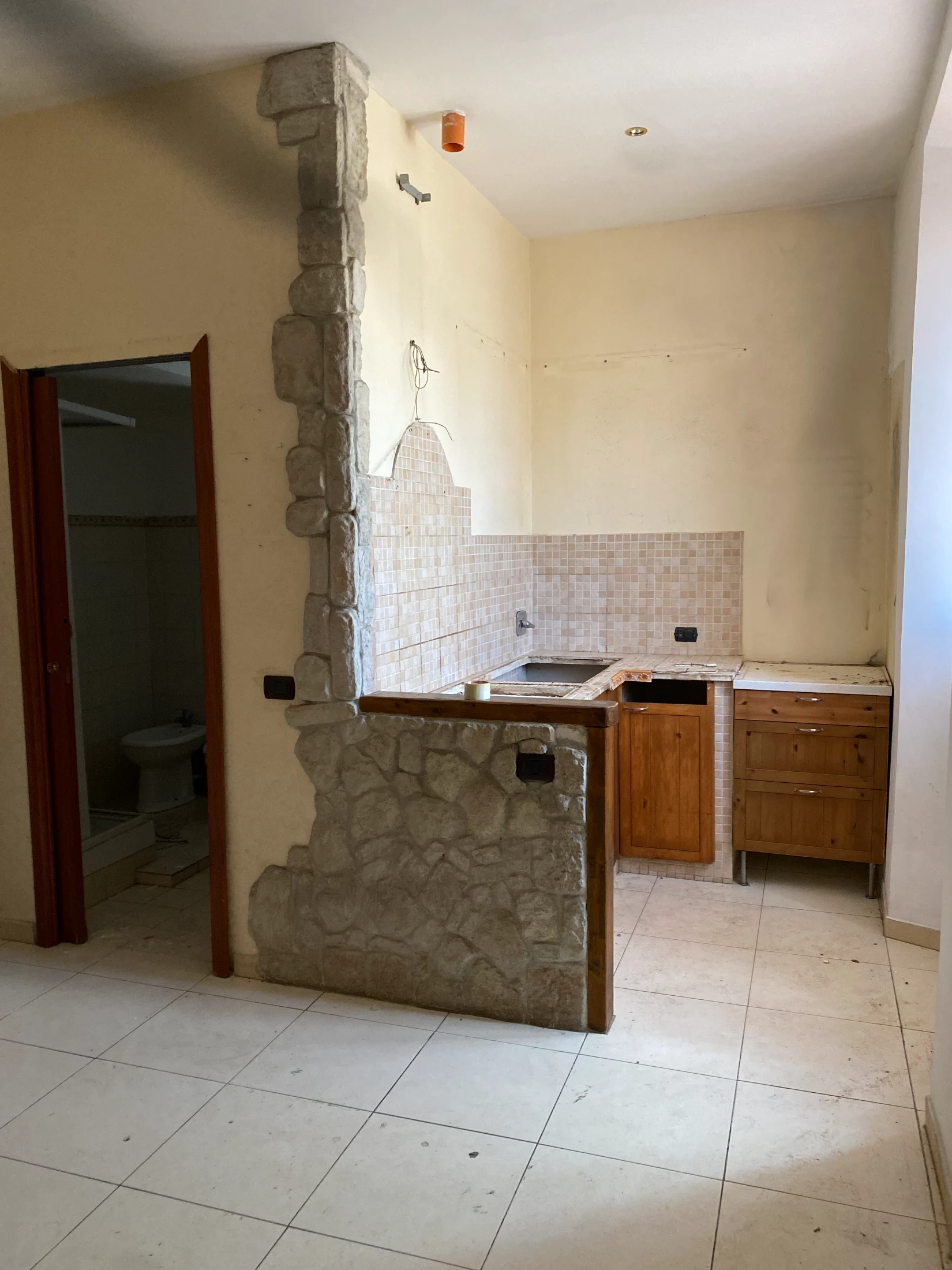
"It had horrible photos, really not very encouraging. There were fake stones on the walls! It looked like a cave. So strange²."

The weird cave apartment was small, but the lack of space wasn't an issue.

"I've always lived in very small houses," ZUZU says, "so I think it's a challenge, not a problem."

And while staring at the bizarre and deeply off-putting photos on her iPad screen, ZUZU came to realise that the apartment had a lot going for it. Including a terrace.

"So I didn't give up, I felt its potential immediately."

A real-world visit to the apartment made that potential even more obvious. ZUZU walked around inside, noted the natural light streaming through the windows, imagined what the place could be once the rocky cave walls were removed. And of course, she stood on the terrace, arms outstretched, drenched in open sky.

This was it. This would be her home – but it would need a bit of work. The "horror stones" had to go. The leaking ceiling in the bathroom needed to be repaired. The tired tiles and half-demolished kitchen were screaming out for a creative renovation.

ZUZU could see how it would all come together – but she’d have to get past the bodybuilding scam artist “agent” selling the place first. The keys were held by a hulking man with a fake tan and fake eyebrows and fake lips, and – evidently – a fake job.

"He wanted to be paid under the table because his activity as an agent was illegal, he didn't have a license."

When ZUZU refused and requested an invoice, the bodybuilder yelled at her and stormed out of the place. He then tried to trick her and her neighbour into renovating the terrace with his own "company", demanding payment in advance built into the price of the apartment. It was all very shady and frustrating, but still none of it was enough to deter ZUZU.

"Only after exhausting arguments, I managed to make him give up," she says.

The deed of sale was eventually signed in the presence of a real notary, who even had to kick the bodybuilder out of the room during the process "because he kept complaining that he was late for an audition".
Finally, the potentially-perfect apartment was in ZUZU's name. Now, to un-weird the place:

She teamed up with Marco Rulli, co-founder of Studio 02A – a Rome-based architecture firm³ known for creating deeply personal spaces that reflect the character of the people living in them. (He, and co-founder Thomas Grossi, once described their approach as "an almost philosophical vision", saying "we see the home as a part of oneself – a physical place that's actually an internal space".)

Rulli's first step was to get to know ZUZU – who she is, what she likes, how she lives and works and plays. Armed with this knowledge, he then set about finding ways to make the apartment work best for her and her family. (ZUZU's husband, and dog Eddison, were also very much part of the picture.) ZUZU makes a point of noting how grateful she is for this process:

"I'd like to thank the architect that helped me, Marco Rulli. He listened to all my ideas, and improved them. I think it's very important to find an architect like this."

Together, they designed ZUZU's home.

“The apartment facilitates the activities I do the most. I love dancing, so I put a mirror on the front door so I can look at myself while I’m dancing⁴. The sofa is small, because I don’t spend very much time on the sofa. I preferred to create more space for the dining table, because I like to have guests.”

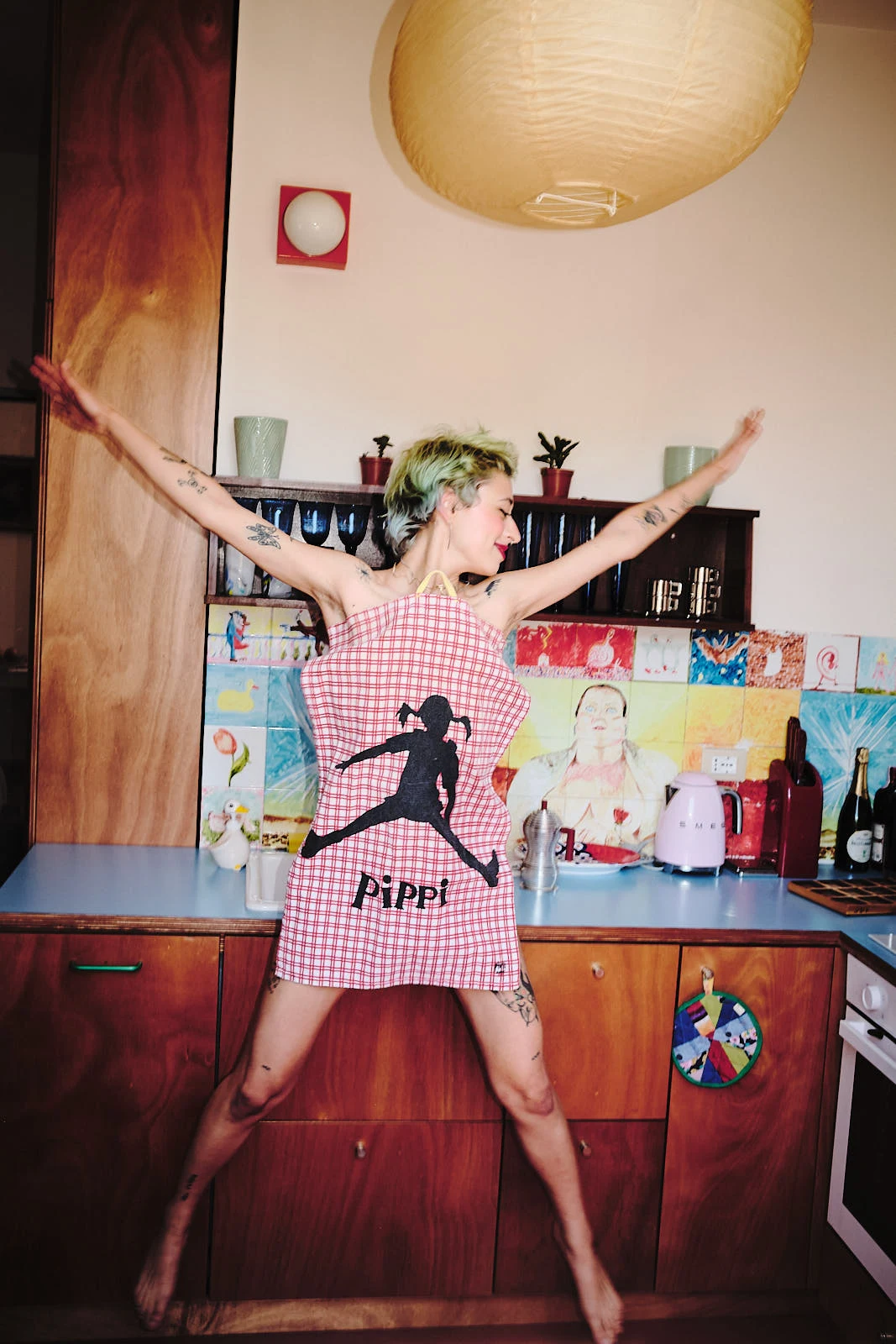
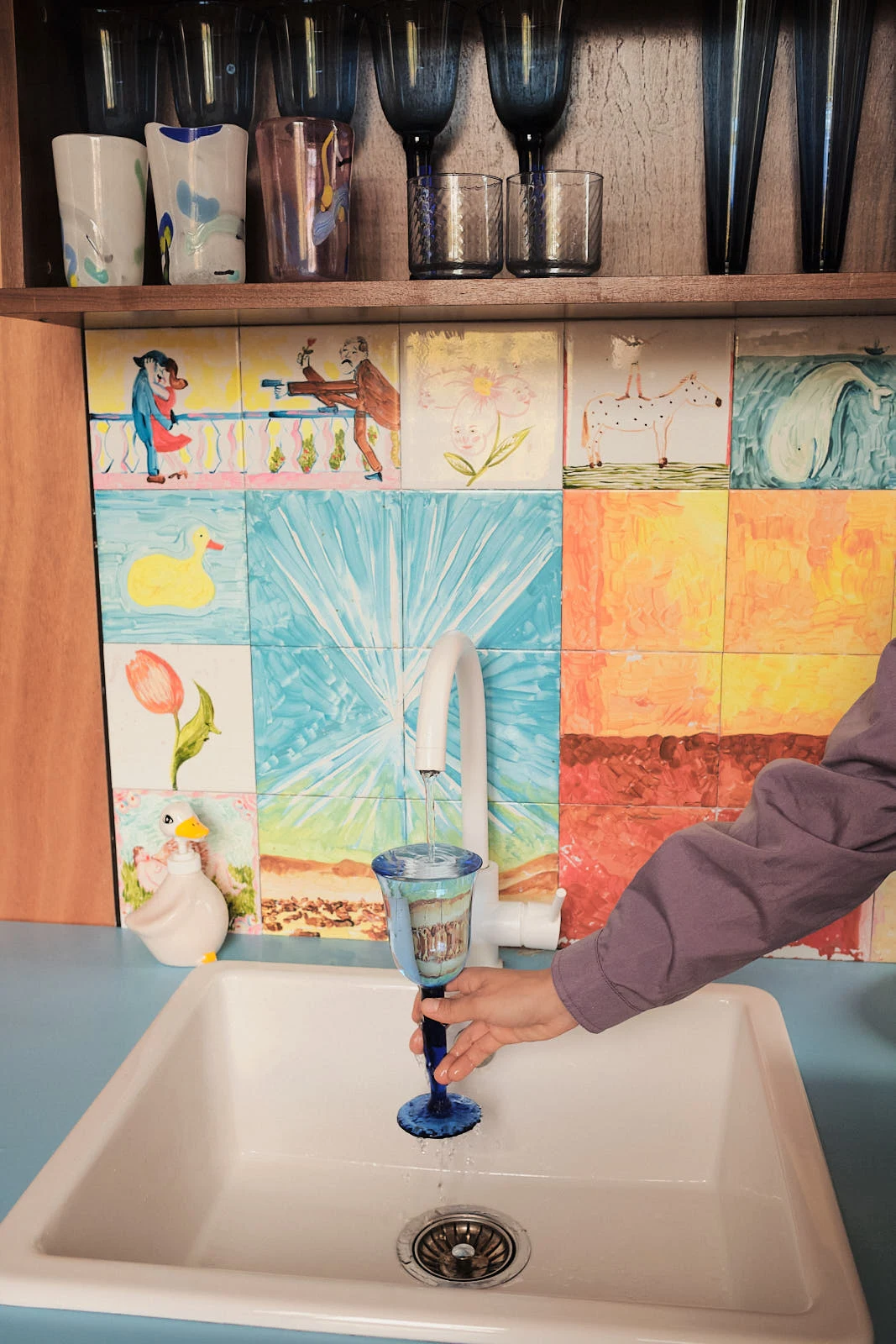
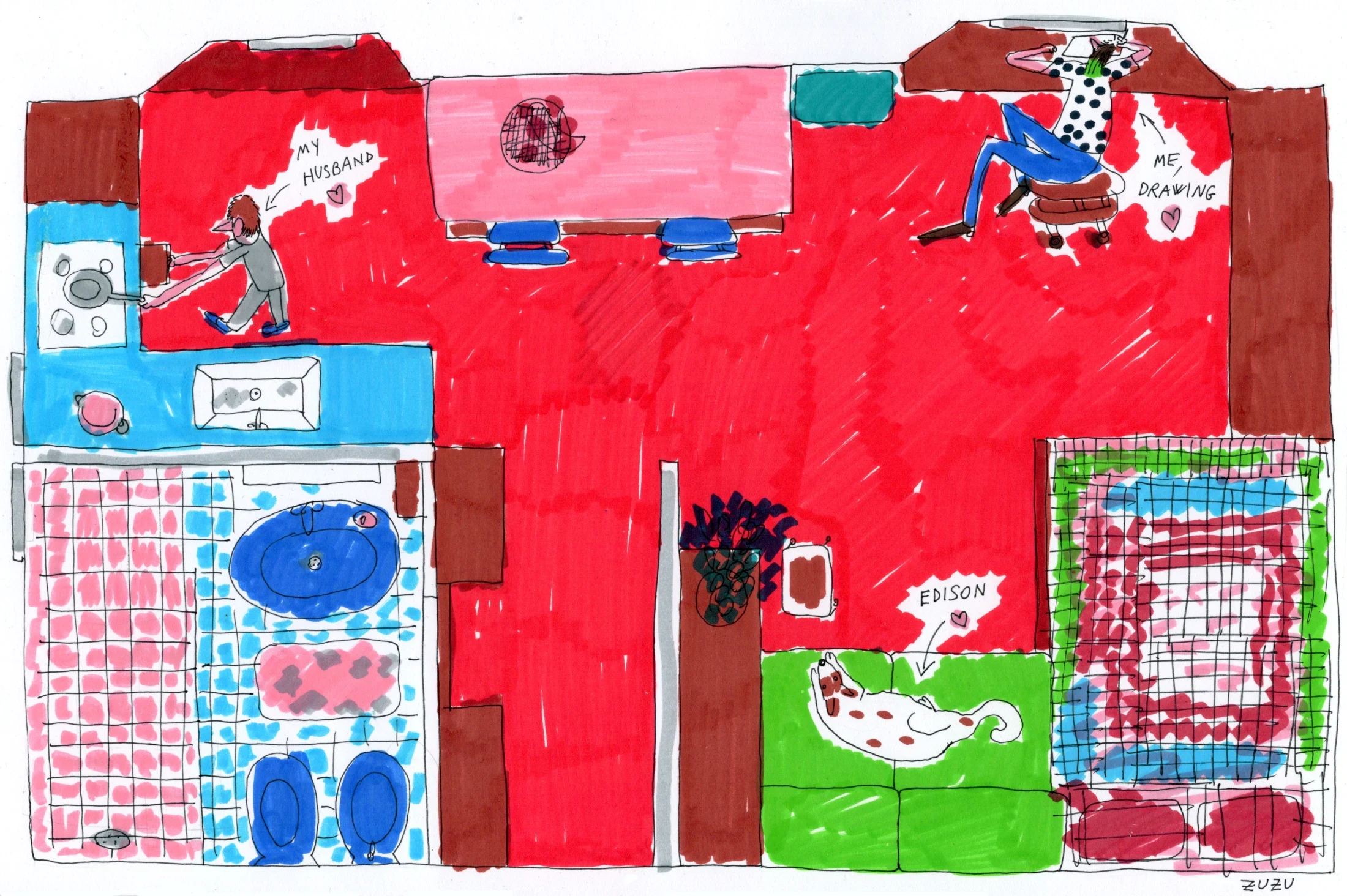
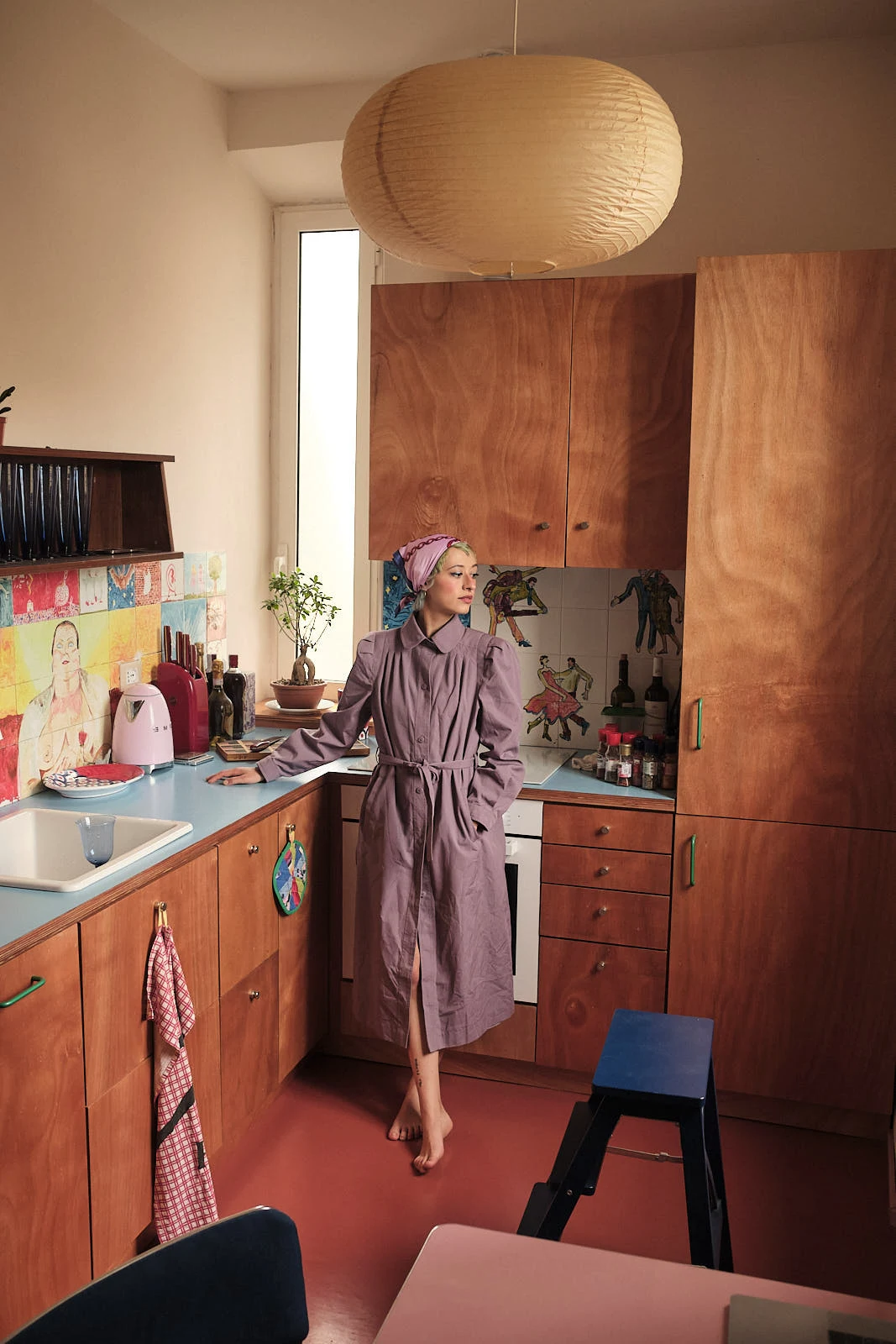
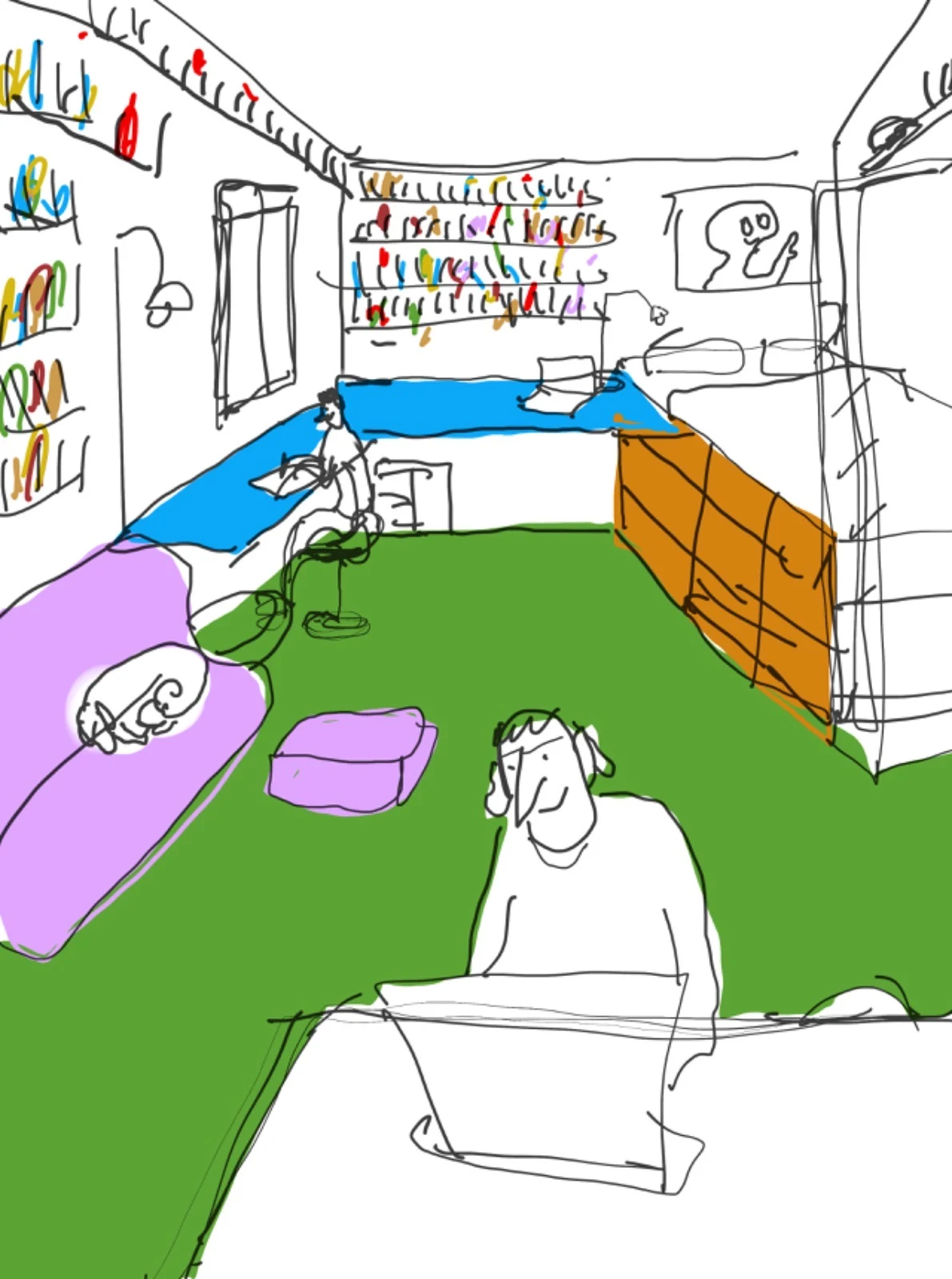
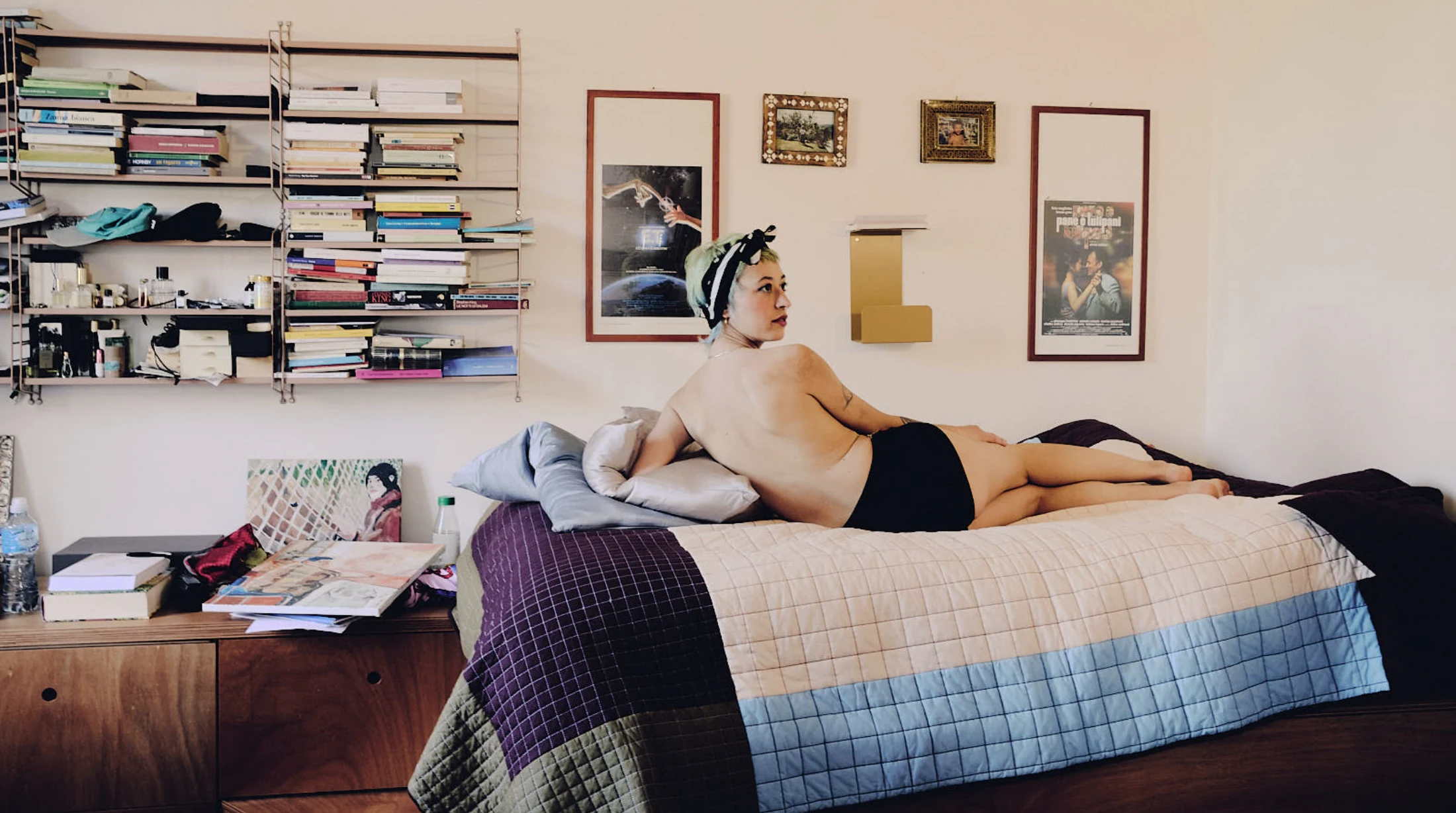
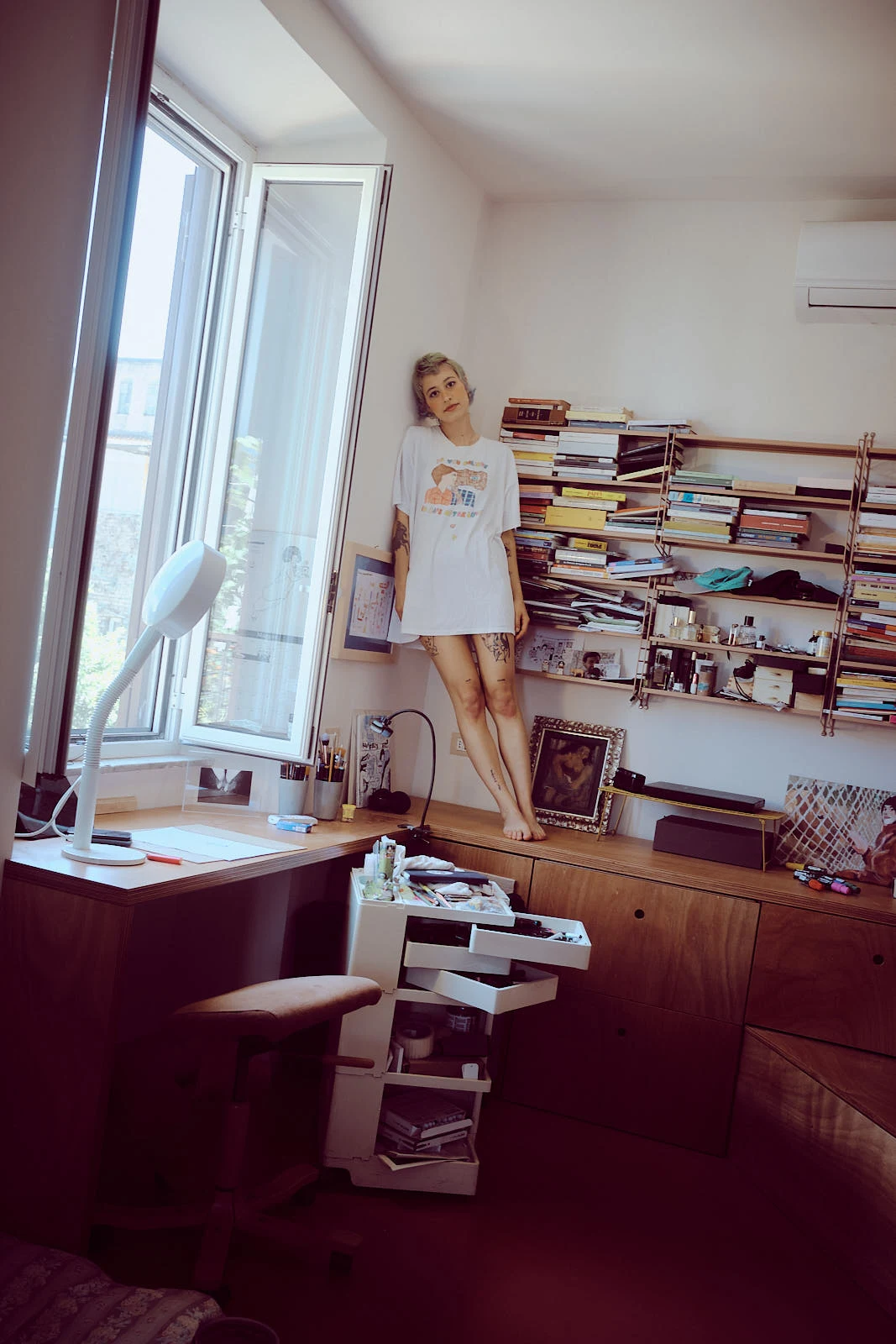
Custom-made carpentry throughout the apartment helps bring functionality to every space and ties it all together. A work station at one of the windows wraps around the corner "so that I can put my paper drawings everywhere without having a mess on the dining table". (ZUZU says that work desk is where you'll usually find her: "Most of the time, I'm sitting here on this chair drawing.") Her bed sits on top of an enormous wooden box – inside is a large storage space for all those things you only need to get to now and then, while a drawer for tidying away more everyday items can be accessed from the side. In the kitchen, the smooth wooden cabinetry is offset by bright, whimsical paintings on the tiled splashback.

"Usually I don't like to see my drawings around me," ZUZU says. "But I wanted the kitchen to be a playful space, because I love cooking, it's one of my favourite activities. So I decided to paint them because I wanted to smile when I was in the kitchen." Pippi Longstocking was the first she did in the series. "I paint all the things that make me happy. Animals that I love, some films that I love. My favourite tiles are the ones that portray me as the main character of my favourite movie, Baghdad Cafe. It's a very sweet movie, so every time I see this woman on the tiles, I'm happy."

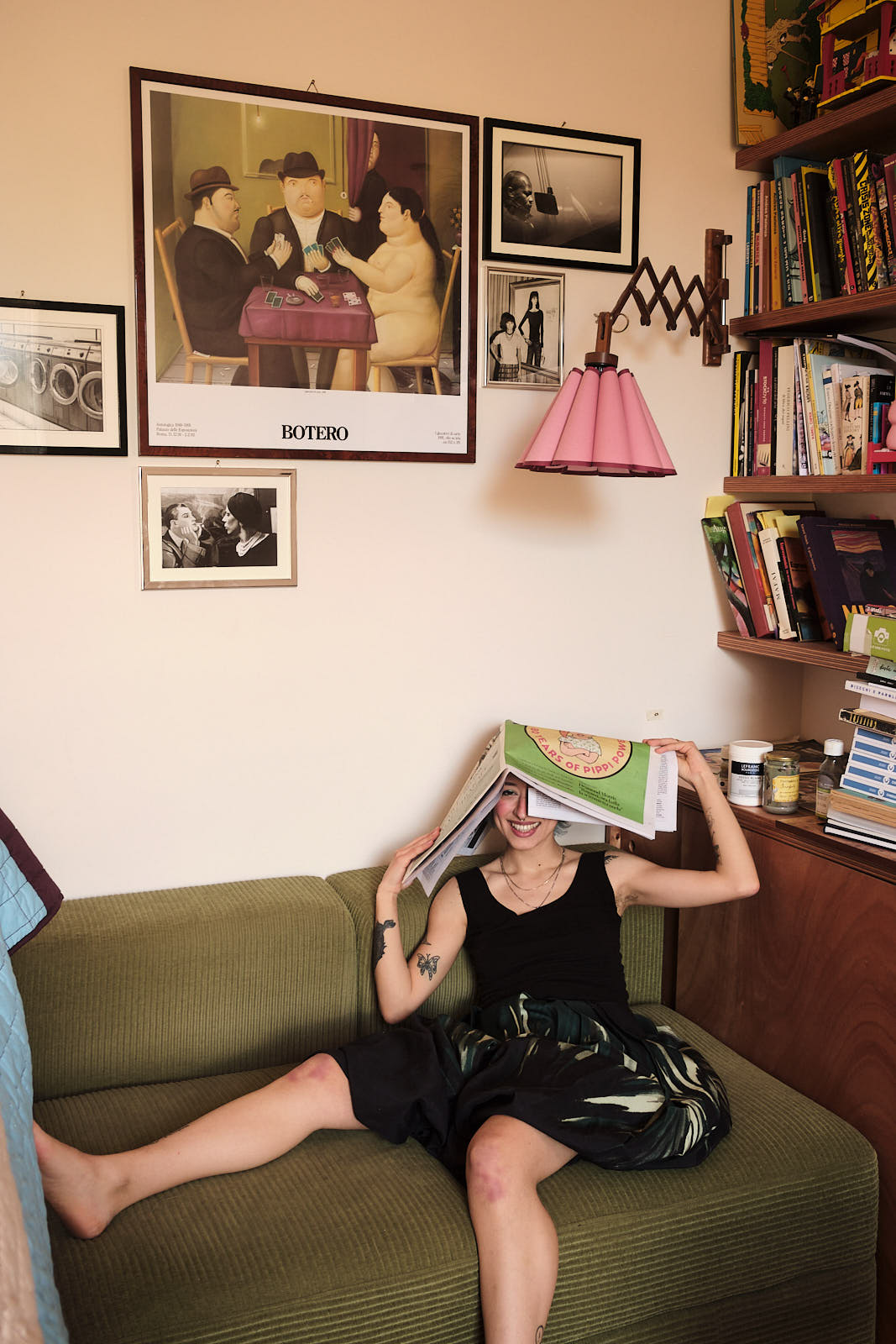
The furniture and furnishings are as key to the feel of ZUZU's home as anything else. She finds all kinds of unique vintage pieces at auctions or second-hand stores, gravitating to anything that speaks to her. A painting in a gilded frame sits above the kitchen table, a delightful enigma.

"It's a portrait of an unknown woman, I found it at an auction. I fell in love immediately because she reminds me of the poet Alda Merini⁵. She seems crazy, and she also looks like a man – maybe she is a man! I don't know. I like her smile, it makes me happy."

The fluted pink lampshade above her green corduroy sofa was made by a Chinese artisan she found on Etsy; she attached it to the extendable wall-mounted arm she found on Catawiki, a European online curated marketplace.

"It's very useful for when I read on the sofa, because it's right above me and I can adjust it."

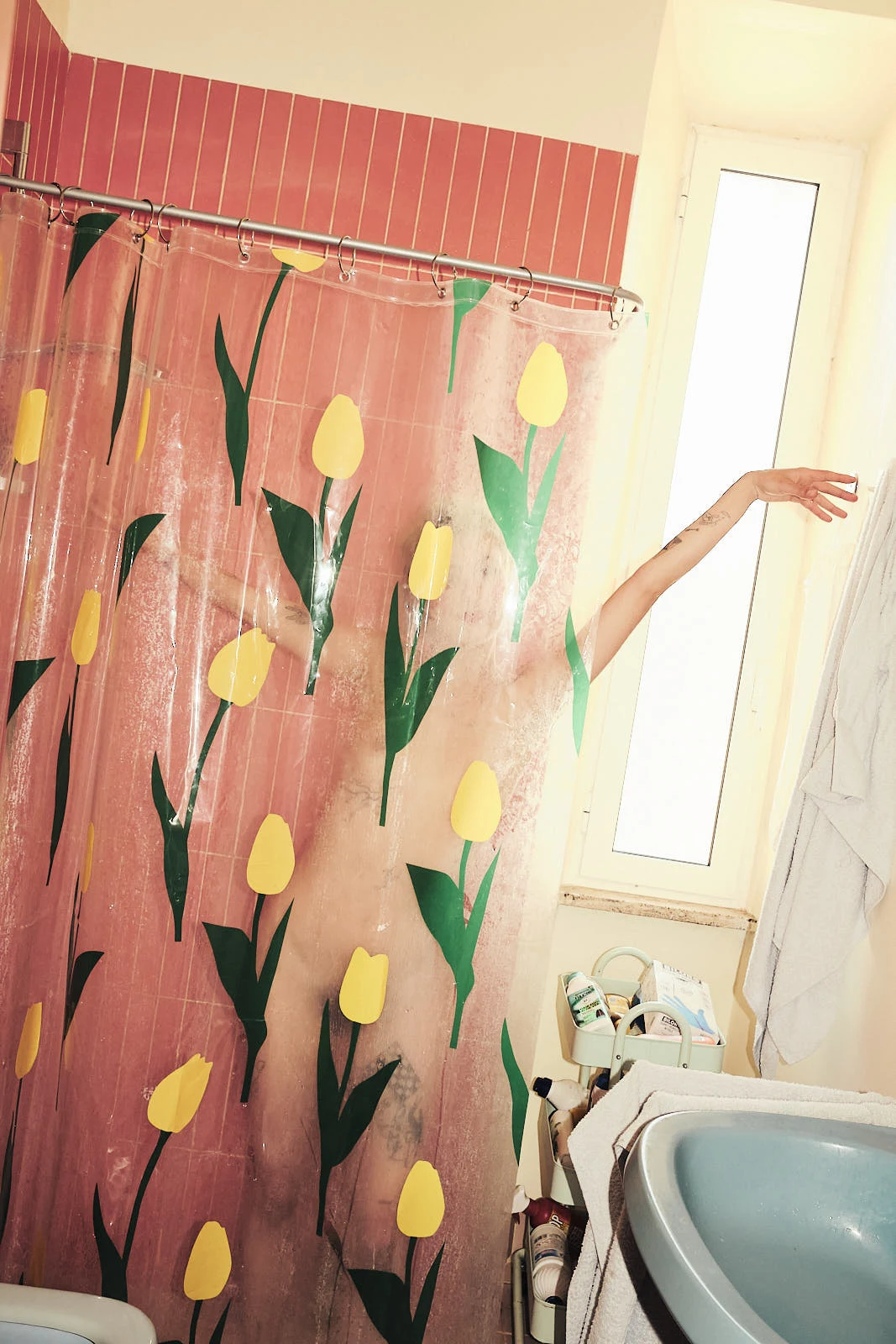
A few items are bought new, or commissioned. The retro-look kitchen table (strawberries-and-cream pink enamel with a pull-out drawer and steel legs and trim) was custom made by a guy who specialises in recreating vintage styles. A clear plastic shower curtain decorated with yellow tulips from Dusen Dusen was seemingly made for ZUZU.

"I love tulips – it's my favourite flower. But also it's transparent, and I'm a bit claustrophobic, so I prefer this solution when I take a shower and not a box, because a box makes me feel a little anxious."

On the wall above her bed are posters of her two favourite films: Pane e Tulipani (Bread and Tulips (2000), an Italian romantic comedy) and E.T. "Between them are photos of me and my husband when we were children."

It seems silly to ask ZUZU what her favourite part of the apartment is. It has to be the terrace, right?

"The terrace! But also the desk. Because it's just under the window, so it gets a lot of sunlight, and it helps with my mood and concentration. I'd never had a desk under the window. It's so important – I never understood how important it is."

But back to the terrace, which is a shared space on the rooftop. Was it everything she'd dreamed it would be?

"It's half mine, the other half is my neighbour's, and she's also a very nice person, so that's nice. I invite some friends over. I like dancing, so we dance and listen to music. It's a good place to write and to think, because it has a great atmosphere, and a lot of green to look out at. And trains that pass by, I love watching them."

ZUZU's creative impulses were evident from an early age. She remembers her earliest drawings were of "monsters".

"But cute monsters. Like little aliens with the bodies of worms – they were between worms and aliens. They were very funny. I was obsessed with monsters."

The drawing never stopped, nor did the urge to tell stories.

"When I was in the last year of high school, I was asked, 'what do you see yourself doing forever and ever, and never getting bored of?'. The answer was easy: it was drawing and writing."

Fate kicked things along when a very special comic book fell into her lap: LMVDM by Gipi.

"That was an epiphany for me. Because I wasn't a comic book reader, I hadn't read any comic books before that moment. I didn't know I could put together words and drawings in this way."

That book introduced ZUZU to the artform she was made for.

"It impressed me mostly for the way that words and images perfectly match. There wasn't a separation between the two. It was the same hand. It was the same style. And it was very free, distinctive, it didn't have the structure that I thought was a necessity for a comic book. It was so free."

Then, "a dream come true": through her publisher, Coconino Press, she was introduced to Gipi himself. He became her mentor while she was working on her debut novel Cheese, guiding her through the process.

"His direction helped me to find a creative process that I still use today. Every time I'm working on a new story, his voice comes back to me. For example – he told me to find a simple word that describes your story, and keep it in mind every time you write. It's very helpful because sometimes you can lose yourself and lose focus."

What was the word she chose for Cheese?

"Audacity."

Cheese was an unexpected and sudden success. It took ZUZU some time to become used to (and learn to enjoy!) the attention it brought her and her work. But she got there, and now does what she loves – and loves that she gets to do it.

"Mostly I work as a comic book writer. I write and draw them, so that is my principal job. But I also work as an illustrator, and now I'm working as a screenwriter for movies. My dream is to direct a movie one day."

Career underway, home secured, how does ZUZU feel about her place in the world?

"Rome is a jungle. Here, everything is difficult, even moving from one place to another is difficult, but it's a great place to hide. Because no one really pays attention to you, you can dress however and do whatever you want. But you can also feel lonely sometimes... freedom sometimes makes you feel lonely. So sometimes I go back to Salerno, where memories chase me everywhere, so it makes me feel nostalgic. I use these two cities to have inspiration: Rome to find new inspiration, and Salerno to come back to old feelings, old memories. So they have a different impact on my work and creative process."

And her beautiful home, once a stranger's cave, has become her anchor point – an emotional, physical and creative haven.

“I want to say that before having this apartment, it was a difficult time for me. I felt that I didn’t know who I was, and I was struggling taking care of myself. So building this house was like it revealed me. It was like finding myself again. So it was very... curativo.”

She was searching for the right word in English. But curativo sounds just right. It means curative; therapeutic; remedial; restorative.

ZUZU found herself a home. And found herself, at home.

¹ ZUZU comes from the nickname her father gave her as a child, Zuzù. It evolved from the diminutive of Giulia, “Giu-Giu”. Lovingly murmured and muttered over time, this morphed – as nicknames naturally do – into Zuzù. It’s not her only nickname: “Some people also call me ‘Pulcina’ – that means the baby of chicken”.

² ZUZU never got a clear explanation for why the walls were covered in fake stones. She says there was just a vague story that the person who’d been living there wanted the place to look “natural”. It’s a mystery that remains unsolved, and perhaps that’s for the best.

³ For more on 02A Studio follow along to the end of this article. You can also see their fabulous work in Issue 5 of our magazine, featuring their Casa Vivamati project.

⁴ You can also watch ZUZU’s joyous dancing at her Instagram @sono.zuzu, where she often posts videos of her at-home boogie sessions (along with updates of her latest work).

⁵ Alda Merini was an Italian poet from Milan who wrote intensely and passionately about her experiences with mental illness and time spent in psychiatric asylums. Despite her struggles, she had a successful literary career, and was a well-known figure in 20th century Italian culture. Her poems and aphorisms are enjoying newfound popularity, thanks in part to social media shares.

Making a Cave of Dreams

A special collaboration between Marco Rulli of 02Astudio and ZUZU realised the creative haven of ZUZU’s dreams – with each detail carefully designed to channel both functionality and ZUZU’s creative personality in her small home. We talk to Marco about their process and his advice for turning small spaces into dream homes.

Interview: Eloïse Lachicorée

Can you tell us the story of how you came to collaborate with ZUZU on this project... Did she reach out to you?

Every year our studio opens its doors during Rome's annual 'Open House'. ZUZU visited during one of those events. She had just purchased a small apartment with a terrace and was looking for someone to guide the renovation. I already knew and deeply admired her work as a comic artist, so the collaboration began very naturally.

What role did ZUZU's creative personality and artistic work play in influencing the project and its design from your perspective?

Our projects always begin with the character of the people who will live in them, but in this case that principle was amplified. We needed to condense a rich, multifaceted artistic identity into a very compact space.

We designed the home around her desk, the heart of her creative process, and placed it in front of the window to capture as much natural light as possible. The burgundy red rubber floor reflects her passionate, visceral energy, balanced by the sweetness of the bathroom palette and the efficiency of the custom phenolic plywood joinery.

Did you and ZUZU both have a clear vision for the renovation from the beginning, or did it grow and evolve as the project progressed?

Because of the limited square metres and a precise budget, the direction was clear early on. I remember a drawing she sent me once we finished the design – it showed the home as she had imagined it from the beginning, and it was strikingly similar. ZUZU and her husband Pigi embraced almost all of our proposals with real enthusiasm, which made the process remarkably smooth.

In what ways was this collaboration unique and special to you?

ZUZU brought a strong emotional layer to the architectural one. The kitchen tiles, for example, were hand-painted by her – an intimate collection of dreams, film characters, self-portraits and hidden messages. Two square metres of simple tiles became a personal graphic novel, adding depth and meaning to the project and making the apartment feel larger than its 30 square metres.

Can you outline the main changes made to the space during the renovation?

We reduced the size of the bathroom to free half of the window for the living area. Everything else was achieved through custom joinery: built-in storage and a raised bed platform that shifts from drawers to a desk, optimising every centimetre.

What were your reactions to the "horror stones" on the old apartment's walls?

It was very funny. There were these stones protruding from the walls that reminded me of certain restaurants in the centre of Rome where this "rough" effect is meant to allude to a truly genuine and authentic image. However, since they were fake, the result was the opposite. We removed them all.

What are some pieces of advice you'd give to someone looking to make their home a truly personal space, reflective of their character?

Firstly, sacrifice standards and prioritise your own specific needs: are you very tall? Build a kitchen that is higher than normal. If you love reading in the bathroom, put a bookcase in there. If you need light, create internal windows, even between the hallway and bedroom. This will make the house your home.

Also, choose objects that have meaning to you: the door handle that was in your parents' house or a chair you picked up in another city while travelling by car with a friend. If your home has stories to tell, it will seem bigger.

Writing:
Writing:
Kirsten Drysdale
Photography:
Photography:
Maria Clara Macrì
Back to Top
Arrow UpArrow Up
Top
Arrow UpArrow Up
The After shot of the Floorplan
Before
before
after
After
Businesses featured in this project
No items found.
Products featured in this project
No items found.
Magazine Current IssueMagazine Current Issue
Writing:
Maria Clara Macrì
Writing:
Kirsten Drysdale
Photography:
Photography:
Maria Clara Macrì
Back to Top
Arrow UpArrow Up