
Magazine Current IssueMagazine Current Issue
Wild, Wild Colour
Wild, Wild Colour
From our Mag
August 1, 2025

Wild, Wild Colour

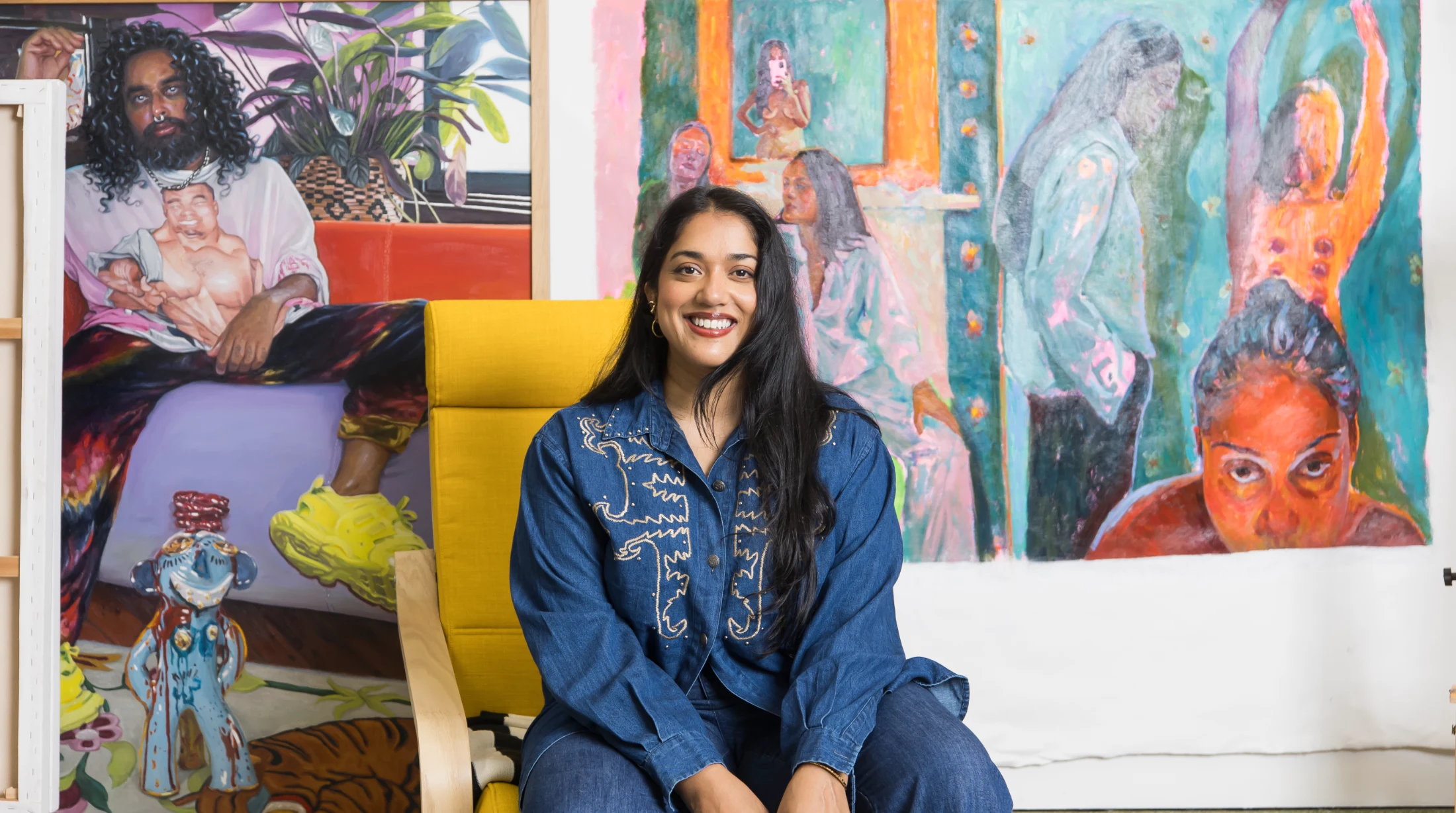
One of Pine’s creative residents is artist Kirthana Selvaraj who, once upon a time, only worked in charcoal. Colour seemed like a foreboding and untamable beast to Kirthana but one day, everything changed.

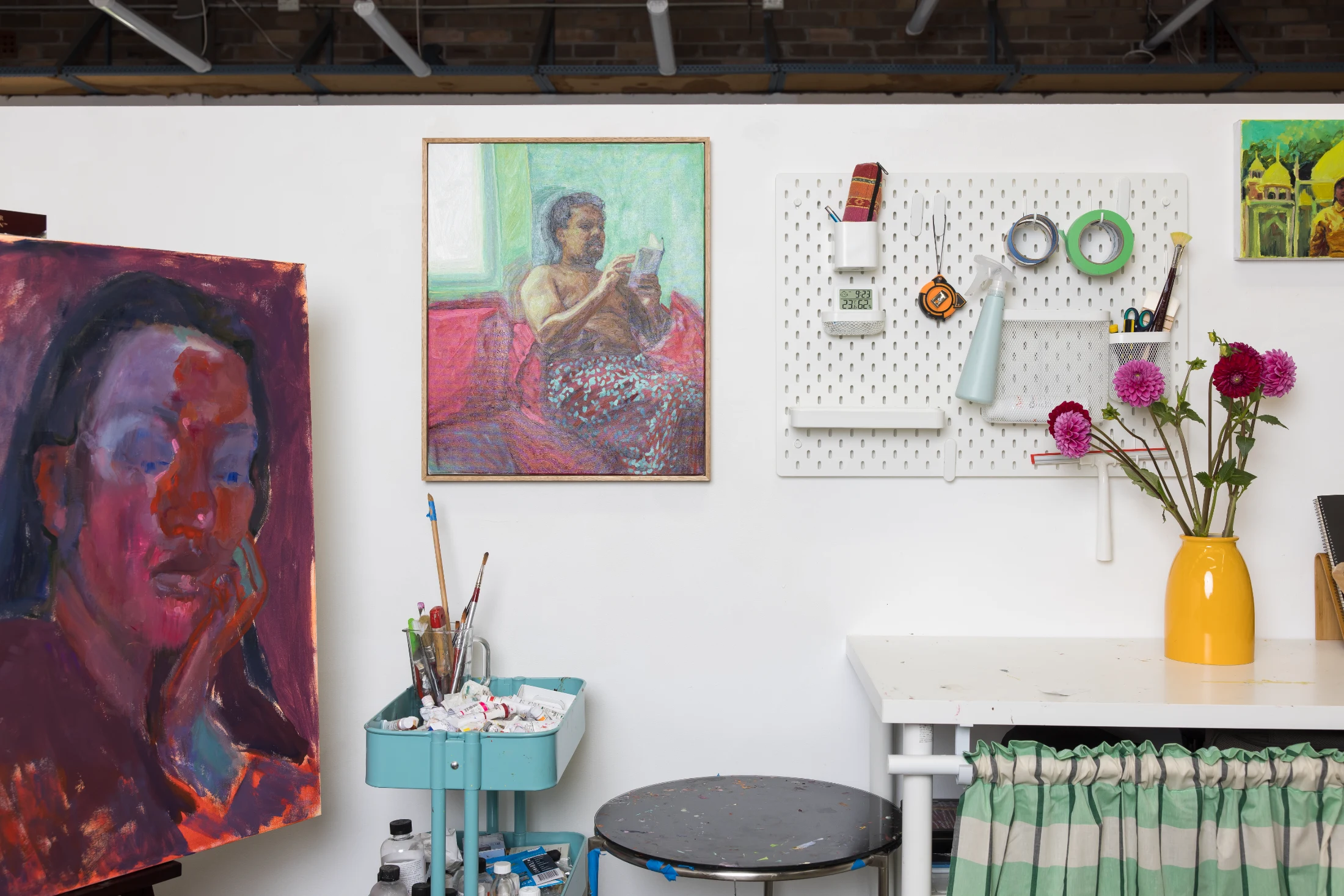
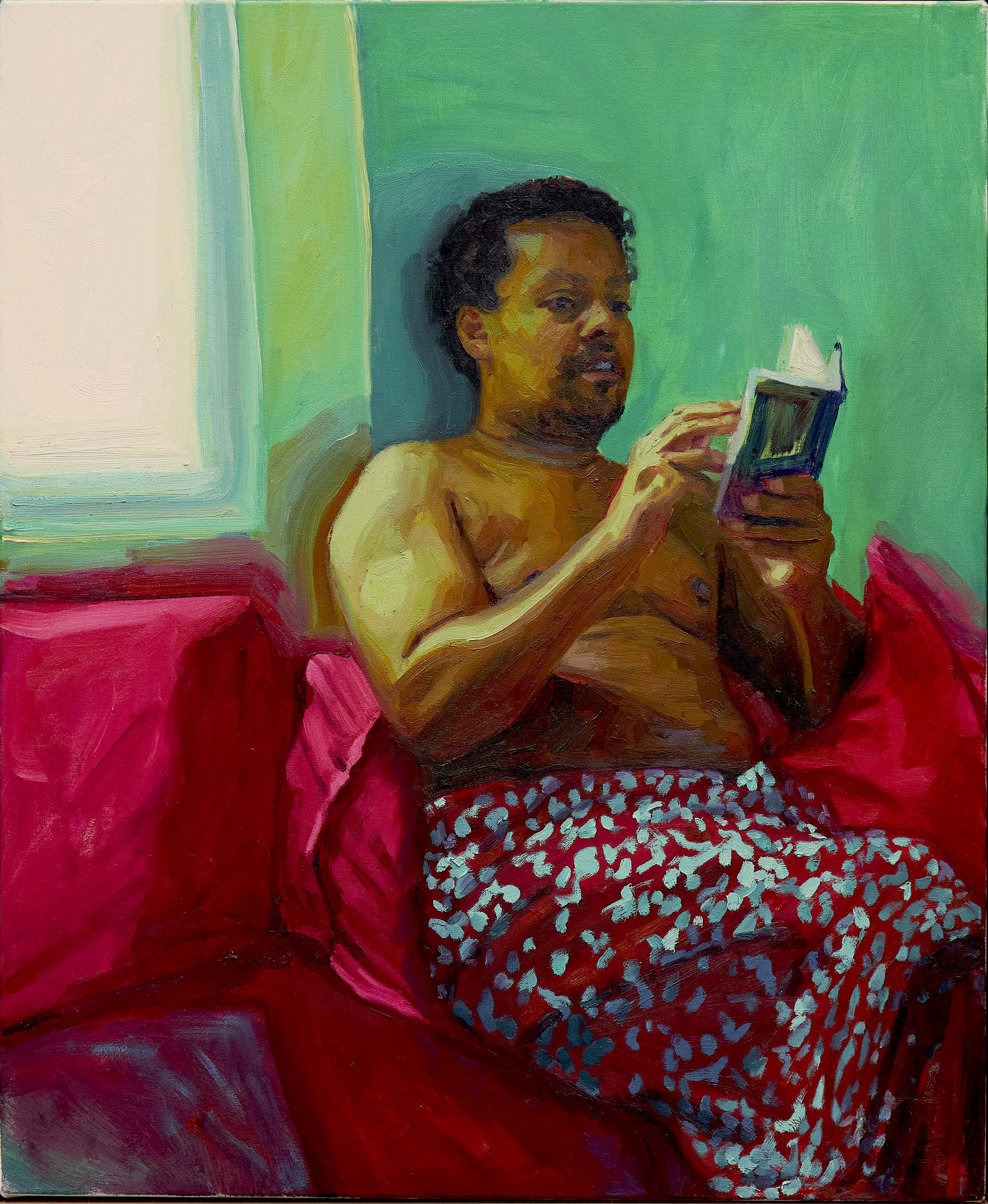
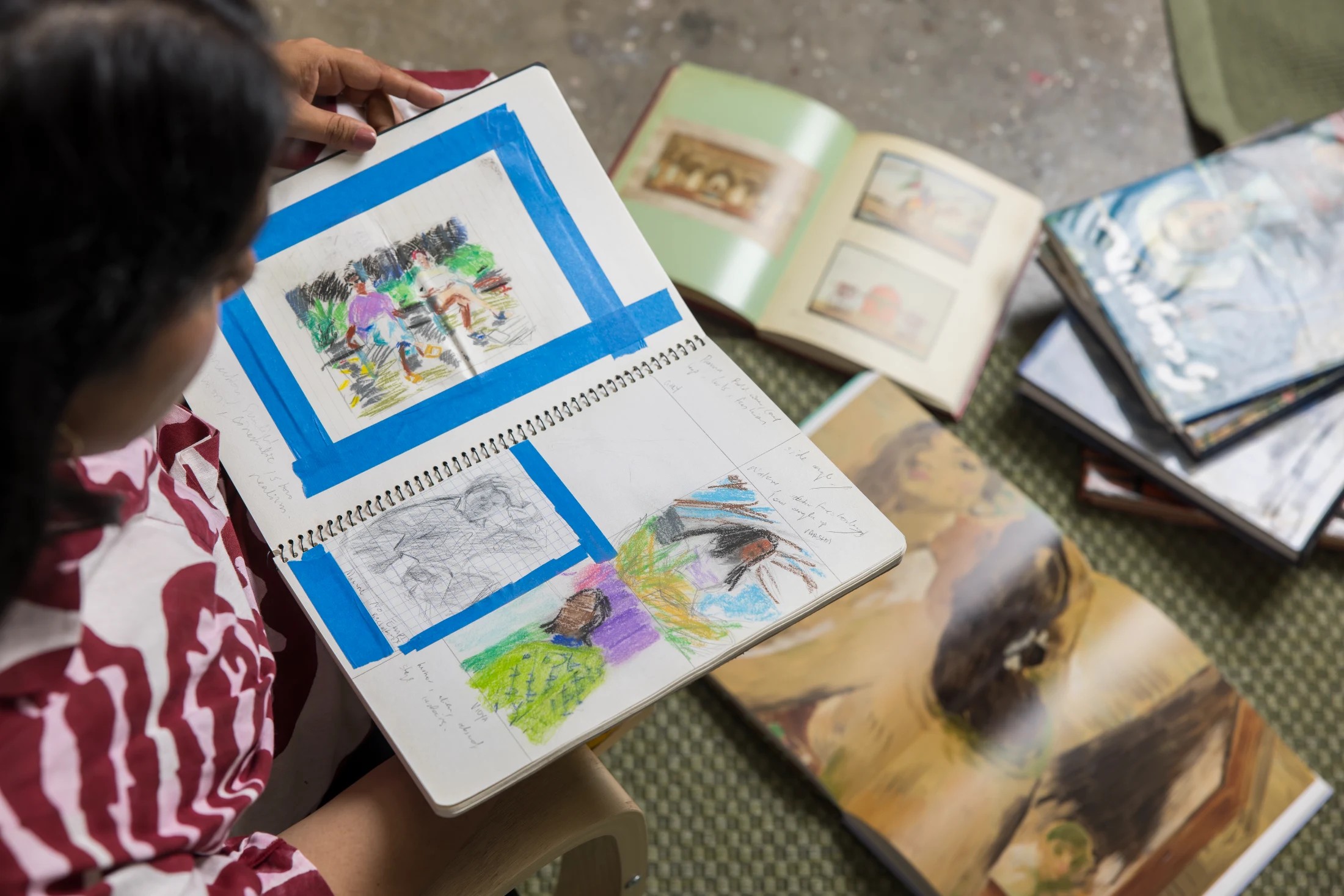
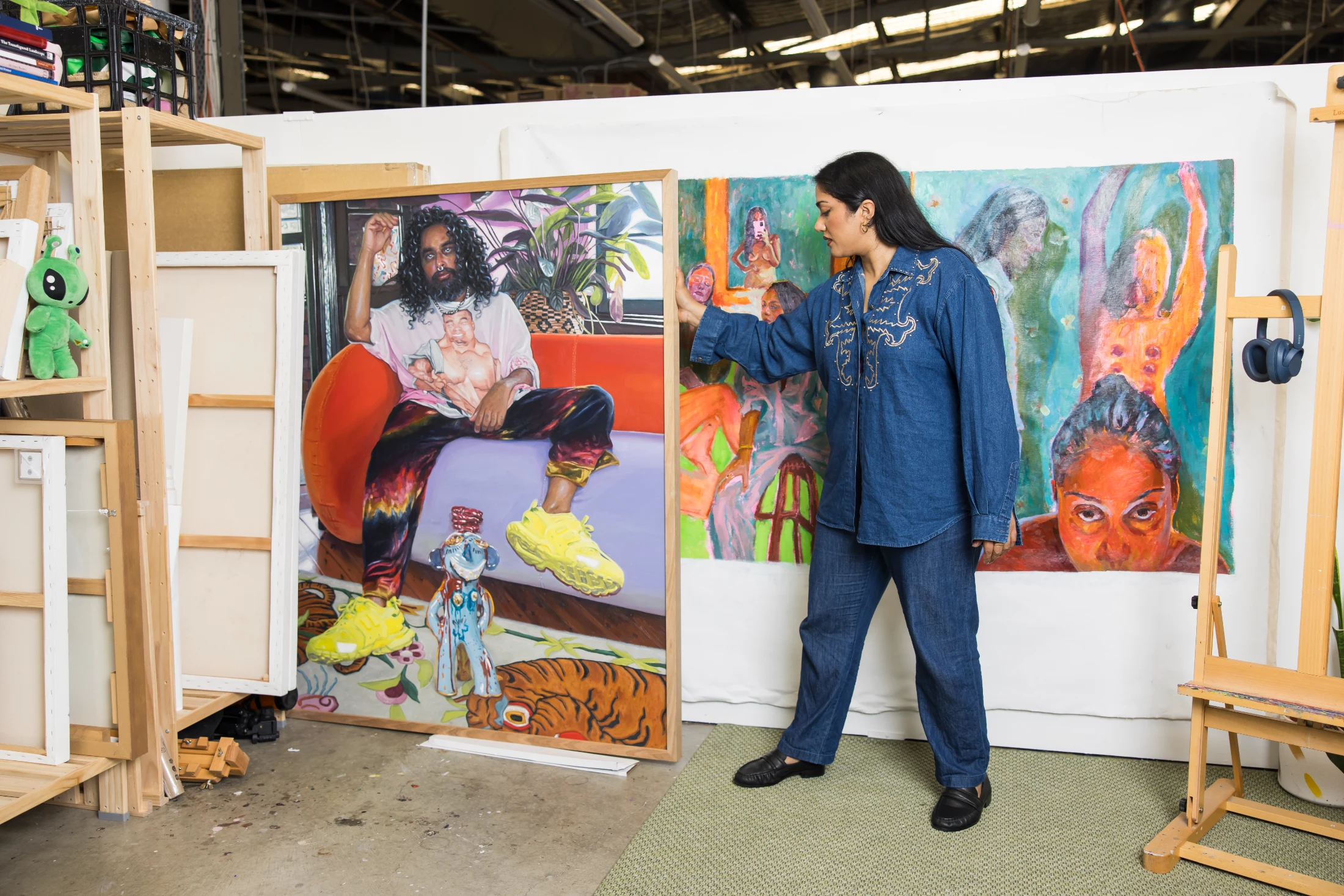
Kirthana Selvaraj is someone who honours the full spectrum of the rainbow. Her studio in Sydney's inner west is stocked with every pigment you can imagine. Huge bold portraits lean against the walls in a visual chorus of reds, yellows, blues, browns, and splashes of pink, orange and teal. These colours have brought the Sydney-based artist plaudits, awards and, most importantly, joy. They bring others joy too: One of her best-known works – a painting celebrating the achievements of the Matildas – the Australian women's national football team – has just been transformed into a spectacular 57-metre-long immersive mural at Sydney's Olympic Stadium.

Kirsten Drysdale
Writing:
Writing:
Kirsten Drysdale
Photography:
Photography:
Anna Kucera
No items found.
Magazine Current IssueMagazine Current Issue
The After shot of the Floorplan
Before
before
after
After
Top
Arrow UpArrow Up

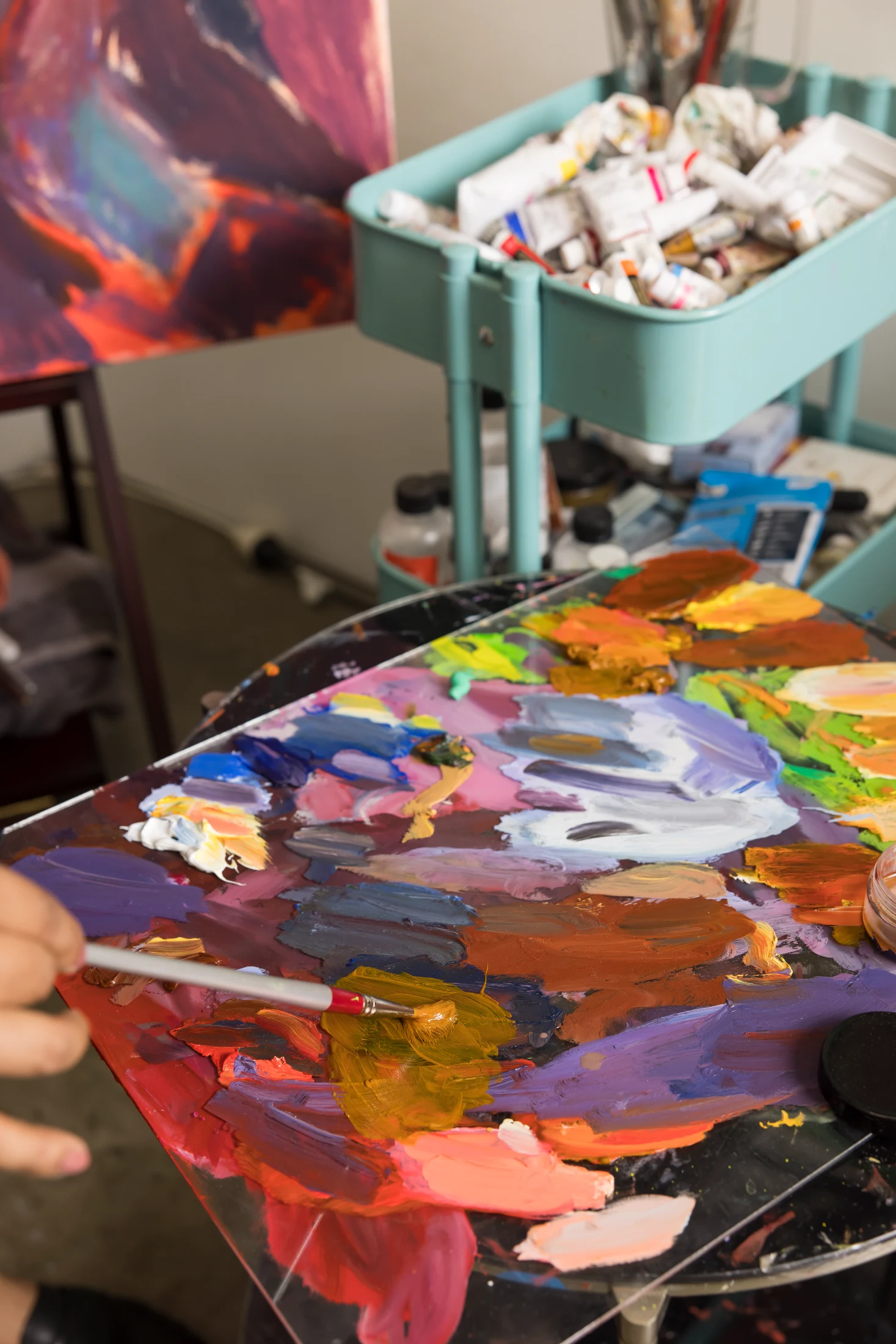
Kirthana's desk is littered with paint tubes – well-squeezed Viridian Green rolls around with Dioxazine Violet and Quinacridone Magenta. Sometimes, she has to travel halfway around the world to find the exact hue she's after.

"I went to Japan, and I found this incredible range of really fluorescent oil paints with really rich saturation. And I never can find that here in Australia. I picked up like 20 of them. They're so juicy – I just want to eat them!"

It's hard to choose a favourite, but Kirthana says she goes through more tubes of Cadmium Red and Indian Yellow paint than any other. (If you don't count Titanium White, which is a mixing medium, and that's a bit boring, so no, we won't count that.)

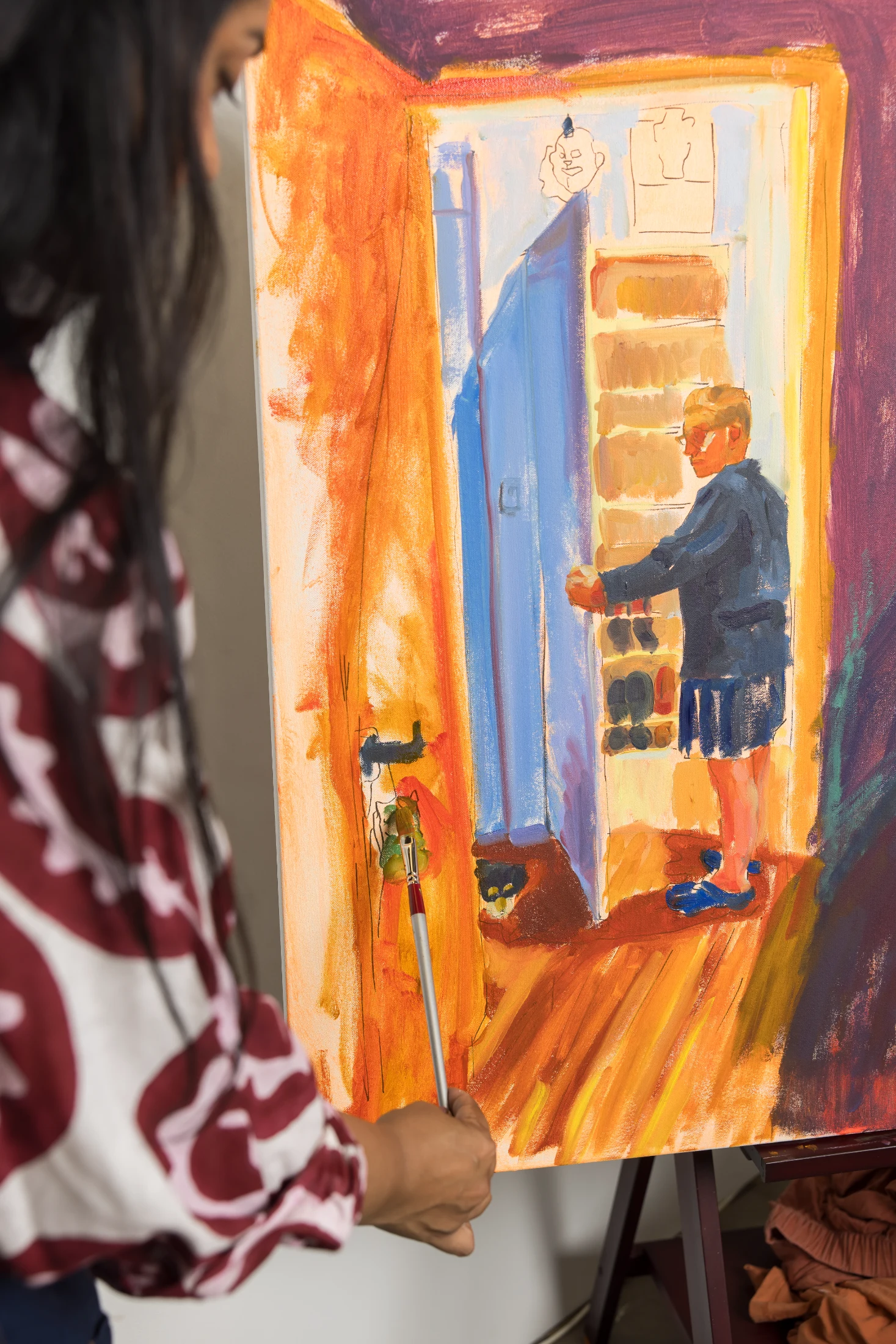
"You can probably see a lot of those colours [Cadmium Red and Indian Yellow] in my paintings. I'd say my favourite would be Indian Yellow. It's a little bit transparent, so I layer it like a glaze on top of a really vibrant acrylic ground underpainting," she says, walking over to a painting to show exactly where she has done just this. "You can kind of see here – where there's like a hot pink underneath, and I put Indian Yellow over the top and I smudge it out and it kind of looks like it's sort of fluorescent coming from underneath."

The painting does indeed seem to glow. It is, like all her works, quite literally vibrant.

"I think about what I use most and am always repurchasing, and it's always Indian Yellow. And it's not just because I'm Indian! It's the true, purest version of a yellow-orange hybrid that I find works well with all the tones I try to paint with."

Perfectly mixing pigments to get those precise tones, especially diverse skin tones, is a Kirthana specialty. This skill and many other aspects of her life – including her journey from biotechnology student to the art studio, being a triplet, and growing up in New Zealand – all feature in my conversation with artist Kirthana Selvaraj.
You've shared how difficult some artists – portrait painters in particular – seem to find painting the diversity of tones of brown skin. And it made me think of how when colour photography was first invented, the film stock was calibrated for white skin – Caucasian skin. And they even had this thing called 'the Shirley card' with a photograph of a white woman to set it to. Are there similar issues in the art world in terms of the paint stock you can buy?

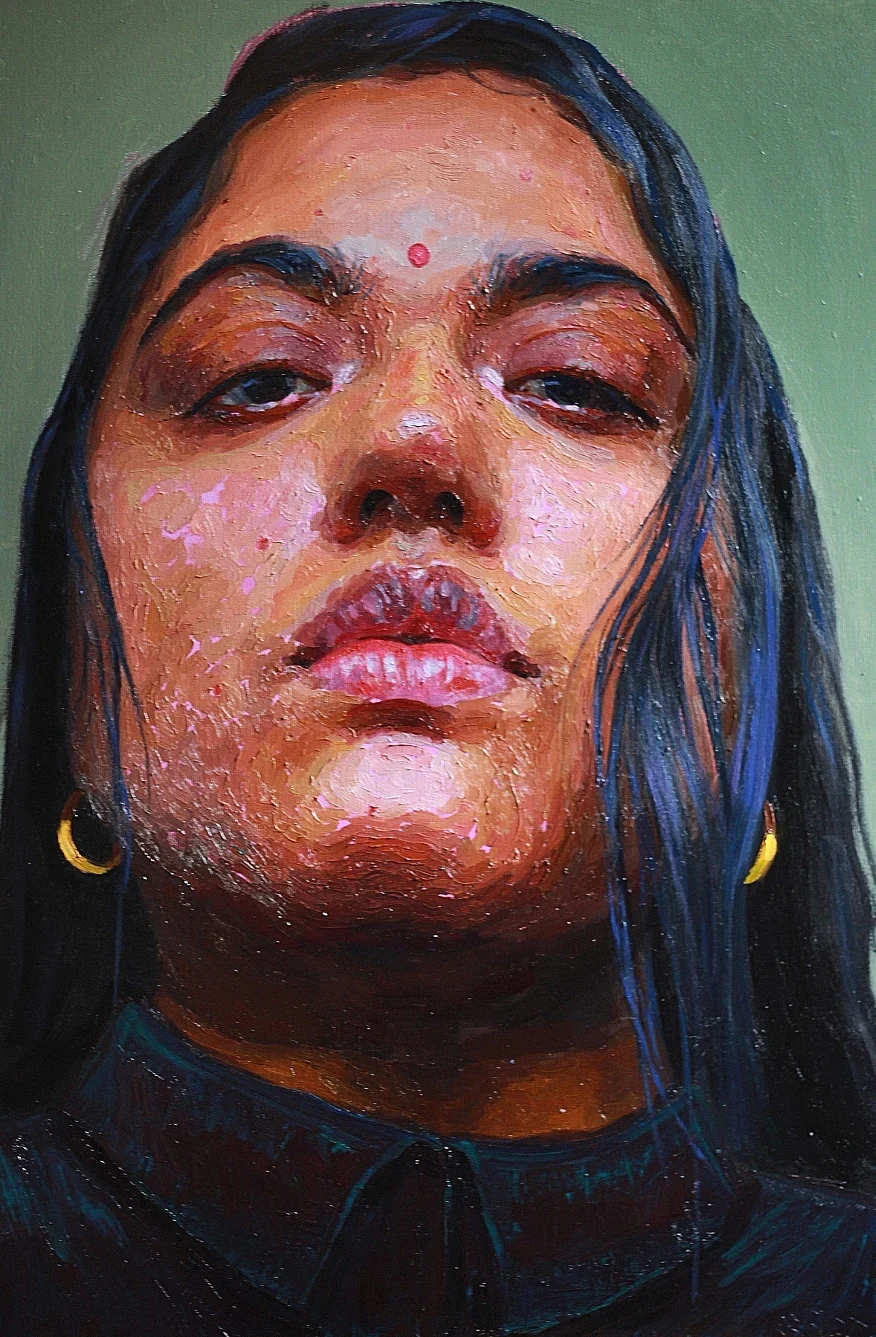
I remember in 2013 I got a scholarship which was basically a whole bunch of oil paints. And I was curious about this one colour called 'Flesh Tone', and I was like "yeah, let's try that!". And I looked at it, and it was this sort of pinky-beige colour. And I remember thinking "oh okay, well, you just work with this and you mix different tones". But then I started getting a little bit annoyed that this was premixed to be this universal skin colour that isn't accurate. And when I see people painting brown skin, it's always so flat. It's like "okay, you mix a little bit of Burnt Umber and you put a little bit of black and then a little bit of a white and there's 'brown skin'". But brown skin has all these nuances – when blood reaches the skin in certain brown skin, sometimes it looks a little bit deeper, or it looks a little bit more purple in the sunken areas. There's the highlights and the lilac tones, but also the shadows are a little bit green.

So often what I see is missing is all the depths of colours that I actually see in the world. And that's why I sort of exaggerate the colour that I see in my paintings. I amp it up, because for me that makes it feel more alive. It makes it feel like skin, like a living person.

Are you ever tempted to play around in a monochromatic way or is it rainbow all the way?

For the longest time I only worked in charcoal. So that was always just black. I never worked with colour – in terms of actually painting with colour, outside of being a child – until probably 2013. Before that I was working with dry mediums like charcoal, and I would grind that down and sort of 'paint' with it. I was more focused on form and volume and composition and shape. And I guess I was afraid of colour? I didn't know how to tame it. It felt wild, like a wild beast. But it was funny – when I first started using colour I was like: "I feel like I can breathe, like this feels like oxygen in my lungs!" So it's hard to think of going back. I can do a sort of more muted palette, with bursts of colour randomly underneath. But I don't know if I would ever go with a greyscale work where it's just gradients and shapes, and colour isn't informing the work in any way. It doesn't feel like me anymore.

So you were studying biotechnology before you became an artist – what's the story there?

I spent a year just at bars going what exactly am I doing here? In fact I think I was drunk for that first year! Honestly – I was a terrible student. But I'm from an immigrant culture, which is sort of like, 'well, even if it feels shit you just do it and we'll see the outcome later'. This yearning to get out of there was actually the only thing that comes to mind about my time there. It made me really see I can tick that off now, that's definitely not what I want to do. I feel that's a typical story from my cultural background, where we start on a path that's created for us by our parents or cultural pressures, and then we start to take on this sense of autonomy and discover our own sense of agency and what we actually want. So I felt like this was my chance to break that cycle, and find joy in what I do.

Has any of that scientific background influenced your art?

I think maybe just the discipline of it; having structure to the process of something, the discipline of getting up early and doing the work. I sometimes start my day at 5 or 6am, and I'm painting, and I see it as work and less than something that is just for fun and something that I love. It's something I'm determined to see as a part of my life that will sustain me, but also be a career.

Speaking of what you don't want to do, you've also said art school was interesting less because you learned how to be an artist and more because you learned what you didn't want to be. Could you expand on that a little?

When I was at art school, I felt that figurative painting was seen as this archaic relic that was laughed at. It was like, "painting's dead, it's outdated – do something contemporary". And I always used to think, 'well, what does that mean?' Because if we looked at figurative painting, often what we saw was certain bodies expressed, certain gazes, right? And for me it always felt to disrupt that or subvert that became more important in my practice, while still using this 'archaic' medium to convey that.

I think what I didn't want to be was an artist that listened to my lecturer solely, and an artist that tried and experimented and failed to then rediscover what they actually wanted to do.

At art school, lecturers had their own books of what contemporary art is and what has longevity and what will sustain your practice. I just wanted to discover the part of me that felt the most seen, and painting has always been something that I felt closest to and I didn't want to pretend I didn't love to paint.

What is your earliest memory of creating art?

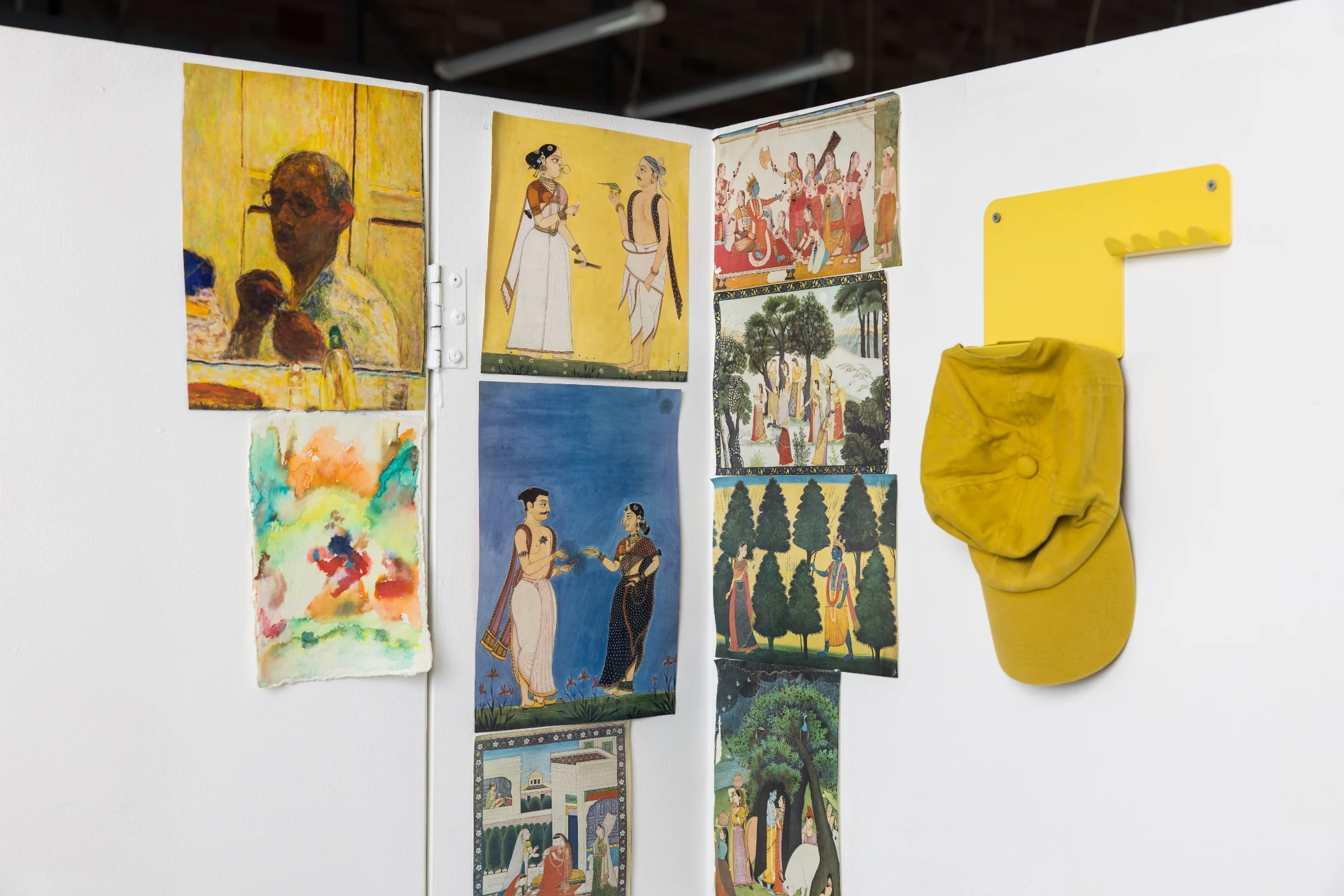
Okay – I remember, and this is funny because it's this idea of 'augmenting reality', I suppose – because I was really young and I remember wanting to be a doctor. I think I was six, and I cut out cardboard shapes of a doctor's apron, and I put a cross on it and I got a hat. And I remember thinking there's so much power in making something, because then I can believe it's real. I just remember that thought, when I was very, very young. But when I first got into actually creating and painting I was probably nine, and I used to paint the deities in my parents' house, like Krishna. And I would always paint them very effeminate and my mum would always ask me about that. And even back then I just thought this sort of idea of gender expression felt really limiting, and I never really fully connected to that until this question actually, that you're now asking me. Because I used to always paint the deities in dresses and gowns. I'm just having a flashback now of when I was really young and feeling like I'm not getting it right. But actually it was probably something I've always felt, and now I'm kind of pursuing it more seriously.

Do you still have any of those paintings?

I don't have any, it's a bit sad actually – we got rid of so many of my drawings and paintings. But my parents kept this one drawing I did of Krishna with very long eyelashes! There was one painting I did that was of a tuatara [a type of reptile unique to New Zealand], and I got selected in my school to have my work in the Auckland Museum of Art, and I remember I was very young then and that's when I first thought "Oh, I think I'm good at this". But we didn't keep it.

You've talked before about growing up feeling quite lonely, and I was wondering was that in the sense of not seeing people who looked like you represented much? Or were you a lonely child? What was your childhood like?

God, that's a loaded question! What was my childhood like?

I know – sorry. We're not in therapy. We don't have to go too deep!

Well, I'm a triplet, actually. I've got a brother and sister my age.

What?!

I always forget to tell people that, because to me, that's normal. I'm like – oh, that's right, it's not really the usual! In so many ways, when you're a triplet, you want to be different and you want to feel unique. All our birthdays were shared, so you want to feel like there was something about you that was special, that wasn't shared. And I think the sense of loneliness came from not necessarily feeling like I knew who I was. Identity becomes sort of blurred when you're a three-person-unit, and you're navigating the world together but you think very differently. And also yeah, I did feel it was hard – I was born in New Zealand, and grew up in Auckland for about 10 years, then moved to Invercargill. That was particularly lonely because there were hardly any people of colour. I think we were one of two South Asian families in my town, and it was always about trying to acculturate or assimilate, whether that's how you look or how you sound, your accent, how you dress. And there was always this projection of this self that was never real. So I think loneliness stems from inauthenticity. And you know you're performing, there's a dissonance there because you know you're not being real. So I think the loneliness came from a disconnect between how I saw myself, and how I was perceived by others.

And now here you are, proudly painting yourself, and people like you, every day. How have people responded to your artwork?

I can only speak to those who have reached out to me – but I've had the loveliest messages from really young, queer South Asian people saying 'I feel seen!' and 'I feel like maybe I can hope for more for my career, thank you for representing'. But I don't see myself that way – I don't see myself as a role model or anything – I feel like anyone can be this person that does work that means something to them. It's persistence. There's no crazy formula. It's just being willing to fail and to not expect a perfect outcome. So I really hope to see more South Asian people feel comfortable pursuing this career. Some of them may hate my work, they may think it's disgusting! And I'm sure they do – which I think is great! I think everyone should be able to love and hate – but just having the discussion about art is pretty cool, because often we don't get to do that in our communities as freely as we want to.

Just finally – as someone who works with colour every day, do you have any advice for how non-artists can bring colour into their lives?

The most important thing is not to be afraid of colour. Colour can create a sense of confidence and energy. Use colour intentionally. If you associate colour to an energy or a mood, and it creates a sense of peace or power, harness it! I'm also an art therapist, and I use colour with my clients therapeutically, and sometimes we find colour is terrifying, and so we create a story around it, a sense of how we can incorporate colour to work for us. Just try it out, because you might find that it brings you something, it might interrupt something that feels monotonous, or it might create a sense of balance when things feel chaotic. When I feel like absolute shit, I'll just put on red lipstick, or I'll wear something outrageously bright and I'm like 'well, it's doing the work for me', so I can just be present and move through the world.

Writing:
Writing:
Kirsten Drysdale
Photography:
Photography:
Anna Kucera
Back to Top
Arrow UpArrow Up
Top
Arrow UpArrow Up
The After shot of the Floorplan
Before
before
after
After
Businesses featured in this project
No items found.
Products featured in this project
No items found.
Magazine Current IssueMagazine Current Issue
Writing:
Anna Kucera
Writing:
Kirsten Drysdale
Photography:
Photography:
Anna Kucera
Back to Top
Arrow UpArrow Up