Magazine Current IssueMagazine Current Issue
Why do beautiful things make us happy?
From our Mag
November 1, 2024

Why do beautiful things make us happy?

An editor, a designer and vintage store owner ponder.

Is there a formula to beauty? It's easy to fall into the trap of thinking beauty is just about the visual, but aren't we just as often struck by a beautiful smell, sound or sensation? It's an understanding of, a sort of un-picking of beauty – and our relationship with it – that unites the following three pieces of writing in theme and spirit.

Elizabeth Price
Writing:
Writing:
Elizabeth Price
Photography:
Photography:
No items found.
Magazine Current IssueMagazine Current Issue
The After shot of the Floorplan
Before
before
after
After
Top
Arrow UpArrow Up

Tackling the subject are our good friends Eryca Green of Melbourne’s iconic vintage design collective, Smith Street Bazaar, Andrew Tuck, Editor in Chief of one of our all-time favourite magazines, Monocle and Jack Mama of acclaimed London design studio, Studiomama.

In preparing the questions I posed to Eryca, Andrew and Jack, I wanted to sidestep the syrupy notions of beauty captured in poetry and in song. Similarly I wanted to set aside the links between beauty and symmetry too, as that all felt a little too reductive. Symmetrical appeal doesn’t explain why some appraisals of beauty are universally acknowledged while others are purely personal. Symmetry also fails to explain why the playful effects of light are so beautiful to many of us. Both Eryca and Andrew reference the beauty in light and my husband spent a decade or more semi-unconsciously taking repeated photos of light reflected off surfaces: a lake, snow, the lens of his camera. The effect, in all these different contexts, clearly captivated him. Because it was beautiful. Surely? I certainly think so – every time I pass one of these very photos, framed and mounted on the wall opposite our kitchen.

It’s the nuance that interests me and that interests my fellow writers here. What follows is not intended to deliver answers, but rather is an exercise in rumination and perhaps a little illumination.

By Eryca Green

I ponder this question whilst sitting in the waiting room of a cancer clinic in a public hospital. There is not a single thing of beauty to be seen – not even a window.

I come to the conclusion that I don't think I could survive without beauty. I certainly couldn't thrive. Thankfully due to circumstances of birth, luck, my job and an innate ability to find beauty in a multitude of forms, both natural and manmade, I do not have to.

Just within the walls of my small apartment there is the beauty of the morning light, the beauty of a thriving plant (a maidenhair fern no less, that I have grown and kept alive all by myself!). There is the beauty of colour and texture, and yes, the beauty of 'desirable' objects.

Do these things make me happy? I cannot deny it.

But why – why do these 'things' make me happy? The plant and the wall colours, the textures, all give me a sense of achievement to effects of light are so beautiful to a degree. I did something to make them happen. The objects however are either bought or found – I didn't create them, merely recognised them. I suppose there's a small measure of achievement in that, but not really (I refer back to luck and circumstance).

The more I delve into it, the more I realise I cannot possibly answer the question of 'why beautiful things make us happy', without raising questions on the often ugly truth behind our quest for beauty. How much of what we accept as beautiful is dictated to us by trends? By our culture, our peers, our socio-economic bracket? How many 'things' that we see as beautiful are diabolical for the planet? I think we all know that the answer to this, no matter how uncomfortable it might make us feel, is a LOT.

However, let us for now set aside the not so attractive reasons of status, worth, and fitting in (I'm looking at my Memphis light by Ettore Sotsass here – would I love it as much if I wasn't a co-owner of a design shop and it wasn't going through a very collectable phase? I'll get back to you on that one after some uncomfortable internal reflection).

I find that I'm not so interested in why beauty makes us happy. I am happy to accept that it subjectively and objectively does. It is the infinitely broad spectrum of what beauty is that really fascinates me and gets my juices flowing.

Throughout history there has been a correlation between perfection and beauty. Symmetry, proportion, the golden ratio, The Fibonacci sequence – mathematical equations to explain why some things feel good to behold. Then we have the wonderful counterbalance to this – the beauty in imperfection. Wabi sabi as the Japanese so beautifully describe it. Once you learn to find the beauty in imperfection, the possibilities are infinite and incredibly egalitarian.

Which brings me to the question of value.

I strongly believe that true beauty has nothing to do with material worth. Beauty is priceless. The value lies in its effect on us. The awe it can fill us with. Or alternatively, the quiet joy.

Thankfully everyone can possess beautiful things that have no material worth. Things whose value lies in their sentiment and memories, and a beauty that is unique, inimitable – a shell picked up on a beach walk, a bit of fabric brought back from travels, a toy that transports us instantly back to a happy childhood moment, a plant that you have grown and nurtured yourself (did I mention my very-difficult-to-grow maidenhair?), a vase from a car boot sale that you are convinced will appear on an episode of Antiques Roadshow one day.

This is perhaps where the true purity of beauty lies – in something that is individually unique, yet universally available. That we can all access, if not necessarily agree on (eye of the beholder and all that).

I'm happy that beautiful things make us happy. Somehow it feels that to enjoy beauty is to have hope in humanity. Today I can honestly say that I will be happy with a shaft of light breaking through the clouds. And maybe just quietly and slightly apologetically, my Memphis light. There, I said it.

Eryca Green is co-owner of Smith Street Bazaar

smithstreetbazaar.com

By Andrew Tuck

Why are we drawn to beautiful things?

That's a big and open question. What's judged to be beautiful will vary in dramatic ways between people, places and cultures. But let's try and answer this.

While some people may be able to surround themselves with only art, design (and perhaps people) they believe to be beautiful, that's not the experience of life that most people have.

Most of us are living in a world that's full of light and shade, grit and gloss, good and not so good. So when we see something that strikes us as beautiful, it can offer a moment of escape, a recognition that even when things are at their messiest, that there exist objects, art, experiences that can lift us to a better place. Beauty shows us there is another path – perhaps one that's annoyingly hard to find in the thicket of life, but it is there.

Why do we surround ourselves with beautiful things?

Well, first of all, congratulations if your home, life, is only furnished with beautiful things.

I wonder if having too much beauty around you is a little like only eating cake all day – tempting at first but a little cloying and overwhelming after a while.

Not everything should be a superlative. We also benefit from owning, for example, objects that are practical, effortlessly functional, battered and bruised from the rituals of daily life. A wooden spoon that's been used to stir a thousand dinners, linen that's worn, may not be classically beautiful but they are riven with meaning. But then again, who decides what is beautiful?

Why do beautiful things provoke pleasure and joy in us?

Joy, now that is a good word. In my role at Monocle I get to travel widely, meet extraordinary people and see pioneering projects up close. Yet, if a much-lauded hotel, or collection of design objects, leaves the viewer unmoved, fails to make a connection, then this type of beauty always strikes you as superficial. But if beauty is married with joy, then you feel elated.

Why do beautiful things bring happiness to our homes/towns/cities/lives?

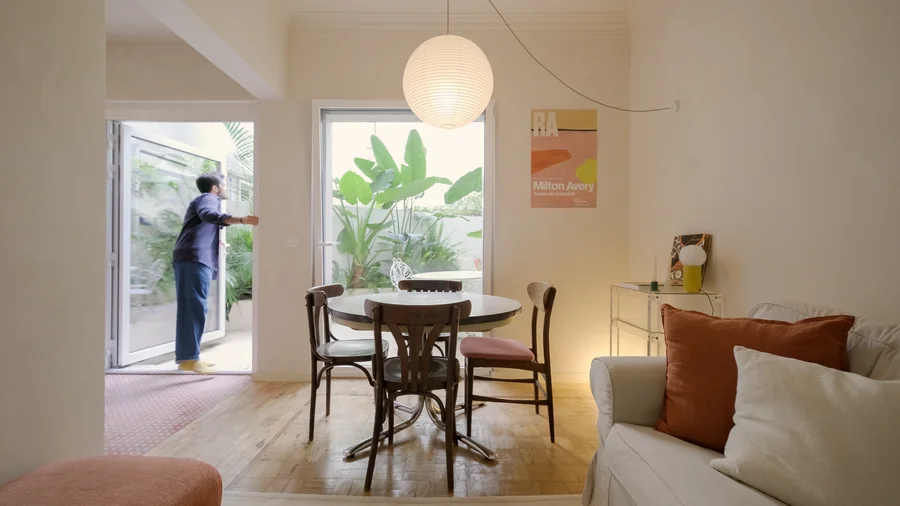
I think my answer is "see all of the above". I live in a small house in the centre of London. I have been answering your questions as the late afternoon sun sends beams of light across the parquet floor. The dog has manoeuvred herself to doze in the warming rays. Is that beauty? It certainly makes me happy – it brings me joy. I own some pictures that still draw my eye even after hanging on my walls for many years – surely that depth of meaning is also about beauty? If I stand in our roof garden I can see the London skyline – again beautiful but certainly more flawed and choppy than say Venice's. So beauty matters but it's not one thing. Perhaps that the worn phrase "beauty is in the eye of the beholder" is rather a good one after all.

Beauty comes not just from visual appeal but also from how a space affects our senses and emotions, often at a subliminal level that is hard to articulate.

Andrew Tuck is Editor in Chief of Monocle magazine

monocle.com

By Jack Mama

This is a question I have pondered over the years. My training in art and design has given me some understanding of the context in which things of beauty are created and how to appreciate aesthetics. For example, Russian Constructivist theories, which emphasise elements like points, lines, planes and volumes in both nature and the man-made world when observing the world around us. Each element was researched and, during my training, I was tasked with designing products focusing on only one element at a time. This method taught me how to observe and design with a new perspective, a learning that has stayed with me ever since.

Years later, I came across George Nelson's book, How to See¹. It's a seminal work that delves into visual literacy and is structured into thematic sections based on photographs Nelson took. Sections like 'Cities and Highways,' 'From the Air,' and 'Buttons' guide readers to hone their powers of observation and make connections between different visual elements.

However, beauty is subjective, and my reflections come from personal experiences. I recall a childhood memory my mother often recounted and we still laugh about. When I was about five or six, she picked out a dark jumper for me, and I cried out in Greek, "No, I don't want to wear it, it's too dark!" Growing up, I developed a love for brightly coloured clothes and fashion. Colour has a visceral effect on us; we are hard-wired to respond to it. People often compliment me on the colours and patterns I wear. This appreciation for colour extends to objects and spaces, which we enjoy experimenting with in our work at Studiomama.

My partner (in life and work) Nina and I make architectural pilgrimages to experience buildings of awe-inspiring beauty, both ancient and modern. We analyse these structures to understand what elements conjure up a sense of awe. Simplicity, order, and the orchestration of movement through space, engaging our senses, all contribute to this experience. Beauty comes not just from visual appeal but also from how a space affects our senses and emotions, often at a subliminal level that is hard to articulate.

As a product designer, I am constantly observing and trying to understand why certain objects possess timeless beauty. I am drawn to objects characterised by simplicity and honesty and seek to bring these principles to our work. As Bruno Munari said, "To complicate is easy. To simplify is difficult."

Sometimes, a product or artefact can be witty and spark joy. Nina and I share a similar sensibility regarding what we find beautiful or amusing and this shared sense continues to inspire us.

Beauty is everywhere and in our everyday lives, found in the tiniest details of objects or simply in how someone wears their hat.

Jack Mama is co-founder of Studiomama

studiomama.com

¹ Originally published in 1977 by iconic American furniture manufacturer Herman Miller, How to See: Visual Adventures in a World God Never Made is architect-designer George Nelson's critically acclaimed manifesto on "how to recognize, evaluate, and understand the objects and landscape of the man-made world".

Writing:
Writing:
Elizabeth Price
Photography:
Photography:
Back to Top
Arrow UpArrow Up
Top
Arrow UpArrow Up
The After shot of the Floorplan
Before
before
after
After
Businesses featured in this project
No items found.
Products featured in this project
No items found.
Magazine Current IssueMagazine Current Issue
Writing:
Writing:
Elizabeth Price
Photography:
Photography:
Back to Top
Arrow UpArrow Up