Magazine Current IssueMagazine Current Issue
A Shop of Secrets
A Shop of Secrets
From our Mag
November 1, 2025

A Shop of Secrets

Aamu Song and Johan Olin have built their art practice around the sacredness of secrets and from their shop in Helsinki, they share them with the world.

There are few things more precious than a secret. The promise and trust inherent in its sharing. Shared to be held and kept. Aamu Song and Johan Olin understand all of this so keenly that they have built their entire art practice around the sacredness of secrets, travelling the world in search of them. They are secret seekers. Secret detectives. And keepers of a shop of secrets: Salakauppa.

Elizabeth Price
Writing:
Writing:
Elizabeth Price
Photography:
Photography:
No items found.
Magazine Current IssueMagazine Current Issue
The After shot of the Floorplan
Before
before
after
After
Top
Arrow UpArrow Up

Long before the ruptures of war put a stop to tourism, Aamu and Johan boarded a train at Pasila station in Helsinki bound for Russia. It was mid-winter and one of the coldest they could remember. It was hard to believe they were headed somewhere colder still. Armed with maps and a list, they huddled together in the heavily curtained carriage, consumed by nervous energy and excitement. Would they find the master craftsmen and women, and the artisan makers they were seeking? And would they convince them to share their skills and artistry with them? Would they discover The Secrets of Russia?

'The Secret Project', as Johan calls it, started as an offspring from an exhibition he and Aamu put on at the KIASMA (Museum of Contemporary Art) in Helsinki in 2007. "We decided to show what kinds of manufacturing and craft skills we still have in Finland," Johan says. "We made a collection and opened a kind of a secret shop within the exhibition spaces of the museum." The pair enjoyed the experience of working with "the makers" so much that they decided to open a real shop in Helsinki and they called it Salakauppa (Sala being 'secret' in Finnish and Kauppa being 'shop'). It was a tiny, three metre by three metre kiosk ("I kind of love small everything," says Aamu.) and since then they have continued to explore the manufacturing traditions of other countries.

Which country came next? "I think that was not such an adventurous story," Johan warns. "I think Aamu was a bit homesick." Aamu had been living in Finland for nearly 10 years at that time (she and Johan met at art school there) and so the couple decided to embark on an artist residency in her home country – South Korea. They stayed for almost six months and during this time, they produced their second collection. Then one day, when Aamu and Johan were looking at a map of the world (the couple declare maps to be their favourite thing to stare at), they suddenly realised there is only one country in between Aamu's Korea and Johan's Finland. Russia. And what a lot of it there was too. "And neither of us knew anything much about Russia." So, from 2010 until the beginnings of the Russia-Ukraine war in early 2022, Aamu and Johan spent more than 300 days in the country, discovering and meeting many masters and makers who became beloved friends. For now, this part of their practice is sadly on hold.

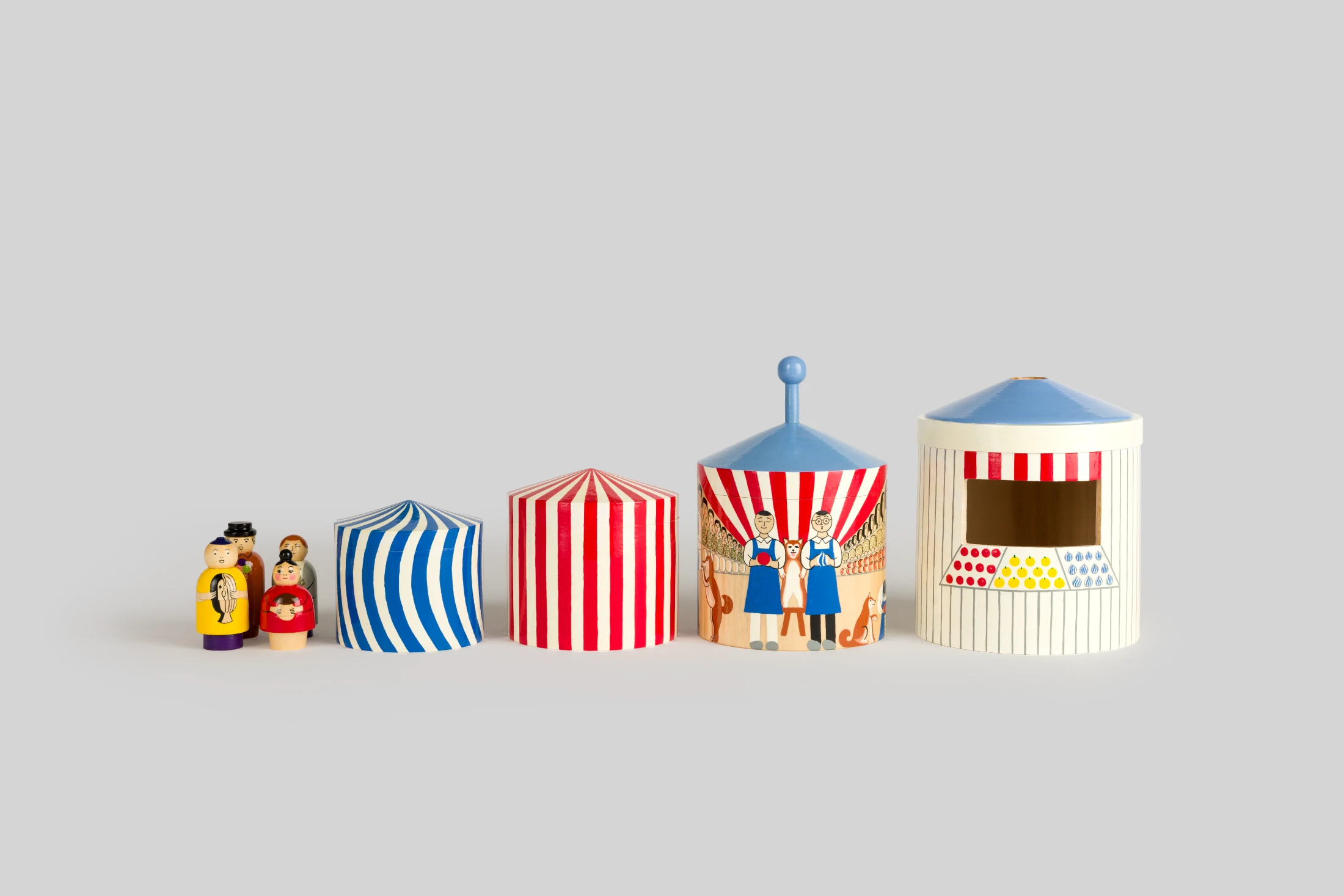
The treasures that emerged from their time in Russia, however, still grace the shelves of their shop. Brightly coloured and exquisitely detailed, glossy wooden figures and scenes – a set of Matryoshka dolls that honours the 'masters of Matryoshka' themselves, a set of four delectable icecream treats, a 'Mama Bird' and her four greedy baby birds, and the showpiece of this collection: a model of Salakauppa itself – complete with Aamu and Johan painted at the counter and tiny customer figurines and even tinier representations of their beautiful products.

These pieces, all designed by Aamu, are joined by many others from the Secrets of Finland, Secrets of Mexico and Secrets of Japan collections. The latter contains a carved wooden container in the shape of a partly peeled red apple made by Sunohara Toshiyuki in Nagano, Japan. To be sure the design of this beautiful object was conveyed accurately (given no common language existed between the designers and maker), Aamu and Johan purchased an apple at Helsinki airport, which travelled with them to Nagano. There, they carved it to illustrate the idea and the intended shape, before dividing the fruit and eating it together.

With all the obvious barriers, I'm curious to know how Aamu and Johan manage to find their makers. Johan declares Aamu to be the "detective branch" of their operation. "It's a really difficult process," Aamu admits. "It takes a lot of love and effort." Aamu is also quick to point out that the makers do not need Salakauppa. "They don't need us but we need them." "We want to learn from them and for learning it's best to work together." These "idols" take one to two years of work and research to find. The detective work might range from scouring books to something more organic (and sequitous). "We might try to live in a certain area and then in some cafe you find a nice jar for sugar and ask 'where is this from?' and it's from some farmers market and you go there and then track them down and then you meet them and they're like 'oh we don't want to work with a foreigner' or they don't want to meet us. And then they don't have an email or anything," says Aamu.

Patience, persistence and charm are qualities Aamu and Johan clearly have in spades. Whether it's in response to those qualities or a product of pure curiosity, the 'master' eventually relents.

"When we make contact with the master, he invites us to his place and then we learn how he makes things," says Aamu. "Quite often we don't share a common language so usually we start to do something together." This act of co-making is where the foundations of trust are laid that eventually lead to the transmitting of generations old skills and knowledge – the sharing of secrets.

"We paint as he paints or carve as he carves. We [do this] maybe nearly a hundred times so it's almost like made by him or her. And then after that we make everything with this individual master in their original country. So it's like nightmare logistics," says Aamu. Beyond the language and geographical barriers that make communication challenging, some of Aamu and Johan's masters don't even have a bank account. But according to Johan, that's a "big part" of the whole project. "If it would be very easy to do it, then we probably wouldn't do it," he says.

Just as Daniel Day-Lewis is famous for his 'method acting', Aamu and Johan like to go full method too when in design mode. "I love Japan and I love Mexico and Russia. I think when I 'do a secret' I mentally give a passport of each country to myself," Aamu shares. "That's true," adds Johan. "During the research and then also during the design and development we always listen to the music from there and we cook the food from that place."

Aamu grew up in "the massive big mega city" of Seoul. Her interest in designing and making beautiful things started at a formative age. "I have kept a diary – a picture diary since I was five. From 1979 until 2025." This is where Aamu keeps a record of her ideas and inspirations. She has all of these diaries still too – with her in Helsinki. I question whether this direct visual connection to the child artist in her has anything to do with the sense of nostalgia and childlike wonder she brings to all they make and sell at Salakauppa, but Aamu says she doesn't look at the drawings from her childhood. This quality in her work comes from a more philosophical place. "We get too serious when we get old. I mean, I got all the education possible – possibly too much education – but I tried to keep the line of something that really makes you happy when you draw or paint."

"I don't want to 'clean that up' with 'design'," she says. "You know, like there is 'green washing' I think there's 'design washing' too – [this idea] that something has to be 'cool' and serious-looking or something that makes you money."

"I believe in something more meaningful," says Aamu.

At the time of our conversation, Aamu and Johan have just celebrated their 15th wedding anniversary. 'Officially' they are sculptors and have collaborated under the banner of the design brand COMPANY since the year 2000. Our conversation takes place in their studio – "a kind of house for artists" – that they share with a number of other sculptors, painters, musicians and actors. It is strikingly sedate in its decor and colour scheme – quite the contrast to the vivid mural painted by Johan in Salakauppa. "It's a bit like a museum where we work and it's good to have a bit of contrast," says Johan. "There are no colours in our home either. We see too much in every other place where we spend our days." And And Salakauppa consumes most of their days and is very different than their public sculpture work. Those projects and pieces often involve collaboration with specialists from other fields where each has control over their portion of that collaboration. 'The Secret Project', however, has "a life of its own". "It's not in our control," Johan says. "It is its own adventure and we follow that trail." He tells me that Aamu is the adventurer and always has been that force in the couple too. "I follow her around and I try to keep things somehow calm," he smiles.

I'm interested to know how the combination of Aamu's South Korean heritage and Johan's Finnish heritage feed into Salakauppa. For Aamu, having grown up in a country and culture that places great emphasis on academic achievement and hard work plays a big part. "I think I'm still a victim of that education system. I'm so hungry for learning – even now at 51." For Johan, the cultural influence of Korea in what they do is just as strong. "Finland is quite peaceful in many many ways, compared to South Korea," he says. "But I think what I've been charmed by and learned – and what we've definitely taken into our shopkeeping and the whole 'secrets art project' – is how you can run a store."

“In Korea you occupy every vacant space and make something happen there – whether it's commercial or some other activity – and every food is full of taste and delicious and nothing is enough and you have so many things, versus Finland where there's just a lot of empty space waiting for something to happen.”

"So I think we try to put that into practice here."

While Johan painted the mural that brings the walls and shelves to life in Salakauppa, the colours were chosen by Aamu. She recounts a French customer saying that he felt like he was in a Mongolian yurt when he was inside the store. "That's true," Johan nods thoughtfully. "They like orange." "So maybe in between Korea and Finland there is some Mongolian vibe," smiles Aamu. "It was not a reference but we wanted to put all the cultures we learned from – all the different countries and it seems it became kind of Mongolian."

So, what defines a Salakauppa product? What makes it worthy to appear in the Secret Shop?

"It follows a tradition that we fell in love with (and kind of interfered with) and respected, but then we contributed something to that tradition," Johan says. "So then it becomes a Salakauppa item and the shop is a place where we try to give it a nice place and platform – a home for that item."

In sharing these secrets – these traditions and practices that have captured their hearts – and respectfully 'interfering' with them, they are finding them new audiences and admirers. Perhaps most excitingly for Johan and Aamu too, they are winning the hearts of Russians, Koreans, Mexicans and Finnish people who visit their store. These people see traditional crafts from their countries – perhaps once dismissed as old fashioned, primitive or only for tourists – in a whole new light. And they are proud. Johan himself experienced this change of heart.

"For example when we started, we began to look into Finnish traditions," Johan says. "I was quite bored with them and thought 'this is not going to be a fun project' but Aamu had a fresh perspective on it. So it turned out to be very fun."

One of Salakauppa's earliest products was part of the Secrets of Finland collection. The Dance Shoes – an adorable set of fire-engine-red adult-sized felt slippers with an identical child-size pair mounted in reverse on top. The sweet idea being to facilitate the act of a child dancing on their parents' feet. Aamu and Johan designed these beauties in 2006 and they have been manufactured ever since in Jämsä Finland by Lahtiset – a family felt shoe company dating back to 1921.

Aamu recalls a teenager from Denmark visiting their store recently. He bought something but before leaving he told her: "When I was child I was dancing with my mum and dad in your dancing shoes."

"And it was made in 2007, so yeah, it's possible!" Aamu says. "I think it's nice to see how our product helped to produce such a nice young man." I myself am struck by the role these shoes played in not only initiating a beautiful bonding ritual between a boy and his parents, but also in helping to preserve the memory of it for this boy, by making it just a little more magical and special. Such is the power of secrets.

Customer interactions at Salakauppa are almost as important as the products themselves for the shopkeepers. "Many people come to our shop like they might go to the park," says Aamu, "and they say 'it's so nice' and then they go or they might say 'oh I don't have money'."

"And so actually I invented this response in the last few days: 'don't buy it. It's like your park, so you come and feel and then go.'

"Because we don't have many of each piece. I think our products are not actually made to sell. I like people to get the meaning and to understand what we are doing – or what that different country means and its amazing cultural heritage."

I remark that it sounds less like a shop and more like a folk art museum. Johan says they have sometimes wondered whether they should call it a museum rather than a shop. And this is when Aamu gets animated: "But if it's a museum it's difficult to approach," she says. A museum or gallery might read as elitist but a shop – a shop is for everyone. Aamu says that as a "museum director" she would never be able to have the same casual and natural interactions with their customers about all the beautiful products. "I mainly say 'don't buy it'," Aamu laughs, "I'm sorry – it's too funny!" and it is. Despite Aamu's best efforts to deter customers, they do sell their products though and this is important, as each product sold means Aamu and Johan can make more with the makers.

I wonder if there are any crafts or traditions in other parts of the world that the couple is itching to explore and learn. Aamu's eyes go wide and she laughs kindly at the absurdity of my question. "Yes!" she says. "We have a long wish list." Johan adds.

"When we were recently in Milano, we found an amazing basket, which I thought was a very Italian thing and I asked the shop owner where it's made and he said Indonesia," Aamu says. "And then the day before yesterday a guy came into the shop with his Finnish wife and he said he's from Nepal but they met in Indonesia and he said there's a basket fair where every tribe brings a basket and it happens in Jakarta." It sounds like Secrets of Indonesia will not be far away.

"All the customers share ideas of where to go too," Aamu says. And I'm not surprised. I find myself doing the same – the thought of a hand-crafted object, a familiar object of nostalgia, reimagined by their care and whimsy is so alluring. "But we are running out of time, so we have to hurry up!" says Johan. "But we are getting old and it's so slow!" Aamu exclaims.

"I mean, this whole process is very slow and there's really no way to speed it up and we don't want to," Johan adds. And this is not just the painstaking process of tracking, tracing and learning towards a new secret – nurturing the existing secrets also takes a great deal of time and energy. Aamu and Johan have been working with some of their masters for 25 years now. "We don't cut any connection," Aamu says.

For this year's Milan Design Week Aamu and Johan were invited by Small Small Space gallery in Milan to take over a very small space indeed. What was particularly serendipitous and irresistible for them was that this space was once a toy shop. They went, not in search of commercial partnerships or to sell lots of products (though they did sell out). "I mean, it's like if you're a fan of rock music you go to a rock festival and Milan is like that – if you like design you gather and share your love," says Aamu. "So by keeping a small shop in a small small space and sharing our way of working, we did that."

salakauppa.fi | @salakauppa

Writing:
Writing:
Elizabeth Price
Photography:
Photography:
Back to Top
Arrow UpArrow Up
Top
Arrow UpArrow Up
The After shot of the Floorplan
Before
before
after
After
Businesses featured in this project
No items found.
Products featured in this project
No items found.
Magazine Current IssueMagazine Current Issue
Writing:
Writing:
Elizabeth Price
Photography:
Photography:
Back to Top
Arrow UpArrow Up