Magazine Current IssueMagazine Current Issue
A Bit Off: An Interview with Tom Loeser
From our Mag
November 1, 2025

A Bit Off: An Interview with Tom Loeser

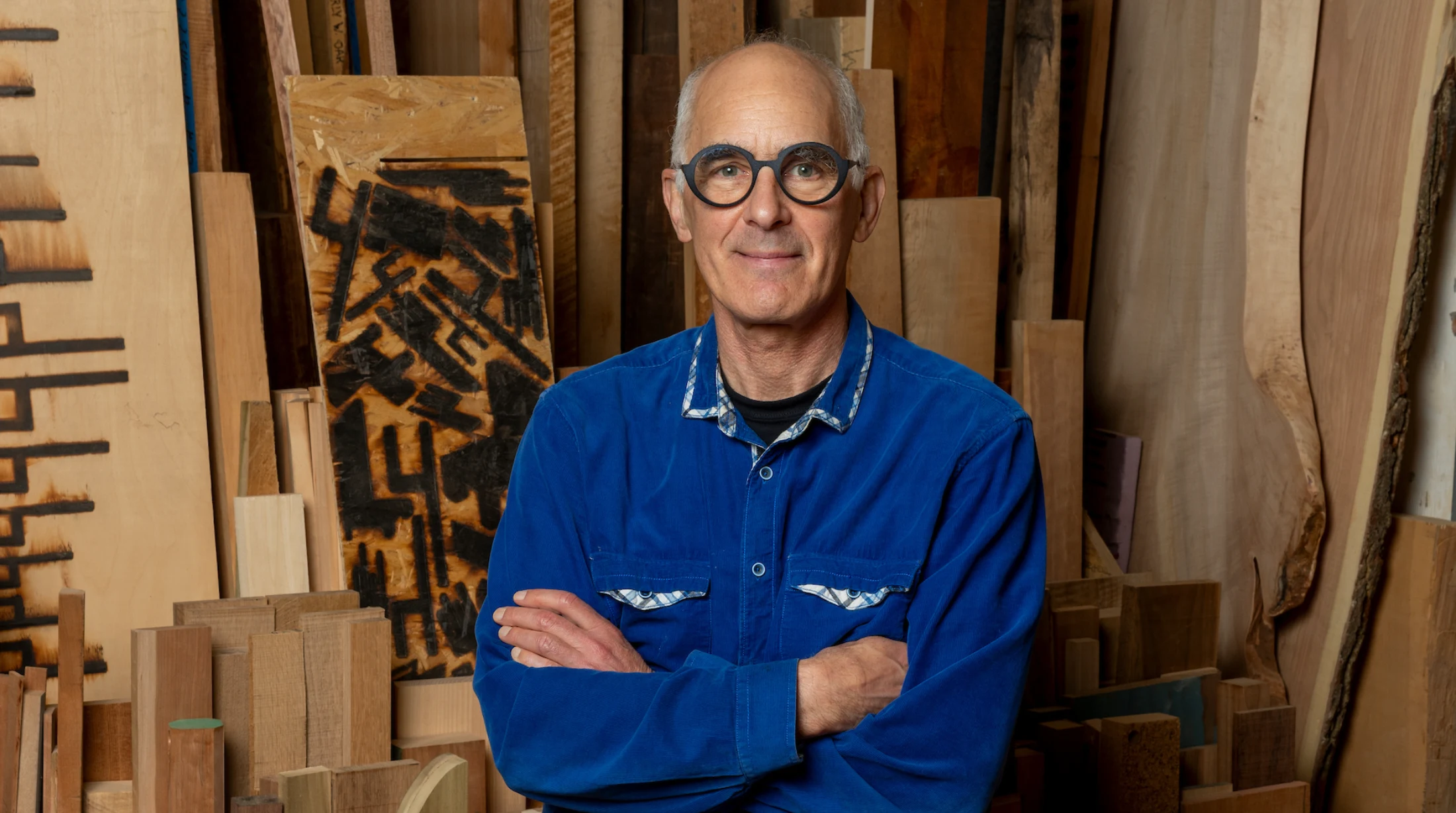
Tom Loeser is not interested in making furniture that disappears. His creations conceal surprises, subversions and questions, ready to reward the curious.

Tom Loeser has been labeled with a lot of labels over the years: Woodworker. Designer. Fine Art Furniture Maker. Artist. He's hard to pin down and that's just how he likes it. Tom is more than content being elusive and hovering between disciplines, fields and the neat little buckets many of us seem compelled to organise people into. "One visual image that I've used sometimes is a three-circle Venn diagram of design, art and craft. I think that's useful," Tom tells me. "I like to be located in those sections where the Venn diagram overlaps." And this is precisely where Tom has been thriving, happily cogitating in his craft for more than four decades.

Elizabeth Price
Writing:
Writing:
Elizabeth Price
Photography:
Photography:
No items found.
Magazine Current IssueMagazine Current Issue
The After shot of the Floorplan
Before
before
after
After
Top
Arrow UpArrow Up

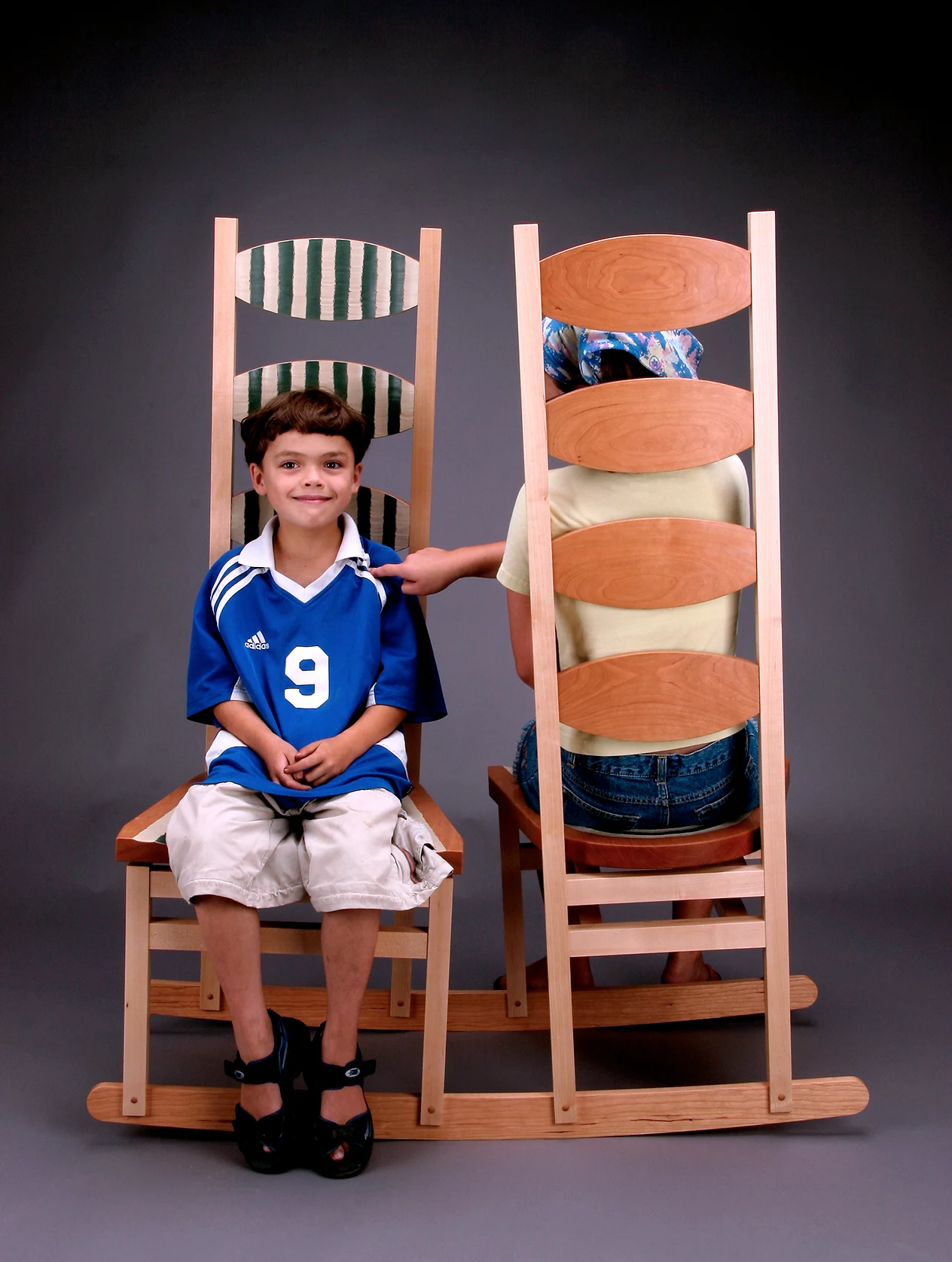
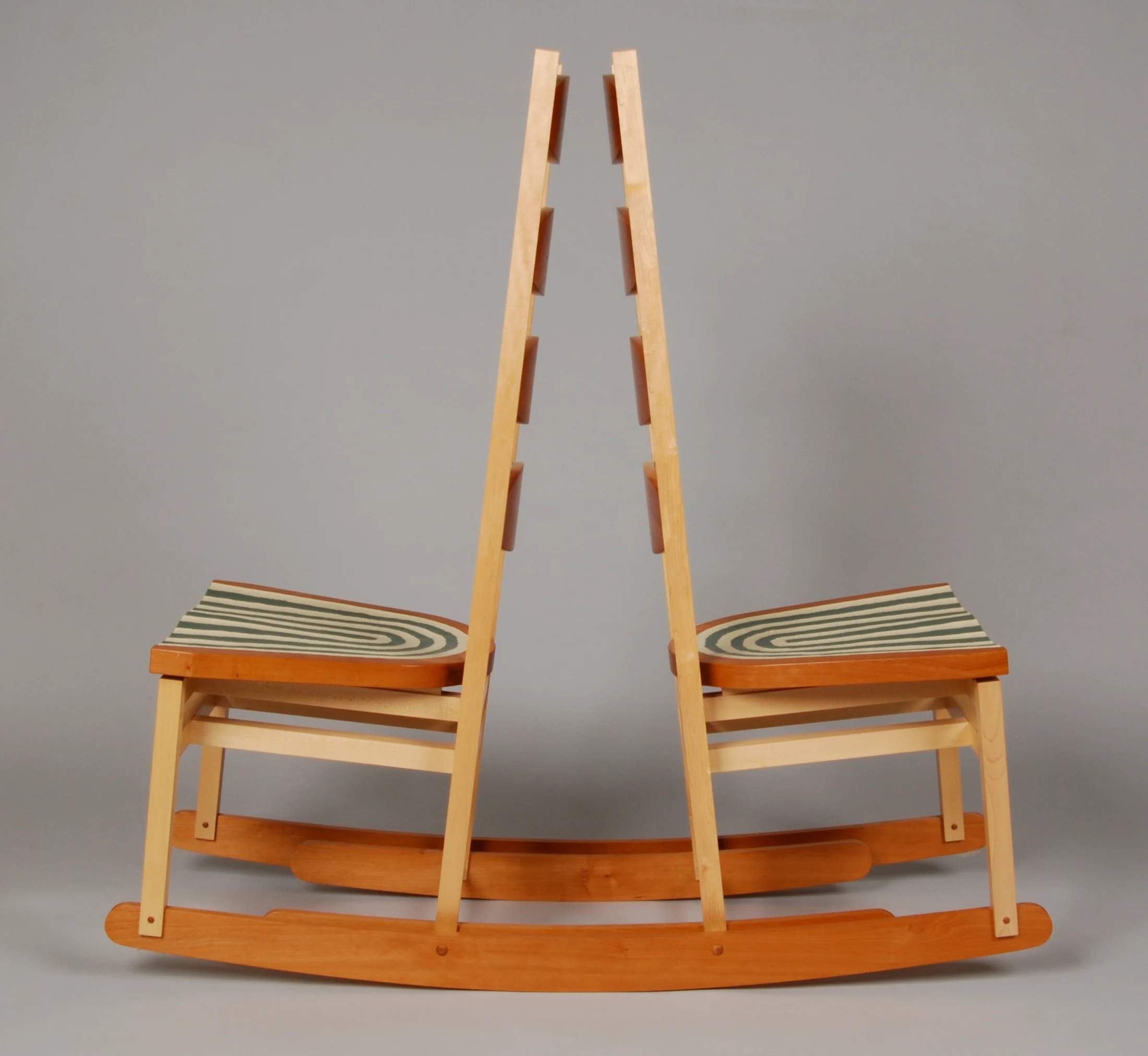
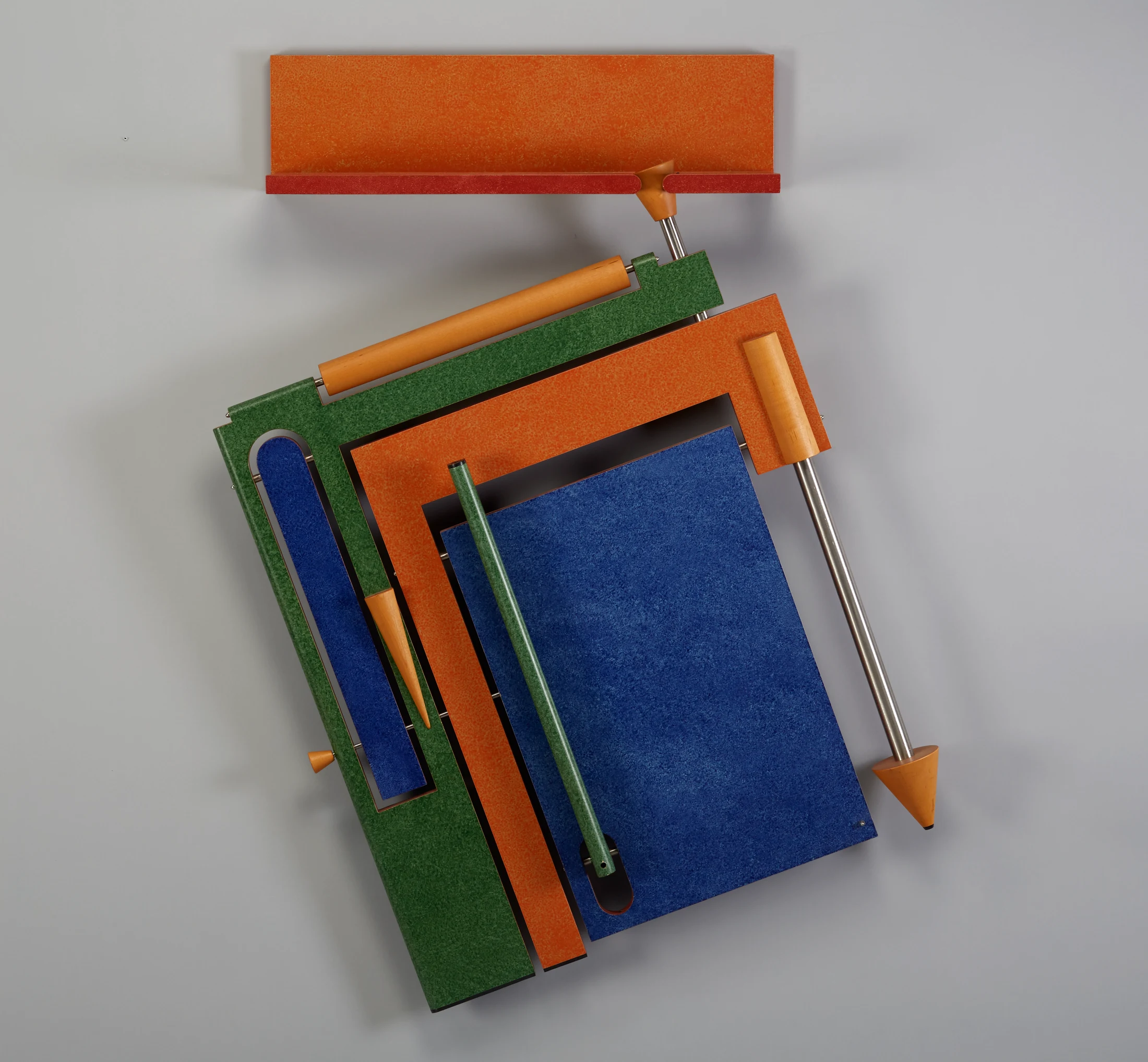
Tom's Folding Chair created quite the stir with the beautiful young things of Manhattan in the 80s. Colourful and intriguingly complex – in either its chair form or collapsed-and-wall-mounted form – it made for the ideal conversation starter for the cool set. Even at this very early stage of his career, a trio of characteristics that endure as persistent threads in Tom's contemporary body of work are plainly evident: a keen interest in the interplay of colours, a fascination with the objects we sit on, and what friend, curator and writer Glenn Adamson describes as his "elegant twist of perspective" on what we expect a furniture archetype to be or do. At Tom's hands a chair is no more a chair than it is an abstract, wall-hung piece of art. A public bench in a museum is a surprise lazy susan for the unsuspecting tourist seeking to rest their weary legs. And a pair of conjoined rocking chairs are a mischievous instrument of social mediation.

Since the early 1980s, Tom has been "turning furniture upside down and inside out" (to return to his friend Glenn Adamson) to beguiling effect and across a teaching career of almost 30 years, he fostered subsequent generations of furniture-focused artists at the University of Wisconsin-Madison. His one-of-a-kind pieces are held in the public collections of more than 20 museums in the United States and continue to be exhibited regularly all over the world. While we go about our busy daily lives asking a lot of our furniture, I find that Tom Loeser is busy in his Wisconsin workshop, making furniture that has some questions for us instead.

I understand that, like us, you have a particular fascination with public seating. Can you share why?

I love this question and I was thinking we could start with Stoops. This was actually a collaboration with my wife, Bird Ross. This is just one example of public seating where I was thinking about stoop culture. Do you use the term stoop in Australia?

Not so much but thanks to a healthy diet of American TV and movies, I can easily conjure some images of people perched on the steps of a Brooklyn Brownstone.

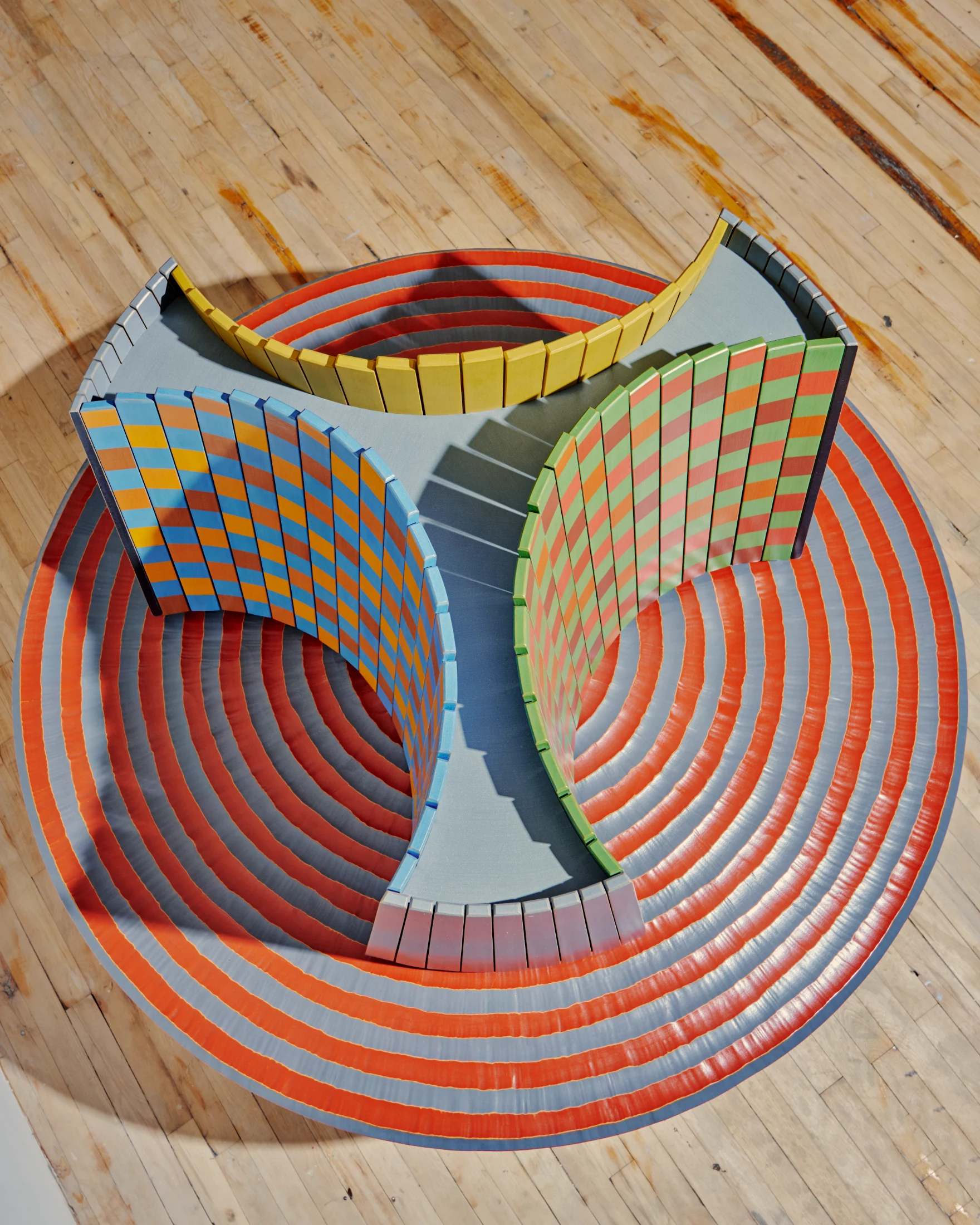
I guess I'm interested in seating especially as it relates to situations where people can have social interactions. What I like about stoops is they seem sort of democratic and they seem to be at the intersection between the private and the public. The stoop usually has the house behind it – the private zone – and then the public zone in front. And so stoops make that connection and get people out of the house and onto the sidewalk interacting with people. The other aspect that I like is their flexibility. They're not very prescriptive. They don't even have places that define where your butt should be located. So you can sit flexibly, you can choose different heights, and you can set yourself up in different ways. That's what the appeal was when we made them as public seating for the Madison Museum of Contemporary Art.

The pieces that I'm just working on in my studio now are kind of picking up on Stoops. What I'm thinking about is ways that you might be able to bring that kind of open-ended flexible seating to a domestic space. They're supposed to be a little more domestic sized, but I tend to make sort of 'white elephant' objects that are hard to place – that aren't conventional and challenge people to figure out how to fit them into their lives.

When children see your furniture – with all that colour and invitation for interaction – they must want to climb all over it, no?

I do like that kids like the furniture and that they like interacting with it. I should expect that will happen because of the way I'm setting up the situations but I'm not making the furniture for kids. One word that gets applied to my work sometimes that I'm not so crazy about is whimsical. I don't necessarily dislike the word whimsical but I feel like once it gets described as 'whimsical' people don't deal with the underlying concept or ideas.

If it's not for children, is there a desire on your part to connect grown ups to a sense of play?

No, not so much. I think for me it's more that I want the objects to be a little bit unpredictable. Sometimes I think you might not necessarily understand what they do at first. You have to explore them or they take a very expected furniture form and complicate it somehow so that you have to think about it. So, I guess I'm trying to make it so furniture doesn't disappear. It confronts you and you have to think through what it's asking you to do.

Your Chairiot and Panoramic Viewmaster pieces spring to mind with their elements of surprise in this context.

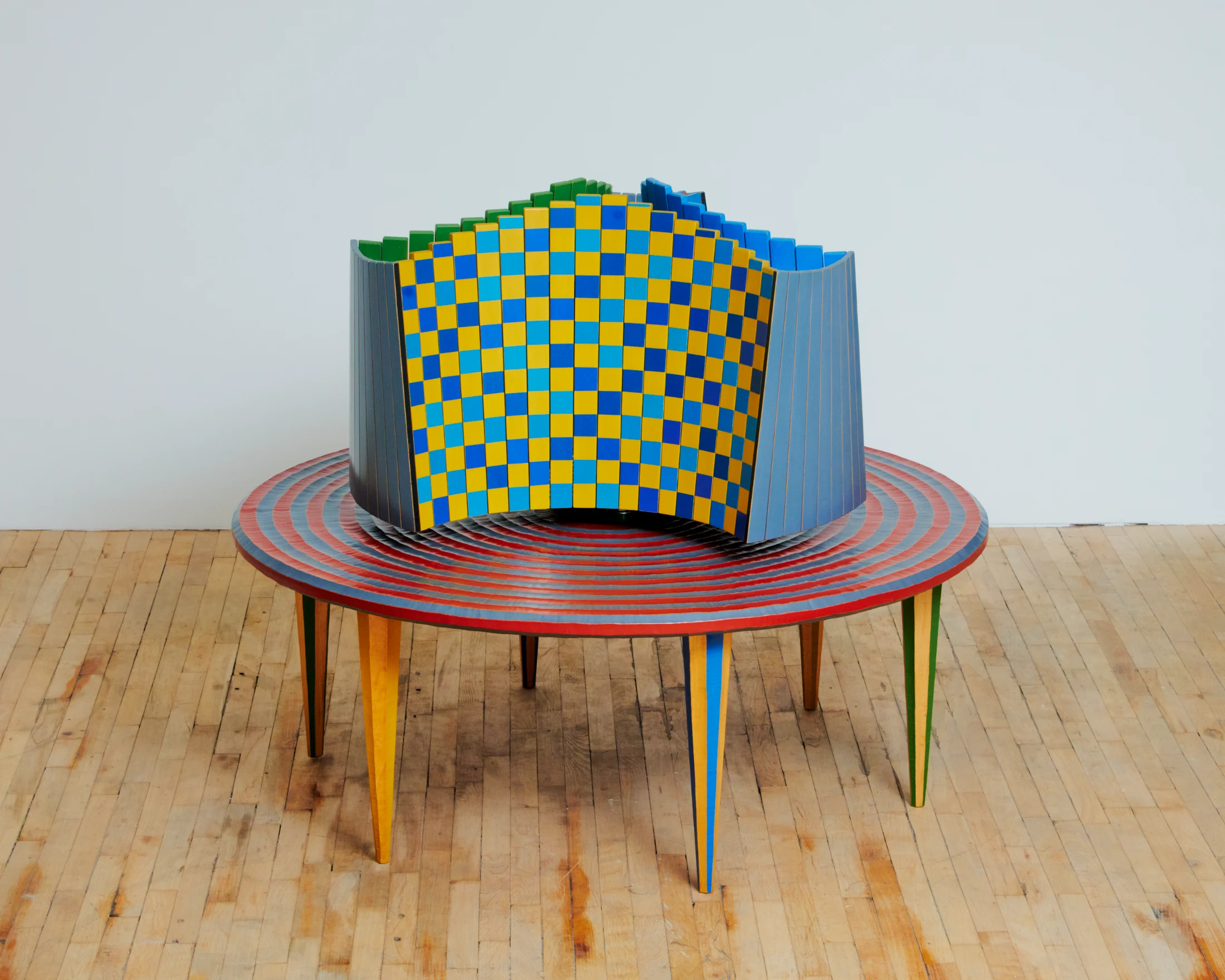
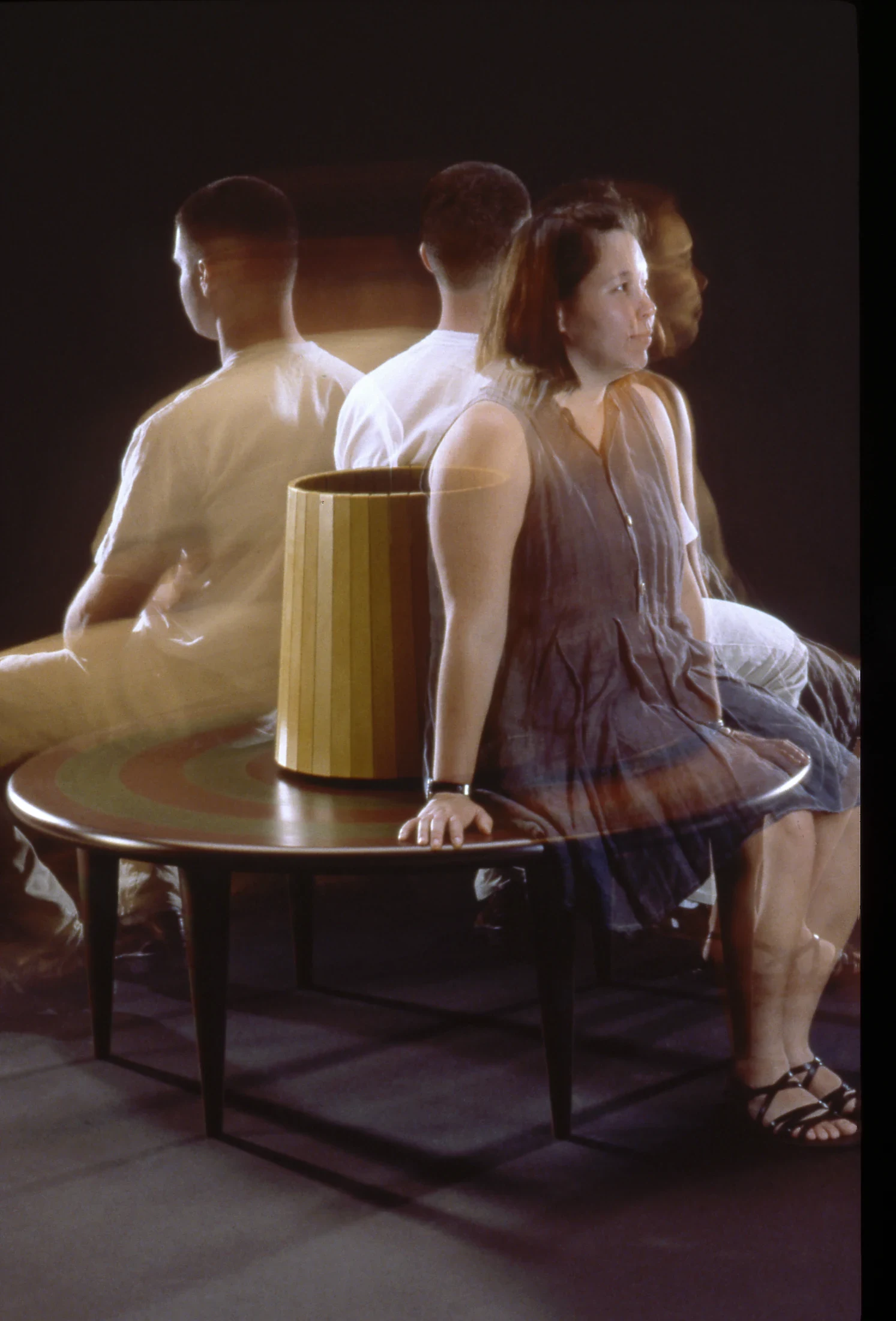
Yes. The Panoramic Viewmaster has a seat that is sort of like a lazy Susan that your butt sits on and you can spin the whole horizontal surface, whereas the Chairiot has a triple backrest, so three people can sit into those backrests and it's the backrest that spins. These were also made for an exhibition at the Madison Museum of Contemporary Art and they were intended as public seating too. When I go through museums I look at the seating that they're using and it's mostly pretty boring, so I was thinking about how nice it is when there's a bench in the middle of a room and you can sit on that bench and move around and look at everything that's in the room. But what this is making happen is people might sit down separately on this piece and then have a sort of a forced social interaction where if one person wants to move, they're causing this other person to also move. Obviously it's fun. It's done because I want it to be fun, but it's also about the social interaction.

How do your pieces evolve? Do you start with the desire to mess with a chest of drawers or do you just start making? I'm interested to know about your process.

Yeah, it's a bit of a mystery. My gestation period is really long. I can carry ideas around for a really long time.

How long are we talking?

I don't know. This is hard because I'm not a person that keeps a lot of sketchbooks and I look at tonnes of stuff all day, all the time. So, I think I'm just sort of packing stuff in and then an idea will start to percolate and then I will do some sort of model-making and as much sketching as I need to. And then a thing that I find I've been doing more lately is making full-size mockups with basic materials. That's been really helpful. Eventually some pieces require detailed technical drawings to resolve angles and joinery and proportions.

So taking Switchback as an example: I went to college a million years ago in Philadelphia and the college I went to was on a commuter rail line with these really nice old trains and when the train got to the end of the line the conductor walked to the other end and the train drove straight out the other way, but before that, the conductor would come through and flip all the seats. They had this really solid mechanical sound that I really loved and so that's an image I carried and had wanted to do something with for ages. So, it took that long for that piece to come together.

I've also been doing this long enough now that I can look back through my body of work and I can see how pieces I'm working on now are pulling out ideas from earlier work and taking previous ideas and developing them further.

When you're model-making with basic materials, what materials are you working with?

Most often I would make the models out of wood of some sort. And then when I'm building, because I'm so interested in colour and paint, I feel like my process is a bit of a two-part process: part of it is structure and part of it is surface and thinking about the relationship between those two and how I can use the two to support each other. And how I can use the surface to have people do a visual read of the piece that makes them see the piece the way I want them to see it.

Glenn Adamson, notes the echoes of Gerrit Rietveld's Red-Blue Chair in your Folding Chair and others note the influences of the Memphis Group. Are there genuine connections there?

When I was in my undergraduate school from about 1979-1982, Memphis was just happening and we would go to the fancy news stand in Harvard Square in Cambridge that had international publications and buy Domus¹ and Arbitare² and that's sort of how we learned about what was going on with Memphis. It was hugely influential. It was essentially liberating because Memphis just blew everything out of the water and made it okay to do everything. And made it okay, in a funny sort of way, to make things that are ugly.

It wasn't really until Droog³ showed up in the design scene that I felt that another movement or idea sort of caught up with Memphis, but then actually moved beyond it. I got a lot more out of what I saw in their design. Droog seemed to engage with a much higher level of concept in terms of what they were doing. But I think they probably would never have happened if Memphis hadn't happened first.

As for Gerrit Rietveld – he's a special hero. One thing that I really like is that he was a furniture maker first and became a brilliant conceptualist later. He was kind of pulled into that De Stijl⁴ group and then the Red-Blue Chair became its iconic object. And then the other thing is that the Red-Blue Chair and really many of his designs are just so rigorous. You can do an incredible analysis of that chair – of every part and what it's doing – and there is not a single superfluous thing there. It's basically a machine for supporting two planes in space that then support a human body.

Given your Folding Chair in particular garnered a lot of interest and ended up in a lot of stylish Manhattan apartments, were you ever approached to take it into production? Has that pursuit been of interest to you?

Thinking back to the Venn diagram, I think one of those boundaries between the way that me and my peer group work in the field and then the design world is that difference between having pieces in production or just making them yourself in your workshop. For me, I'd love to have pieces in production. That would be great. It's just not the way that I've operated in the world.

And the Folding Chair was interesting because I was approached by an Italian company. We signed an agreement, I gave them all the plans and they played around with it and talked with the production people and they decided it's too complicated. But I have to say they were very honorable about the whole thing. I think in many ways they were right – it doesn't really lend itself to production. So I made the initial prototype and then I made a couple more prototypes. Then I did a run of six chairs and then did a couple runs of 12 chairs. So they were a sort of limited edition production (they weren't really editions though because the parts were the same, but then I always painted them differently).

They were ridiculously popular. I made them from something like 1982 to 1987 or 1988, but I didn't want to just keep making them. And so, I actually cut off the production run at 35.

Do you have contact with any of the people who own them?

Yes, lots of them. Some people have done nice things with them like donating them to museums.

I'd like to return to your two-part process – the relationship between structure and surface. What drives your approach to colour in your work?

In part, my attraction to colour owes some credit to Memphis, for making it okay. But, part of my attraction to colour is that even if you get all the woods in the world, the portion of the colour wheel that they cover is fairly narrow. I'm interested in using the whole colour wheel. I also like colour in contrast with wood. Sometimes everything on a piece is painted, but often I'm combining natural wood and paint.

And because I'm locating my work as handmade and one-off objects, I've tended to avoid doing things like using a spray gun. I work more with a brush in my hand. And I think, if you're going to make these ridiculously labour-intensive pieces that take so long to make, I'm not so interested in making it look polished and perfect. I'm more interested in letting it be irregular. Irregular in an appealing way, in the way that quilts might be lumpy and irregular but all the more compelling for their individuality.

I'm probably the most interested in the relationship between colours too. How the colours talk to each other. I rarely have a fully conceptualised way that all the colours are going to work. Sometimes I might have a general idea of what I'm trying to do, but more often I'm working with mixing colours and seeing how they interact with each other. So on a piece I'll have a lot of colours mixed up and I'll be experimenting with them and shifting them and putting down samples and seeing how they work together. People think my colours are bright, but they're not very bright. I think that sense of brightness is just from the way the colours are interacting with each other.

How do you like to think about movement and inviting interaction in your work?

Oh, well that goes all the way back to why I'm a furniture maker. When people see how much I like colour, they'll say, "Well, how come you don't just paint?" The reason why I enjoy working in the terrain of furniture so much is that it has a level of accessibility. People know what furniture is. They know how to approach it. They're not intimidated. It's not a painting on the wall that's hard to understand. And so I like that approachability of furniture – I like that everybody knows what a chair is. So, I think I try to get people to slow down and think and interact by playing with and undercutting that expectation, or building on the basic expectation and hopefully making it into something more interesting.

tomloeser.com

¹ The architecture, design and art magazine founded by Gio Ponti and ‘Barnabite father’ (I can’t add a footnote within a footnote, you will need to Google) Giovanni Semeria in 1928 in Milan.

² Another Italian architecture and design magazine founded in Milan but a bit later, in 1961.

³ The Dutch design movement and collective was formed in 1993 by design historian Renny Ramakers and designer and educator Gijs Bakker. "Droog", which translates as "dry" in Dutch, points to the movement's humour and critical edge. Its output was characterised by the reimagining and reuse of everyday objects including Tejo Remy's Accumulation of drawers without a cabinet (if you don’t know it by name, it’s the stack of mismatched drawers held together by a tension strap).

⁴ Another Dutch design movement (translation: "The Style") but from way back in 1917. Primary colours, straight lines, rectangle planes, that sort of thing.

Writing:
Writing:
Elizabeth Price
Photography:
Photography:
Back to Top
Arrow UpArrow Up
Top
Arrow UpArrow Up
The After shot of the Floorplan
Before
before
after
After
Businesses featured in this project
No items found.
Products featured in this project
No items found.
Magazine Current IssueMagazine Current Issue
Writing:
Writing:
Elizabeth Price
Photography:
Photography:
Back to Top
Arrow UpArrow Up