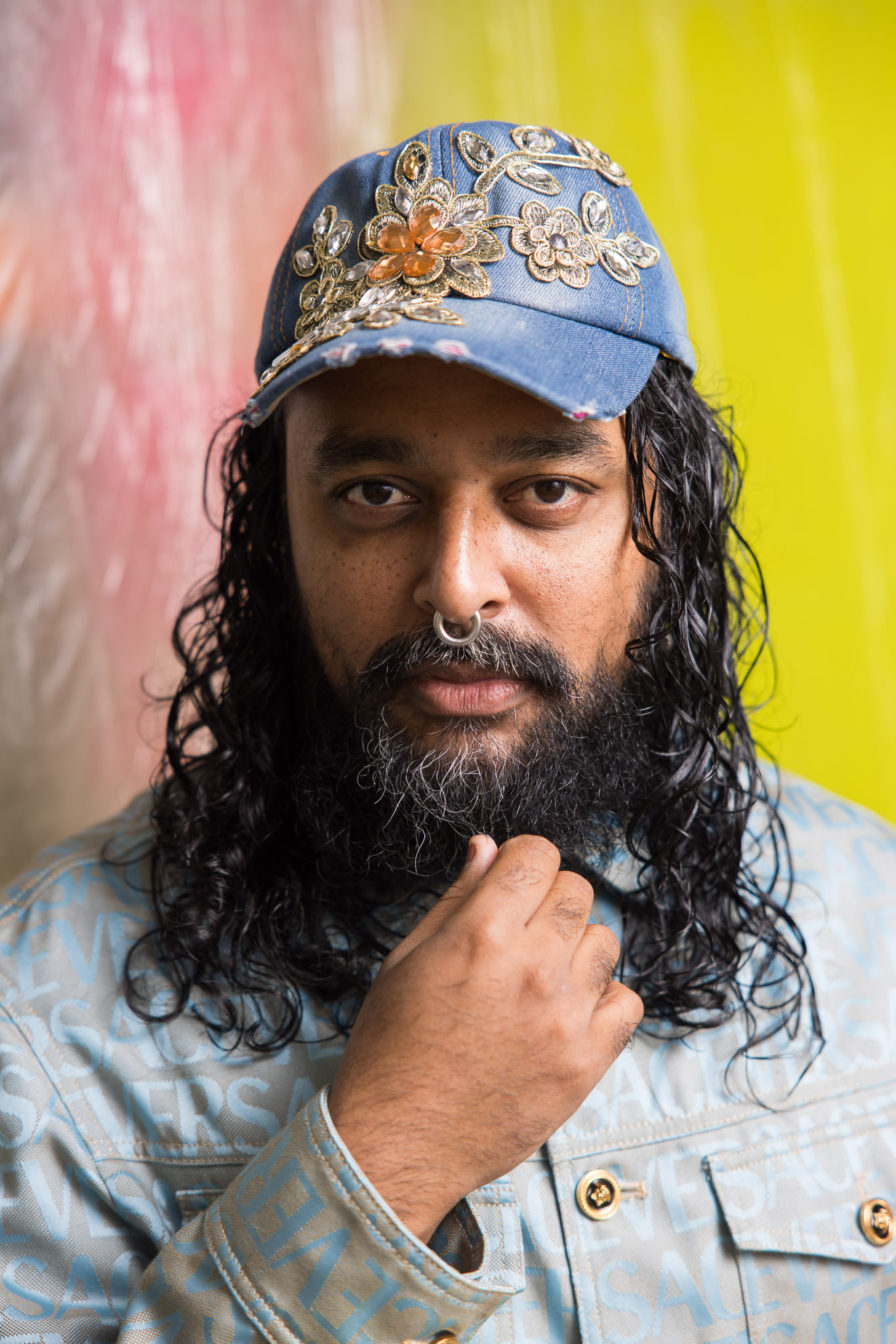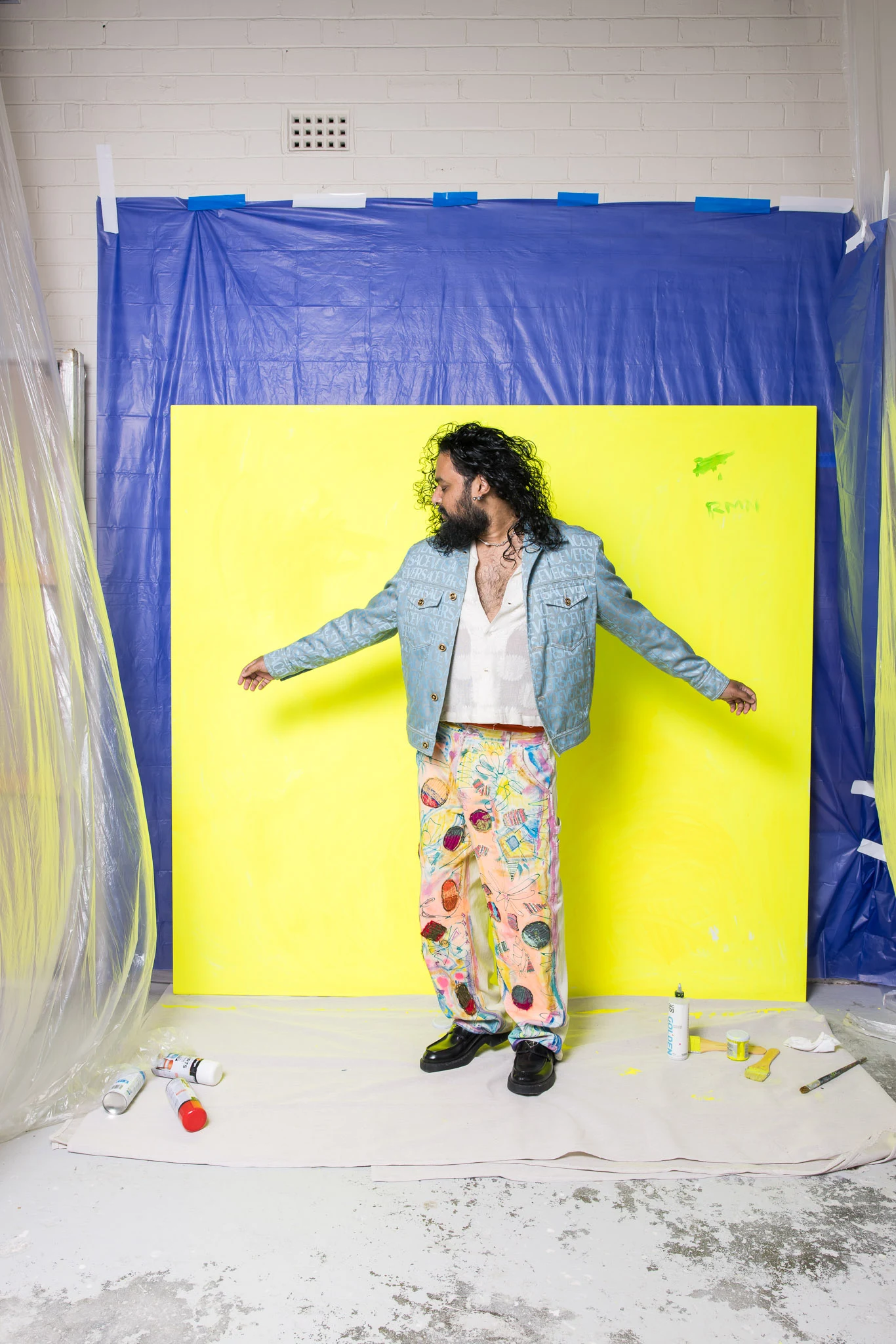




I'm very surprised to see you in black today. I saw so many pictures of you in the brightest colours.
[Laughs] Well! It's a bit of texture, it shows you reality. Actually…
Ramesh jumps up to grab his laptop, flips it open and starts scrolling through images of a recent photoshoot. He flies past thumbnails of him in purple and yellow on fuchsia backgrounds, slowing down when he hits a run of ponytailed, monochromatic shots.
It's really funny, because there were so many images of me in colour so I wanted to get some photos that were a different edge. So we did a slicked back look, and white and black.
How funny that for you to get 'an edge', you wear black and white.
Yeah! Well, it was an idea – if it worked, who knows? But that was kind of in contrast to the more chaotic energy of being in the studio.
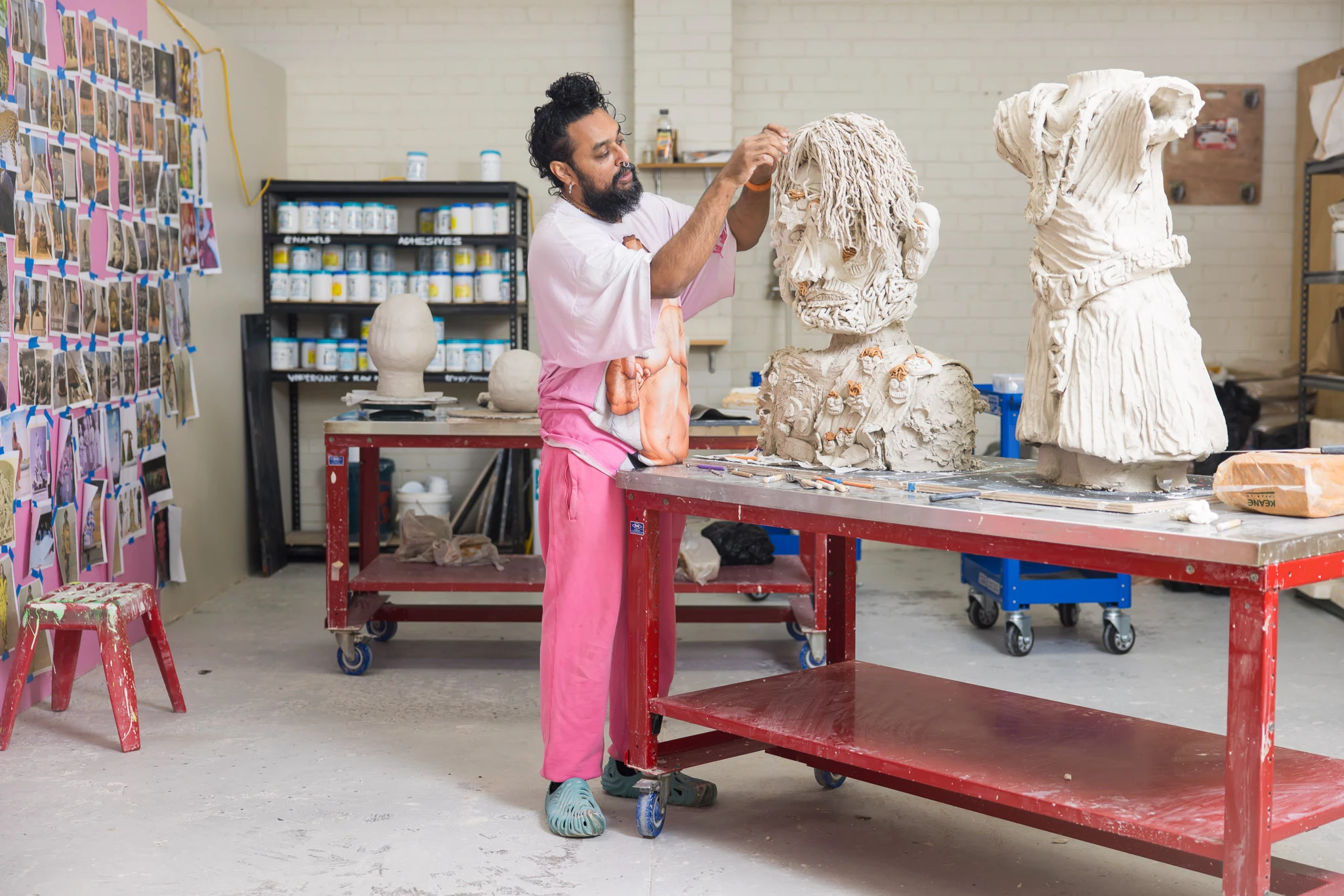
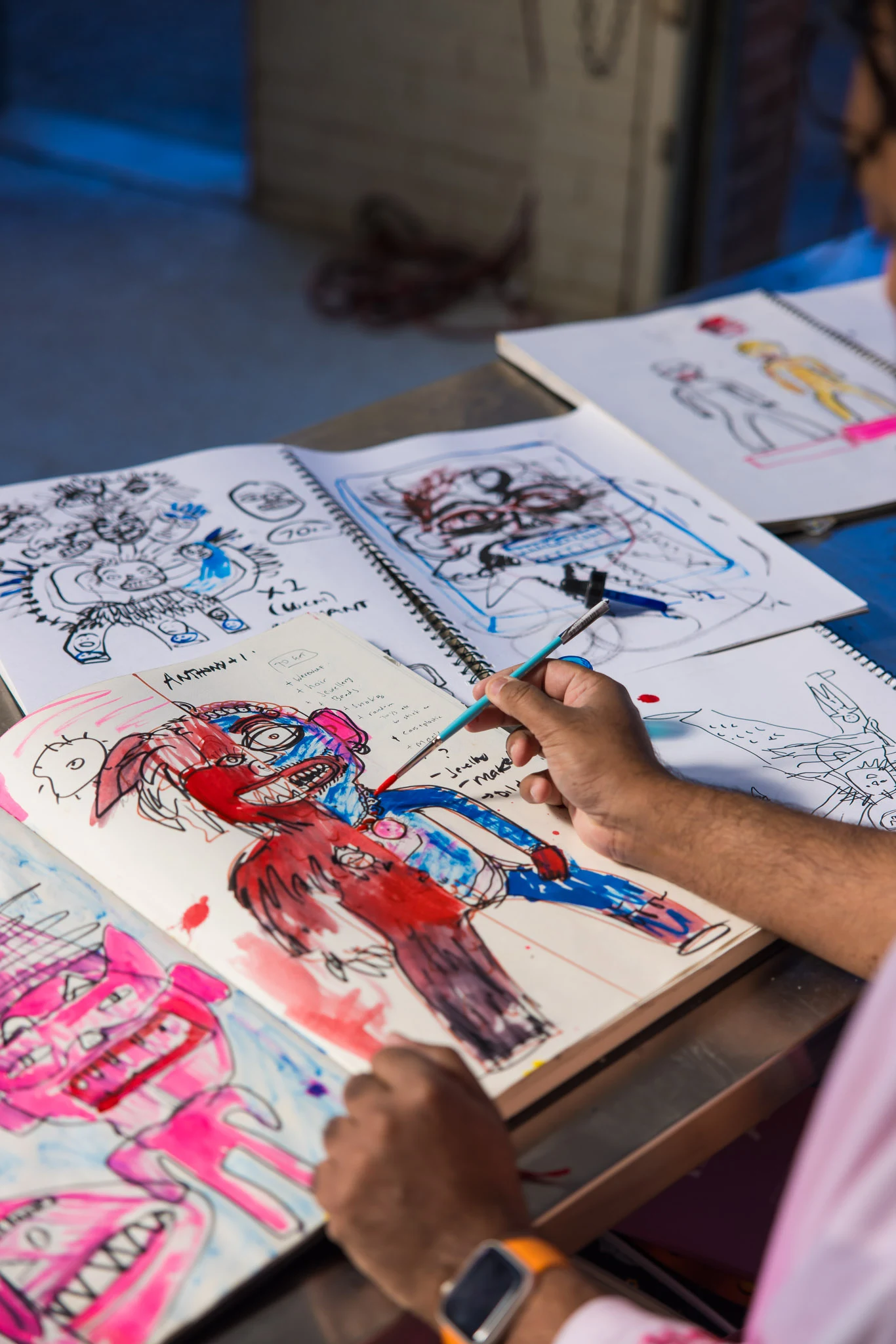
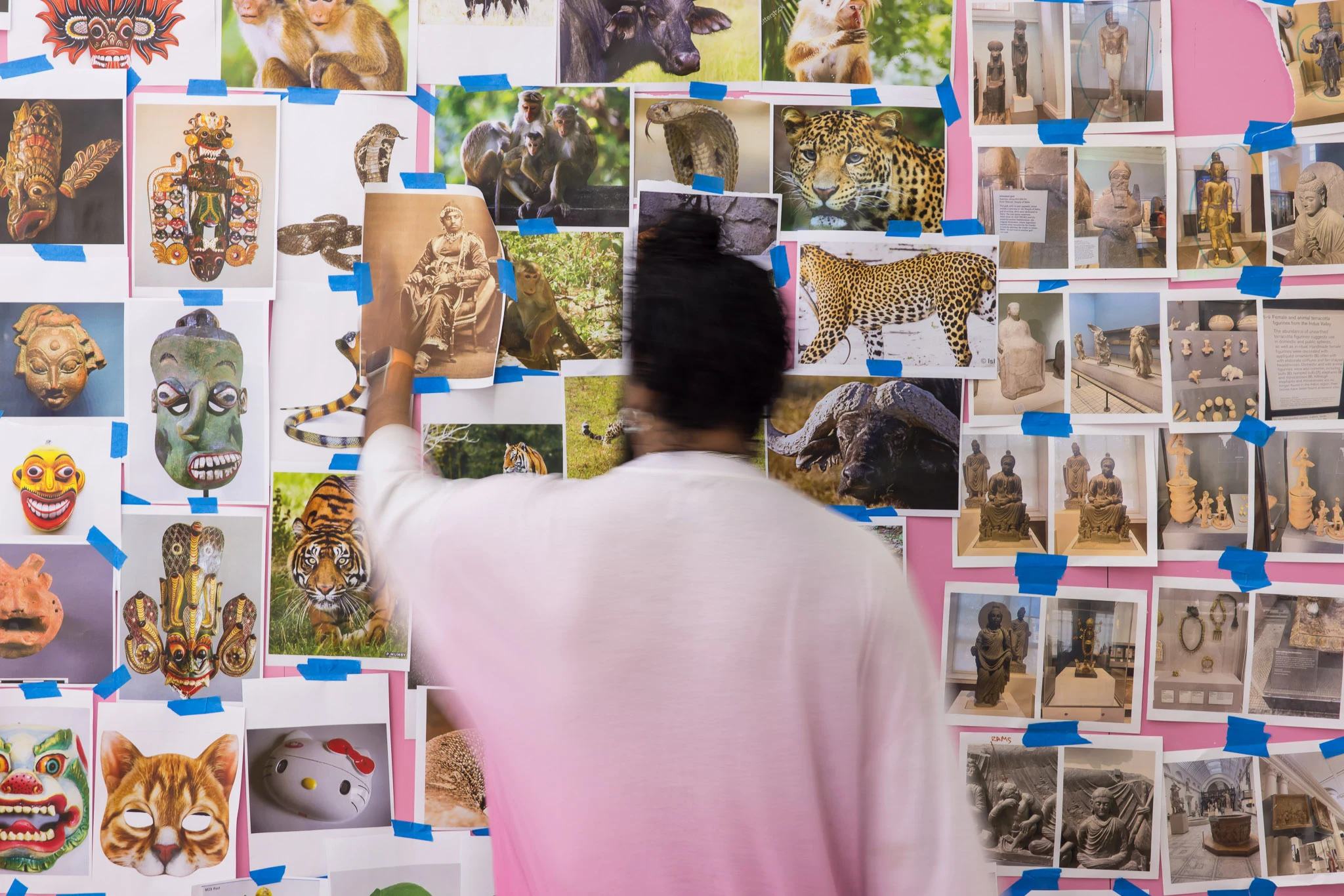
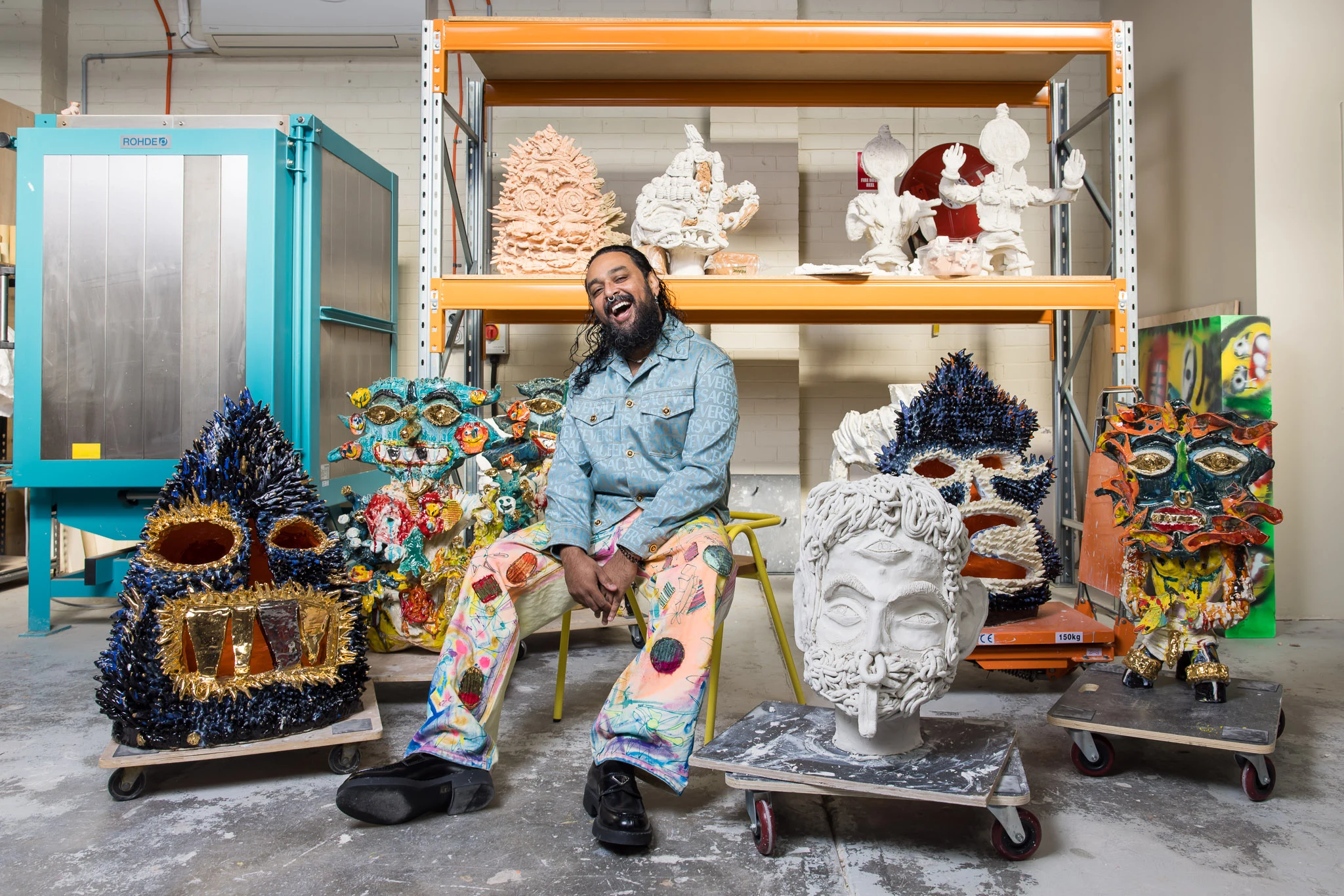
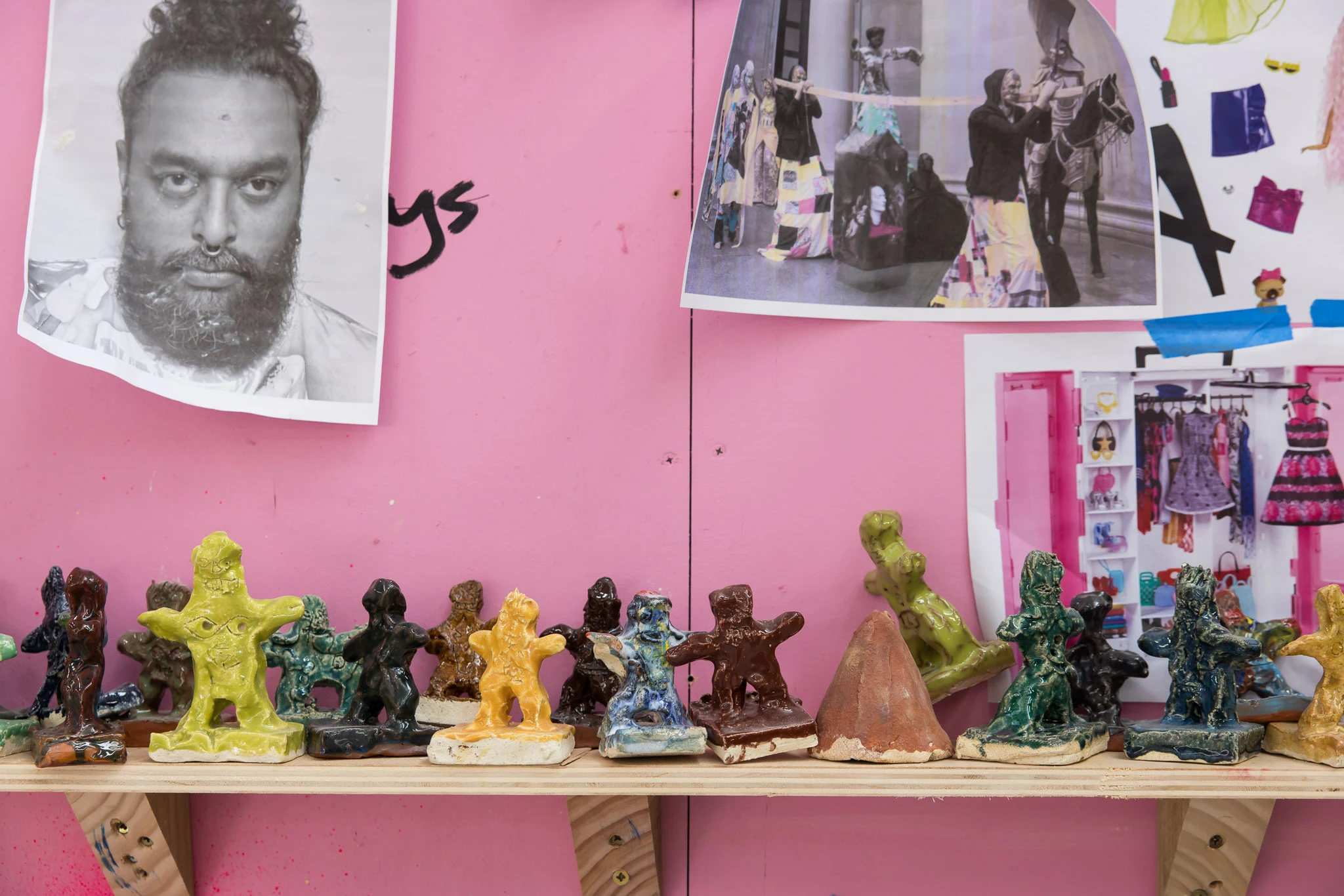
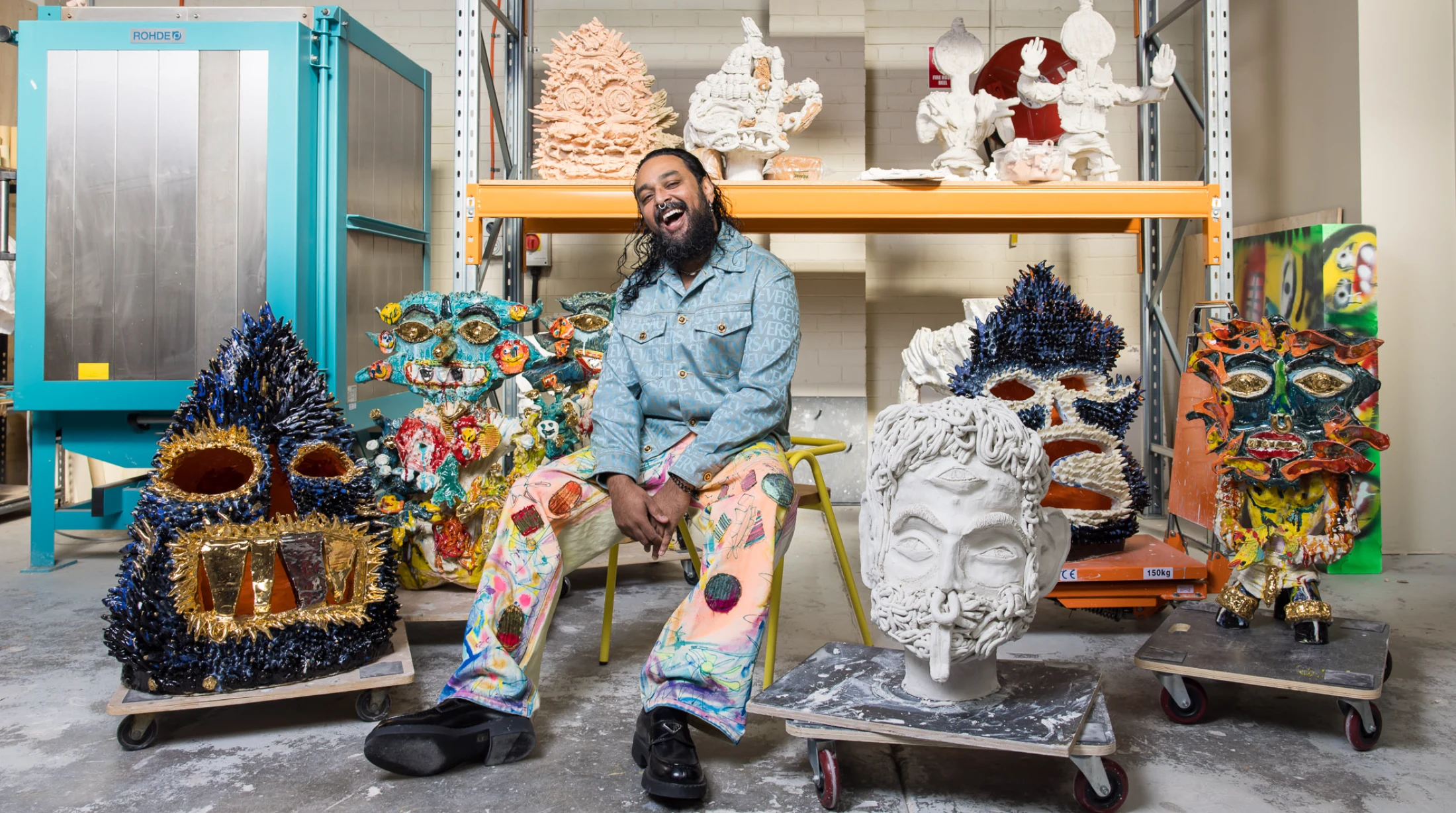
That 'chaotic energy' is palpable – Ramesh's studio is alive. He warns we'll be 'getting our steps in' as we circle and dart around the place. There are finished works in one corner. Part-way done works in another. An enormous spiky blue-glazed figure sitting in the open door of the kiln. There are works just being started – Remy Faint (an emerging artist who assists in the studio a couple of days a week) stands at a bench hand-forming a large mass of clay destined to support a four-headed piece for Ramesh's next solo exhibition. There are imagined works in drawings stuck to the walls (he sees these as 'prompts' rather than blueprints), and in thick diaries full of sketched ideas. A reference board is plastered with A4 printouts of Barbie and her modular wardrobes, photographs of big cats in the wild, and images of Gandhara Buddhas. This sculptural programme of Buddhist imagery dates back to as early as the third century – a time when Alexander the Great was moving through the region of northwest Pakistan – and forms 'the key historical reference' for Ramesh's latest work.
On the face of it this is a disparate collection of references but somehow, it makes sense. RAMESH! sense, anyway. And it all points to a very deliberate process behind the spontaneous feeling of his finished work.
It's kind of that push-and-pull between trying to make something look expressive and quick, when it's actually not at all, you know. So it's this highly constructed aesthetic. All of these, for example [he points to the snaking appendages on a row of drying busts], they were hollow forms that were attached, and there were all these props so that they wouldn't fall while they dried. So to get this thing looking like it's 'RAH!' [he mugs like a cartoon lion] is not very easy.
In only 10 years, Ramesh has become internationally renowned for that 'rah!' look. There's just so much work, put out at such an epic scale. He was once called a 'prolific maniac' – how does he feel about that? He laughs – and readily agrees.
I just feel like I've got so many ideas all the time. You know what I mean? There are just so many things I want to make. And it's almost like, I wish there was a time machine and I could speed things up – like those things have been sitting there drying for weeks, and I just want to get their heads on. And then once you make that thing, it's like you want to make sixty other things. It's this almost consuming ideation, that ends up with form.
An artist's obsession, clearly – but there's also a drive and discipline in the mix.
I think it also comes from having that migrant background – like, there was no such thing as a gap year for me. I went to a selective school. It was always about your value contributing to an economy, to society, to labour. And I think I was raised to think like that – so I've always liked working. It's always been my default position.
I pause a fraction too long before asking my next question, and Ramesh is already back to work.