

What is it about 10/1 that still fascinates people 17 years on, do you think?
I have gathered many layers of answers and questions, mostly from people who were touched by my work. One of the beautiful evolutions of the work has been that it seems to answer questions for people and organisations about how people live in apartment blocks. Just like a piece of classical music (let's say Bach, which I like) or like a good book that still manages to impress after many years, I am glad that 10/1 manages to touch on the ideas of convenient housing, domesticity of living, and the safety and privacy of the home in the collective memory. It has done this for quite a while, despite the fact that photography nowadays is consumed at an impressive speed.
The photographs taken are of your neighbours and their homes within your building at that time. Can you describe what prompted you to begin the series? What interested you?
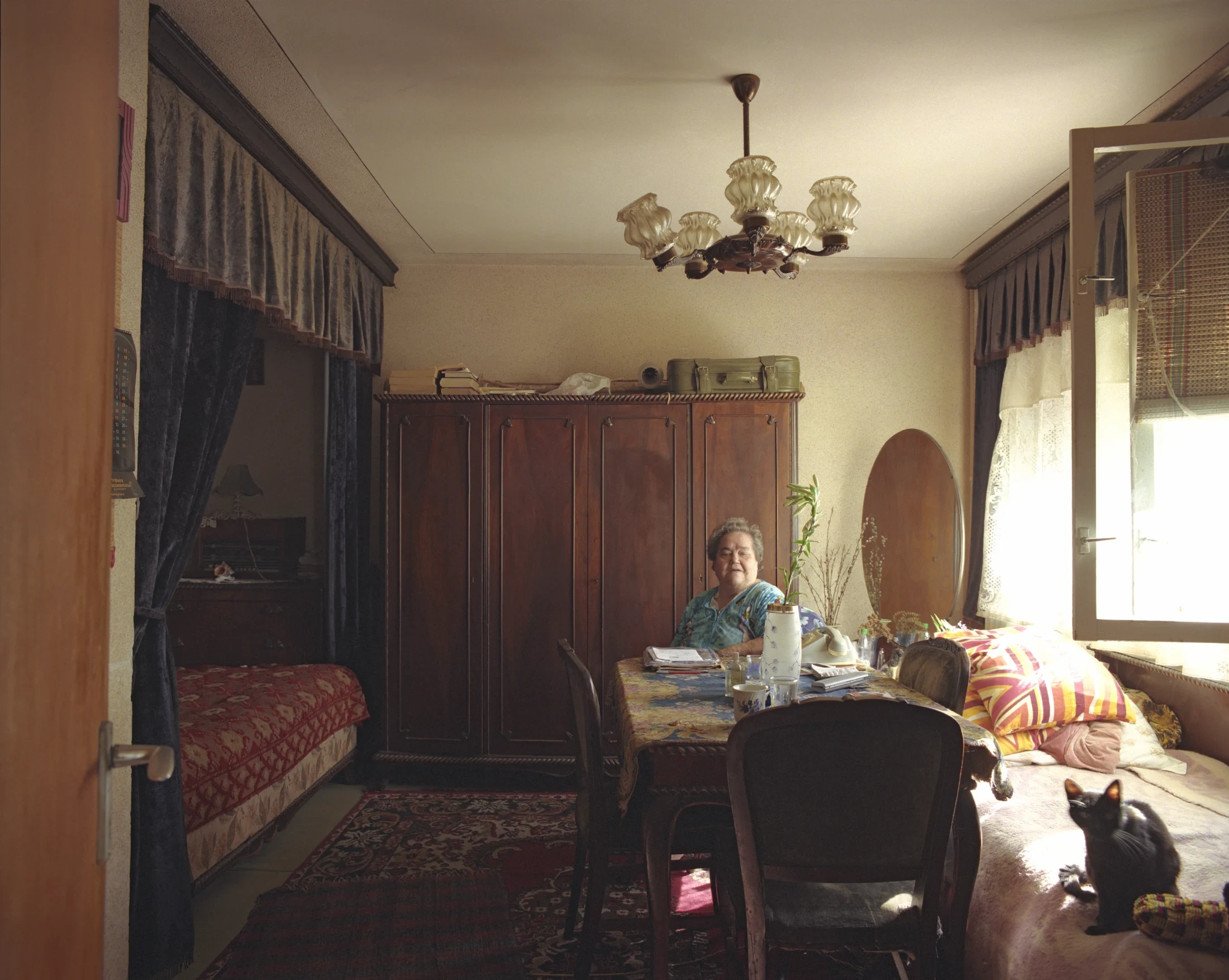
Yes, the photos are taken in the apartment block where I lived, on the 10th floor, and the series includes images of the neighbours' houses vertically. The middle apartment in the arrangement of the five apartments on each floor was a studio, the smallest apartment (about 32 square meters), which included a small hallway leading to the main room, the bathroom on the right of the hallway and a small kitchen reached from the room. I started with my studio, a kind of self-portrait, then I continued with the studio on the ninth floor and I eventually reached the first floor.
In my third year of my bachelor's degree – towards the end if I remember correctly – we had to submit to the head of the department a synopsis – a draft, an idea – of what we wanted to do for our final thesis. At that time I was very fond of interior photography. I was reading an article on spatial anthropology Naming The Rooms written by Maria Vittoria Giuliani that fuelled my curious spirit about how people adapt their homes. I was pretty determined that for my final thesis I would photograph interiors of my neighbours' apartments so I submitted a draft, rather uninspiringly named Photographs of the Neighbors, to the school. I didn't have a clear concept, I didn't know who to start with (the relations with the neighbours were not the closest – we respected each other, we greeted each other but we didn't sit around talking). We were not a community in that 10-storey building with five apartments on each floor.
I started my fourth year in college, my final year, and I still hadn't managed to outline anything on the project – just some self-portraits in my own space, from several angles and promises from some neighbours. And as it happens in life, when I got tired of searching or convincing, Mrs Bita, the neighbour below me (on the ninth floor), came and asked me to help her. She had a door that creaked very loudly and it needed to be taken off its hinges, so I instantly accepted the offer to go into her home. This was the trigger to start the series – when I walked into a space identical to my own but which was totally different.
Already in the back of my mind I had the idea of going down to the first floor through these studio flats: the play between identity and identical, the architecture of the space as a convenient dwelling (being only one room, it was very cheap to live in). Many ideas were running through my mind in those few minutes while I was greasing Mrs Bita's door. In the picture of the ninth floor at Mrs. Bita's, the oil used for the door is on the table. You can see that I took the picture right after I finished the task.
As for my interests, they were manifold, starting with the idea of identicality and identity, that repetition from 10th floor to first floor, right through the whole history of photography, or at least a fairly consistent part of it.