Magazine Current IssueMagazine Current Issue
You are what you read.
From our Mag
August 1, 2026

You are what you read.

Basheer Graphic Books started out of a suitcase and today it is an icon that draws creatives and designers from all over the world to explore its one-of-a-kind collection.

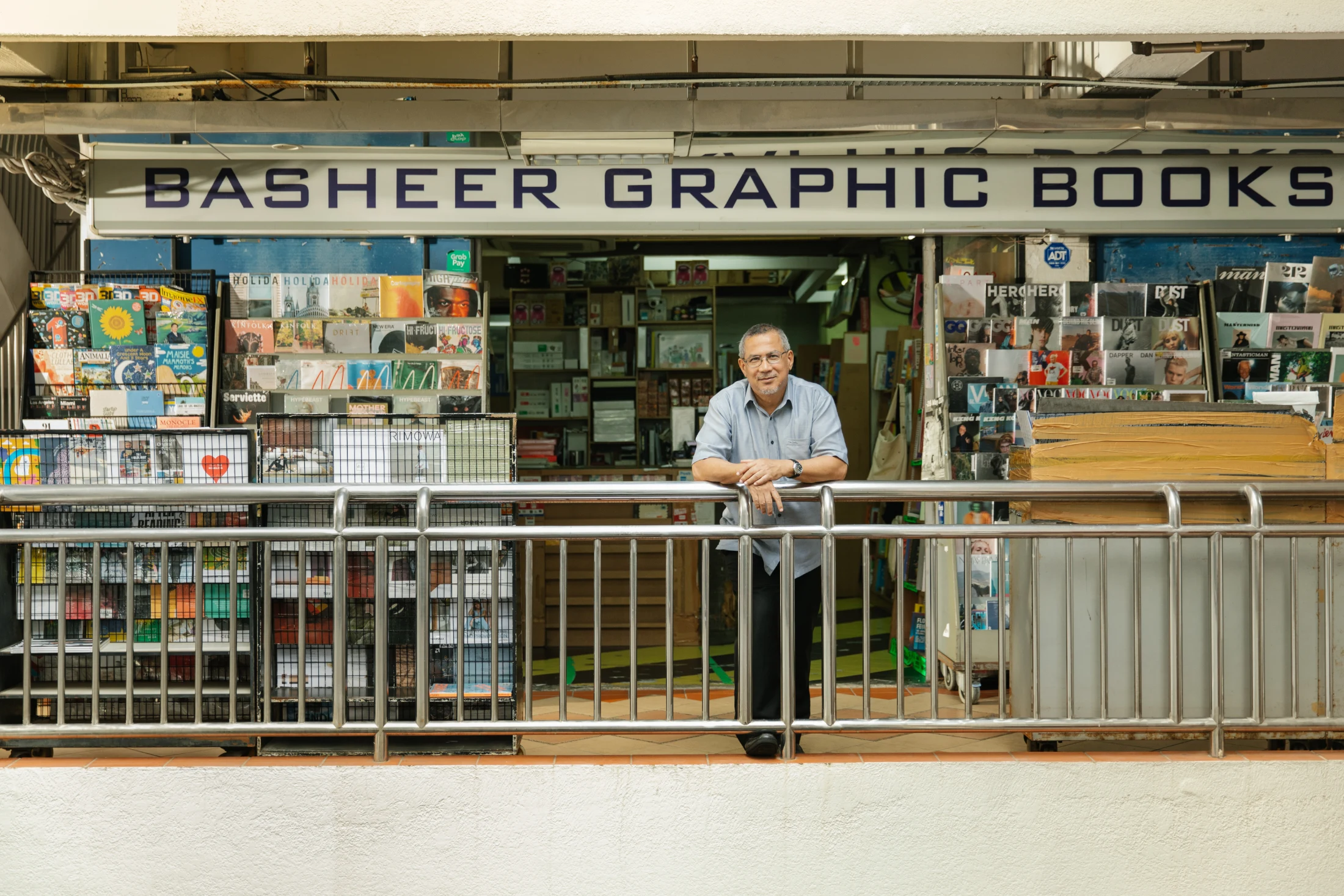
For over 30 years, artists and designers have ridden the escalators up to the fourth floor of the non-descript Bras Basah Complex. It’s a pilgrimage, of sorts, to the undisputed mecca of Singaporean independent bookshops — the one and only Basheer Graphic Books.

James Shackell
Writing:
Writing:
James Shackell
Photography:
Photography:
Juliana Tan
The After shot of the Floorplan
Before
before
after
After
Top
Arrow UpArrow Up

A few years ago, the owner of Basheer Graphic Books, Abdul Nasser, got a mysterious email from the renowned New York design consultancy, Pentagram. It was a request for some long-out-of-date copies of Typography Papers, a legendary British journal for font nerds that had only existed in time and space between 1996 and 2013.

Among certain circles, especially those circles who spend a lot of time thinking about things like kerning and optical margin alignment, back issues of Typography Papers are serious collector's items. Rare un-google-able treasures. The sort of thing, as weird as it sounds, that you usually can't find on the internet. And as it happened, Basheer Graphic Books did indeed have a couple of old editions on the shelves, carefully preserved in cellophane, sitting there like dinosaur fossils. But the mysterious thing, and the thing that was bugging Abdul, was this: how did Pentagram know?

"Sometimes my books, they'll be sleeping on the shelves for 15 or 20 years before someone finds them," Abdul says. "And I thought, 'How do these people in New York know what's in my shop?'"

The answer was appropriately old-school. Abdul does a little social media marketing, but with between 15,000 and 16,000 books on the shelves at Basheer¹, and a stock catalogue that has accumulated and evolved over the course of 30-odd years, the web store is far from encyclopaedic. Some books live only on the shelves, and perhaps in the dusty corners of Abdul's hippocampus.

As it turned out, the local Singaporean design writer, Justin Zhuang², had visited Basheer Graphic Books several weeks earlier with a curator friend who was visiting from New York, and the curator (a graphic design expert) had been amazed to see Typography Papers just sitting there on the shelves at Basheer, like it was no big deal. It was like finding a Tasmanian Tiger in a pet shop. They promptly returned home and spread the word: you guys, seriously, when it comes to everything rare in graphic art and design, Basheer Graphic Books in Singapore is insane. And lo, the international emails did start flooding in...

"Bookstores are becoming a dinosaur, it's true" Abdul says with a chuckle, "but every day people come to my shop from all over the world. They give me the encouragement to keep going. Yesterday we had a couple from Russia. Last month there was a group of students from Switzerland. We even had the editor of the Spanish magazine, Openhouse, along with a photographer. They came in to look around and buy some books."

To understand what makes Basheer Graphic Books so special, and why it attracts visiting artists, designers and students from all over the world, you have to go back to the beginning, in the mid-1980s, before the shop existed, when Abdul and his late father, Basheer Ahamed, walked door-to-door through the central business district, lugging two huge, heavy suitcases. In pre-internet, pre-Amazon, pre-overnight-delivery Singapore, this was a feasible and, indeed, lucrative way to sell books. Clients didn't even need to leave the office.

Most of Basheer's early customers were advertising and design agencies, like Leo Burnett, as well as the old Baharuddin Vocational Institute, who appreciated Basheer's collection of hard-to-find western design books, many of which weren't stocked anywhere else in Singapore. They asked for more. So Basheer expanded his range, filling the suitcases with the very best in typography and graphic design, architecture and photography.

"We split the area," Abdul says. "He would go one way, I would go another. And we kept all the books at home, which was a problem, because in the 1990s in Singapore, with the public housing boards and everything, you weren't really allowed to run a business from your home. The neighbours started complaining."

With the book stacks growing (and knee ligaments aching) father and son decided to settle down and open a shop. In 1993 they moved into a space on the fourth floor of the Bras Basah Complex, on the edge of Singapore's Civic District, about a five-minute walk from Raffles; a building containing so many bookshops and stationery suppliers that it soon earned the nickname 'Book City'. Basheer Graphic Books has been here, in unit 04–19, ever since.

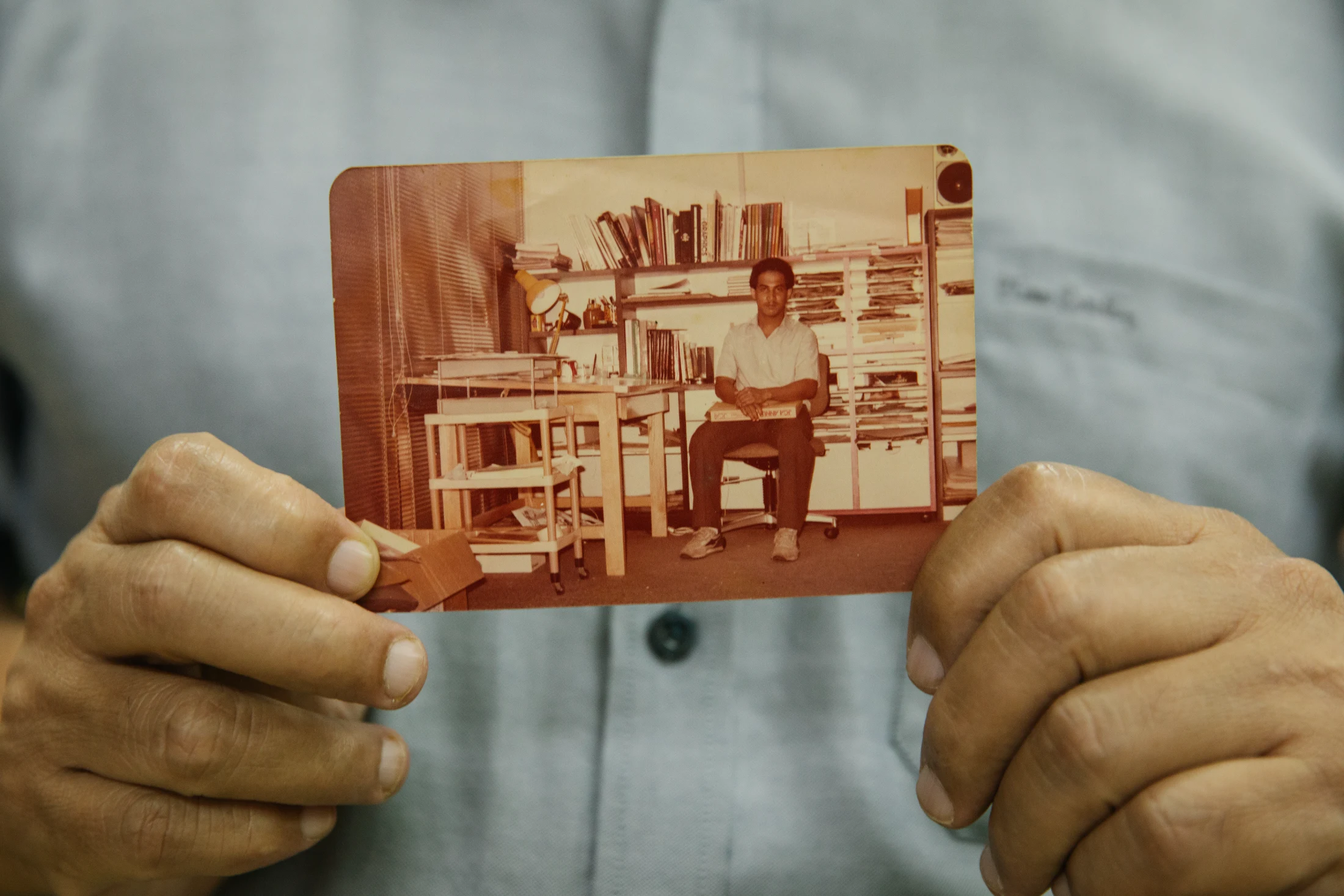
"We've seen a lot of changes over that time," Abdul says. "And we spent a lot of those years expanding our business. At one point we had stores in Kuala Lumpur, Jakarta, Bangkok and Hong Kong. We even opened one in Japan. Then, of course, there was the SARS outbreak, and the financial crisis, and COVID. Now we just have the original shop in Singapore, and one small one in Kuala Lumpur."

In the early days, the business case for places like Basheer was more clear-cut. For design students in Singapore, there was literally no other way to source images for their work, or for inspiration. No other way to stay in contact with emerging design trends from around the world. We're talking pre-Google, pre-Pinterest times – the primordial days of the early internet – a world in which single-cell organisms bumped into one another on AOL chat rooms. Even if images could somehow be found online, dial-up internet made downloading them in high resolution completely unfeasible. You'd be waiting days for a single JPEG.

"I was introduced to Basheer 30 years ago, as a design student," says Pann Lim, co-founder and Director of Singaporean design studio, Kinetic. "And in those days, sourcing images was so difficult. I have to explain this to young people all the time. In order for us to submit work at design school, you literally needed to find a book and scan a page. You would have to buy a book just for that one page!

"So everyone went to Basheer to research best practice. And Basheer was always very nurturing with students, very kind. He would open up sealed books for us to browse. I'm not an OG Basheer customer, but I'd be one of the few over 50 who still remembers those early days."

The story of Basheer Graphic Books is the story of all independent booksellers, and yeah, bookshops in general: expansion and booming cultural relevance, followed by constriction and decline. Swallowed whole by the internet. But it's not the whole story, and in some ways Basheer survives because it hasn't changed. In a world where booktopia.com exists, you might wonder what function places like Basheer Graphic Books actually fulfils. But if the story about Pentagram and Typography Papers proves anything, it's that independent bookstores can still offer something the internet simply can't: curation, expertise and a direct supply chain to the rare and unusual. Abdul himself personally sources hard-to-find design books from nearly every continent on earth. His contacts are vast and unparalleled. If he thinks a book is interesting, or beautiful, or that people will find some use for it, it's going on the shelf³. Even if it doesn't sell for the next 20 years.

"They come from nearly everywhere. All across the UK, all of Europe. We buy books from Germany, Spain, Holland. A bit of Belgium. We also import from Korea and China, even Japan. Most of our stock is in English, but if the pictures are good, it doesn't matter if the text is in Chinese or Japanese. People can just translate the pages on their phone.

“It’s not like a restaurant,” he chuckles, “where the food is served and they have to throw everything out the next day. Some of my books can sleep on the shelves for decades.”

Abdul's unconscious tendency to humanise and anthropomorphise his books is part of the store's innate charm. So is the décor, which literally hasn't changed since 1993. In the beginning, Abdul and his father couldn't afford to furnish Basheer Graphic Books, but luckily another bookshop owner (who was quitting the business) donated the shelves. The floor, with its iconic black and white plastic tiles, now heavily worn and scuffed, has been trodden on by generations of designer feet. The shop has zero of Brooklyn's faux industrial style, or Copenhagen's cosy minimalism. In fact, for a business that stocks the best and brightest of global design, it has a refreshingly anti-design vibe. We're here to sell books and chew bubble-gum, it seems to say – and we're all out of gum. "A lot of customers, they say, 'Please don't change anything!'," Abdul laughs. "They like the black and white."

The store has a secondary function, which is a sort of Singaporean publishing community nexus. Zines, like Pann Lim's own locally-made Rubbish FAMzine⁴, host their launch parties here. Authors come to give talks. Students from Nanyang Technological University (NTU) or LASALLE College of the Arts hang out among the stacks, chatting all things Bauhaus. International bigwigs like Suzy Annetta, the founder and editor of Design Anthology (which, of course, you can purchase at Basheer) make a bee-line here whenever they're in town.

In an online world that tends to fragment people and splinter communities, rushing customers through lonely little checkout silos, physical spaces like Basheer Graphic Books are more valuable than ever. Where else are you going to bump into New York magazine editors, Swiss design students, and Singaporean zine makers on your lunch break? Or track down impossible-to-find collections of architectural photography? Or be recommended something to suit your interests, personally, by Abdul Nasser, a guy that's been sourcing design books and journals from all over the world since the 1990s?

If the internet has given us convenience, then the price we've paid is community. Basheer Graphic Books is one of the few places left where that compromise isn't necessary. Here, you get breadth and depth, local history and cutting-edge global design, packaged and served in delicious, sugary nostalgia. It's a place that encourages you simply to browse. To be. To take the time and dig around and uncover something that genuinely inspires you. Amazon.com might struggle to see the value in that process, which only goes to show how impoverished our modern definitions of value have become. Some things, the best things, you simply can't measure in money.

"Abdul's clients include some of the most famous architects in Singapore," Pann says. "All the big ad men and women in Singapore. Everyone. Everyone goes there. From the top tier professionals to students and people who are just interested to read about design. His stock is so wide ranging, and for those people looking for out-of-print stuff, there are so many treasures in there.

“Everyone I know who’s into design, wherever they are from in the world, when they come to Singapore, they head to Basheer.”

Like a lot of analogue ventures, independent bookstores have an interesting push-pull dynamic going on, which is that their cultural importance and meaning tends to increase even as their commercial success dwindles. Which is basically another way of saying they're a dying breed. Places like Basheer pull at our heartstrings precisely because they're rare, endangered – like seeing a solitary polar bear on an iceberg. And for a bookshop owner in possession of a priceless family legacy, not to mention 16,000-odd books, that iceberg is not a particularly fun place to be. Hard enough selling any books in 2026, let alone restricting yourself to obscure collections of graphic design.

This kind of thing preys on Abdul's mind.

"The biggest challenge right now is the reading habits of the younger generations," he admits. "That makes me worry. We used to have a lot more design students in the old days, but young people now, they're buying books less and less. And sometimes I ask myself, okay, they're not buying books now, what happens when they grow up? Where do our customers come from?

"But on the other hand, we can fulfil that niche that a lot of bookstores can't. So if we can fulfil people's demands here, if we can serve them, we can keep going on."

Maybe there's a glimmer of hope if we look to other ancient, prehistoric commercial ventures, like vinyl and film photography. Technologically obsolete, sure, but thriving now in spite of their obsolescence (just ask any rare vinyl collector about second-hand vintage prices in 2026 – and brace yourself for a diatribe). As a long-time Basheer customer, Pann, at least, remains optimistic about the shop's future.

"If you ask me about relevance now, it has come full circle, like all things analogue," he says. "Anything digitised will return to the form of analogue eventually, so let's see. I feel like this is Abdul's time now. A lot of people are recognising how special this place is."

As for Abdul, he remains resolute and determined in the face of extinction, which is pretty much all anyone can do. This was his father's store, and there's a memory on every single shelf. Basheer Graphic Books started in a suitcase – now it's on TikTok. The shop has 24,000 Instagram followers and about as much global goodwill as any small indie bookshop can possibly have. The future might look uncertain, but it definitely doesn't look lonely.

"If I quit, what am I going to do, you know?" Abdul says with a shrug. "As long as I have my energy, this is my ambition. I will be here, selling books."

¹ Even Abdul isn’t sure of the exact number.

² Whose thoughts on Singapore’s nation-branding you can read in the article "Brand Singapore" of this very magazine.

³ And yes, we’re happy to say, Never Too Small is stocked at Basheer Graphic Books.

⁴ For more info on Rubbish, and Singapore’s underground zine community, please refer to our article "Unground Reading Material".

basheergraphic.com | @basheergraphic

Writing:
Writing:
James Shackell
Photography:
Photography:
Juliana Tan
Back to Top
Arrow UpArrow Up
Top
Arrow UpArrow Up
The After shot of the Floorplan
Before
before
after
After
Businesses featured in this project
No items found.
Products featured in this project
No items found.
Magazine Current IssueMagazine Current Issue
Writing:
Juliana Tan
Writing:
James Shackell
Photography:
Photography:
Juliana Tan
Back to Top
Arrow UpArrow Up