
Magazine Current IssueMagazine Current Issue
At Peace in a Crazy World
From our Mag
February 1, 2025

At Peace in a Crazy World

With her gravity-defying paintings and murals, Cinta Vidal invites us to pause and ponder.

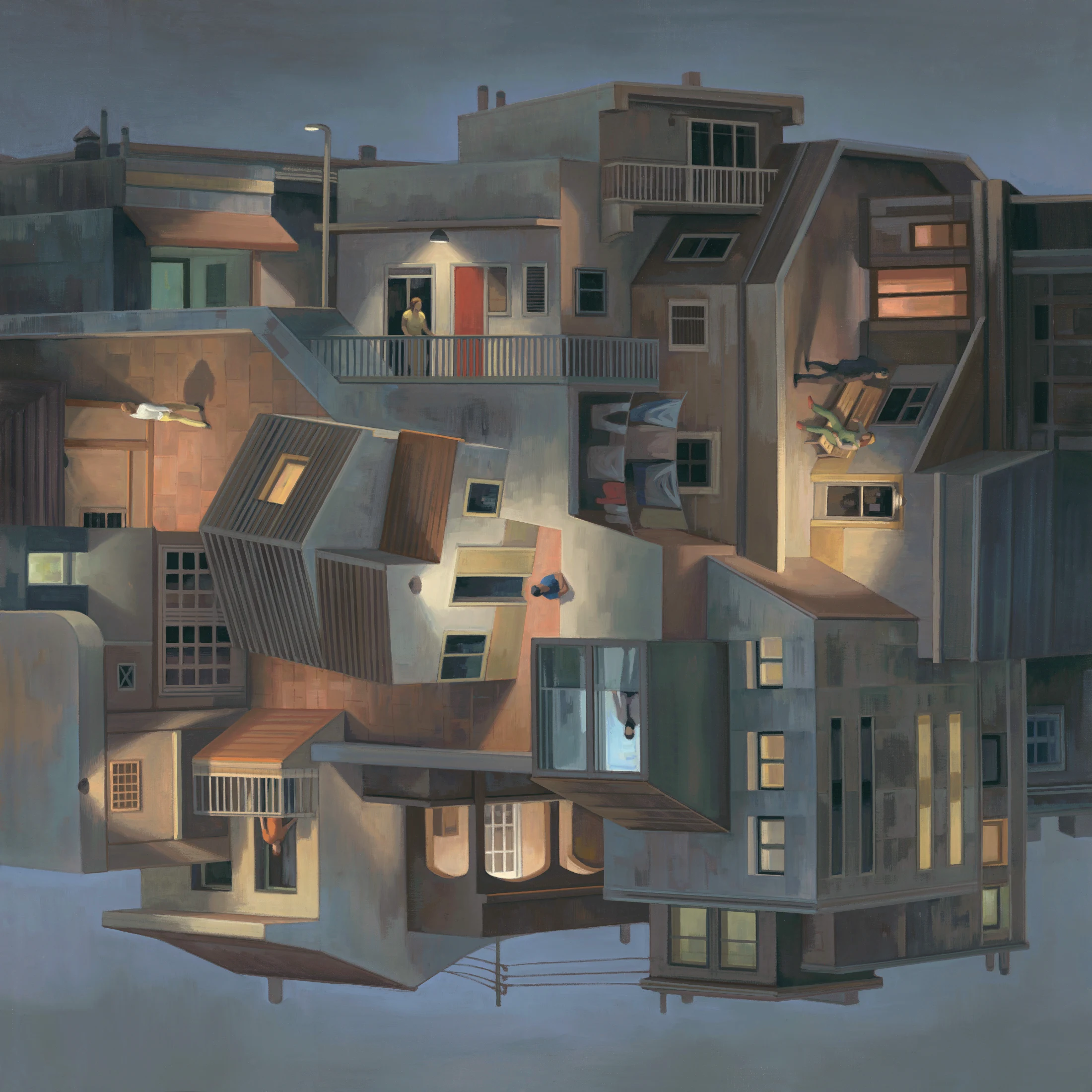
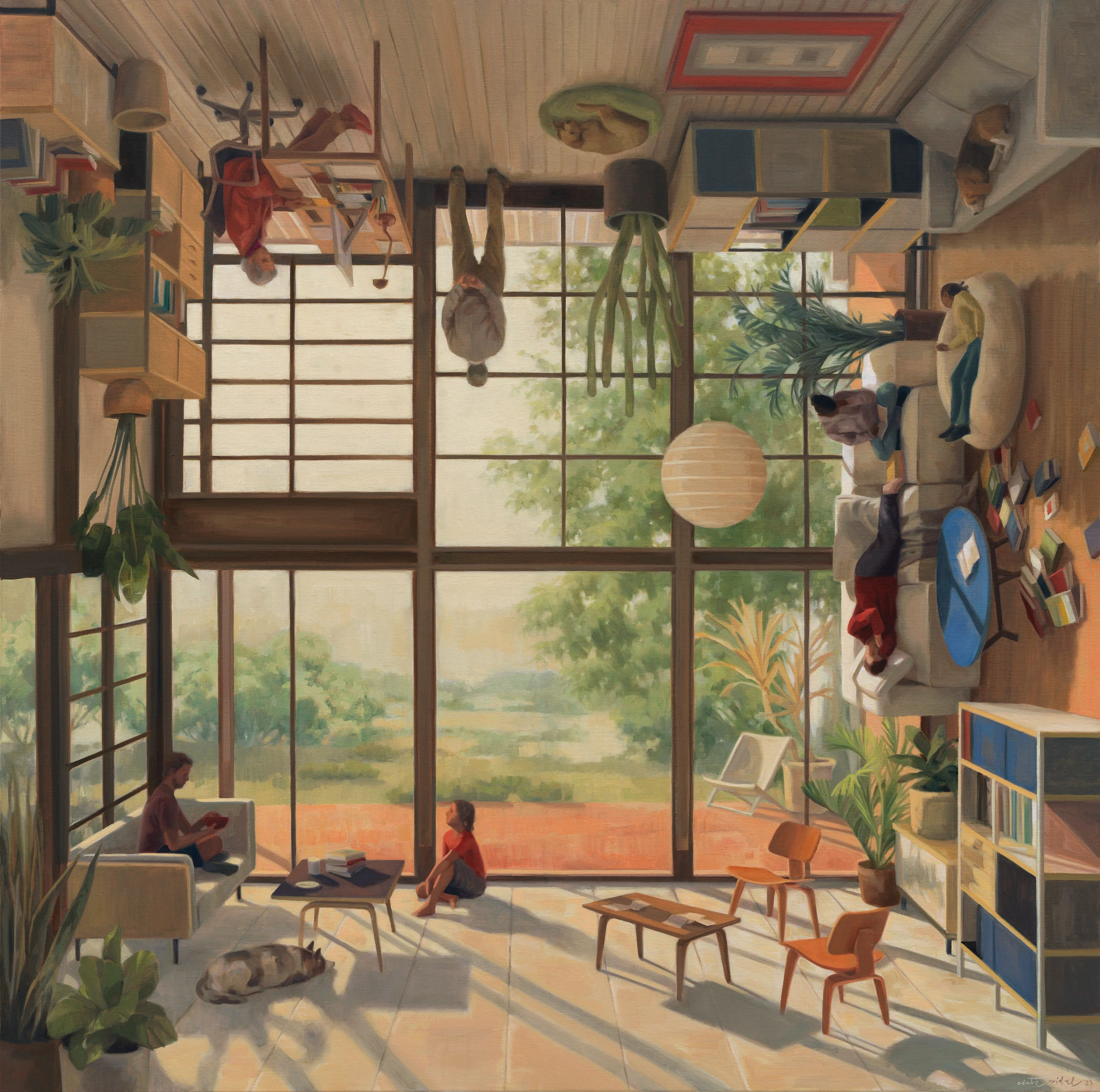
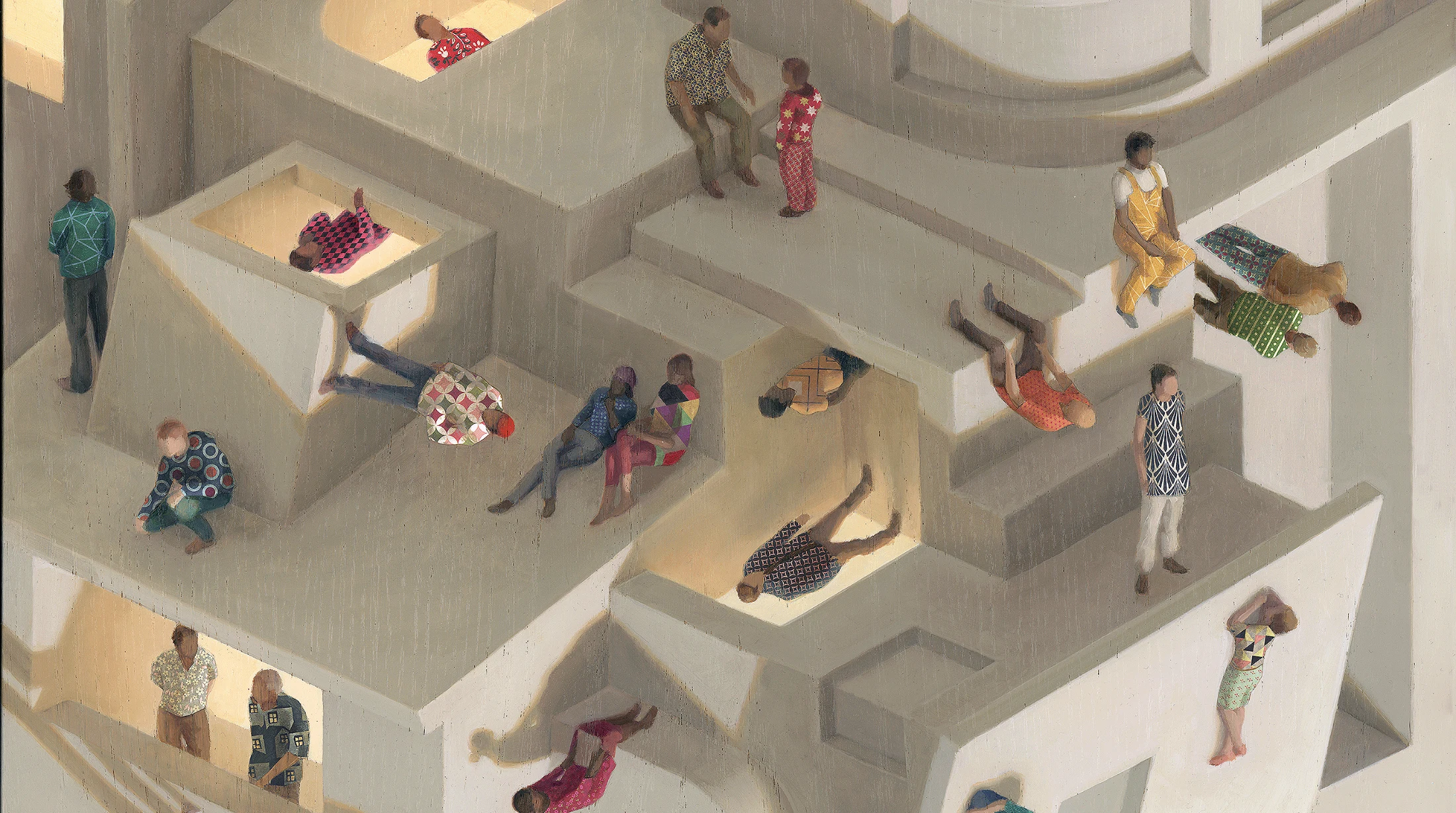
If you ever find yourself lucky enough to encounter one of Cinta Vidal's paintings, be sure to warm your neck up before looking at it too closely. The Spanish artist's perspective-bending work will see you craning your head sideways and trying to turn yourself upside down to take in every luscious angle. Her extraordinary visions of architectural riddles have a circular composition, filled with touching scenes of domestic and urban life which "despite the gravitational chaos, evoke moments of calm". Her enduring focus on the interplay between everyday human life and the built environment has also resulted in commissions for large-scale murals all around the world – a skill she honed in her early career as a scenographer for theatre productions. In the frenetic pace of our modern world, Cinta's work is an invitation to break step, pause and contemplate.

Writing:
Kirsten Drysdale
Writing:
Photography:
Photography:
Cinta Vidal
No items found.
Magazine Current IssueMagazine Current Issue
The After shot of the Floorplan
Before
before
after
After
Top
Arrow UpArrow Up

You've said art has been your 'obsession' ever since you were little, and that as a child you were always drawing and painting. What is the very first image you can remember creating?

I mainly remember copying images that fascinated me, like comics and animated movies. Beyond simple imitation, I loved drawing ballerinas and gymnasts I saw on TV. I have notebooks filled with attempts to replicate figures from Disney movies.

Did your family encourage you to pursue art as a career?

Yes, my family has always supported me. My older sister is an illustrator, my father used to draw a lot when he was young, and my grandmother took up painting after she retired. When they saw that my passion was drawing, they enrolled me in an art academy with a very free approach, where I learned various painting techniques. I'm very grateful to them for that.

So much of your work relates to urban contexts – either the subject matter itself, or the canvas in the case of your murals. Why is that?

I'm fascinated by the spaces humans inhabit and how we occupy them in different ways. Spaces say a lot about us and how we relate to each other. I don't usually focus on specific individuals; I prefer to portray people as a whole. I'm particularly interested in the tensions that arise between them, and in urban environments, where the need for coexistence multiplies, polyhedral spaces are created that I find very interesting.

You've said that you love "50s vintage architecture", especially in LA. What do you love about it?

It's an aesthetic issue that's hard for me to verbalise. I guess I'm drawn to it because it's an architecture of clean and simple lines, with large windows and unconventional geometric shapes. I find it very elegant, but at the same time full of character and originality.

If you could choose any place in the world to paint your next mural, where would it be?

It would probably be in some Asian city. I've already painted murals in Kobe and Hong Kong, but I only spent a few days in each city. I'd like the opportunity to delve deeper into these cultures and explore the cultural contrast. I was left wanting more.

Perspective is such an enduring theme in your work. How and why did this become your focus?

It was quite a natural process. As a child, I loved drawing, and the technical drawing class, where I learned the basic principles of perspective, fascinated me. I could spend hours creating volumes and shapes. Later, when I worked on painting backdrops for theatre, perspective was part of my job. When I started exploring gravity-defying elements in my works, perspective became the tool that allowed me to construct these interconnected worlds.

What do you most enjoy when you see people responding to your work?

What I enjoy most is when people make my work on their own: when they identify with it. For example, when someone tells me that a painting reminds them of living with their roommates. It also amuses me to discover which orientations of the paintings people prefer and the reasons behind these preferences. This leads to many interesting conversations. At openings, sometimes strangers come up to me, and we end up philosophising about human relationships. These are magical moments for me.

We are fascinated to know how you start one of your works, and the step-by-step process. Do you base them on a real building or scene, then build out from there? And where on the canvas do you begin?

I'm always attentive to my surroundings and gather ideas from here and there. I often start by creating a space and then add the characters. Since my images can have multiple orientations, I can't say exactly where I start on the canvas. I work by continuously rotating the surface – whether it's paper, wood, or canvas – looking for the best angle for each part of the composition. This allows me to maintain balance in all perspectives and ensure that no element dominates the others. It's a very dynamic process, where the piece evolves and takes shape organically.

How do you make sure the perspectives all come together neatly?

The key to ensuring that all perspectives fit together coherently is to keep rotating the image while I work. This way, I can evaluate how it looks from different angles and correct any imbalance that may arise. I try to avoid having a predominant point of view; rather, all orientations should be equally valid and interesting. This results in a composition where the elements are distributed harmoniously, creating a kind of visual 'tapestry' where no part is more important than another. It's a process that requires a lot of patience!

There are so many detailed scenes in your paintings. Are these real places and events, or are they from your imagination?

Some scenes are inspired by real places, but I always modify them or add elements. Sometimes I take photos of interesting spaces I find and then play with them on paper. I often create 'Frankensteins' by combining places I've seen. In recent exhibitions, I've made small tributes to special houses, like the Eames House in Los Angeles. I also like to occasionally include people I know, and people often search for themselves in my works.

Imagine you have travelled back in time to talk to yourself as the art-obsessed child. How would you describe the path your career has taken? What advice would you give yourself?

When I was little, I thought the only possible career was to be an illustrator or an animator for Disney movies. I copied a lot, and later, I found it hard to get rid of the aesthetic tics of those movies. I would tell my younger self to copy less and create more. But I also believe that copying teaches you a lot, and now I'm a realistic painter thanks to that learning.

We're fascinated to know how your artwork came to be the album artwork for Tears for Fears's latest album – how did that come about?

It was their record label that contacted me, and I was thrilled to learn that both band members had chosen one of my images for the cover of their album Tipping Point. They told me that the concept of gravitational play and the multiplicity of perspectives fit well with the theme of the new album. I was very surprised and it was a great honour for me. Curt Smith even attended the opening of my exhibition at the Lancaster Museum of Art and History (California) in 2021, which made me very happy.

I noticed that when you play that album on Apple Music, the album image rotates, which of course is the perfect way to display your work. Was that something they came up with just for you?

I wasn't aware of that, but it makes perfect sense, as records spin when they play, and my image also makes sense when rotated. It's an interesting visual game. In fact, at an exhibition I did at Thinkspace Gallery in 2018 in Los Angeles, my father created rotating mechanisms that, placed behind the paintings, allowed viewers to see them spin and change orientation.

Do you listen to music while you work?

Yes, I like to feel accompanied while I work. I switch often; sometimes I listen to music, but I also enjoy radio and podcasts. When I'm in a good mood, I listen to upbeat music, and sometimes I find myself half dancing while painting.

You've said you don't consider yourself an artist – that you're a 'craftswoman', and that what you do is a 'skill'. Why is that? And what do you think makes someone an 'artist'?

Because I trained for many years in the craft of painting theatre backdrops, which is very much an artisanal job. There, I had to adapt to each project, where the creator was the set designer. I really enjoyed being part of a machine with a multidisciplinary final result. Now that I work on my own, I feel more comfortable with the word 'artist', since I am the one creating the images. Even so, craftsmanship remains an important part of my work.

You are clearly very disciplined when it comes to how you approach your work, and consider yourself a perfectionist. Are you like that in all areas of your life?

Surprisingly, no. When I paint, I'm an extreme perfectionist with the image I'm creating, but chaos reigns around me. I struggle to keep my studio tidy, and in my daily life, I'm quite absent-minded. Little by little, I'm managing to be more disciplined in my everyday life. In fact, I'd like to be less demanding and freer when I paint (I often get too obsessed with details) and more disciplined in real life.

When I paint, I'm an extreme perfectionist with the image I'm creating, but chaos reigns around me.

There's something very mathematical about what you do – working with perspectives and angles of light. Are you good with numbers?

No, I'm actually pretty bad with numbers. But I love technical drawing, where no numerical calculations are needed, just more intuitive structures. In murals, I use an axonometric perspective, and in paintings, conical perspective. One of my obsessions is making sure the architecture is well-structured, with straight lines; if not, it looks weak.

Some years ago you said you were exploring the possibility of working with wooden sculptures. How did that go?

Well, it was a dream I had. My images are very volumetric, so it made sense to take the step toward sculpture. It's a discipline that fascinates me, but I don't have the knowledge to create a final architectural piece. At the COHABIT exhibition I did in New York in October 2023, I presented two floating wooden sculptures for the first time. I designed them, and a carpenter brought them to life. I would like to explore this discipline further, but I have to admit that I feel much more comfortable with painting.

Your paintings really force the viewer to stop, stand still, and spend some time really looking at them. Is the concept of time or the pace of modern life something you're consciously commenting on in your work?

Yes, I am a calm person, and I enjoy contemplation. I live in a small town, far from the big cities that overwhelm me. I paint scenes that, despite the gravitational chaos, evoke moments of calm. It's like a life goal: to learn to be at peace in a crazy world. The paintings I create often end up in homes, domestic spaces that I like to think of as refuges from the hectic world outside.

Cinta's original artworks and prints are available for purchase at cintavidal.com ad miscelanea.info

Writing:
Kirsten Drysdale
Writing:
Photography:
Photography:
Cinta Vidal
Back to Top
Arrow UpArrow Up
Top
Arrow UpArrow Up
The After shot of the Floorplan
Before
before
after
After
Businesses featured in this project
No items found.
Products featured in this project
No items found.
Magazine Current IssueMagazine Current Issue
Writing:
Cinta Vidal
Writing:
Photography:
Photography:
Cinta Vidal
Back to Top
Arrow UpArrow Up