Magazine Current IssueMagazine Current Issue
Breathe, Fold, Glow.
From our Mag
August 1, 2026

Breathe, Fold, Glow.

From vacuum-sealed rice to discarded rubber gloves, three emerging designers turn everyday inspiration into some very surprising lamps.

Experimental lighting from Singapore design week.

Elizabeth Price
Writing:
Writing:
Elizabeth Price
Photography:
Photography:
No items found.
Magazine Current IssueMagazine Current Issue
The After shot of the Floorplan
Before
before
after
After
Top
Arrow UpArrow Up

A pack of vacuum-sealed rice and defective rubber gloves were the unlikely sources of inspiration for three emerging designers...

For E Ian Siew, the pack of rice triggered an urge to explore air extraction in the design of a rehabilitation device for people recovering from open heart surgery. Siew himself had undergone such surgery as an infant and again at the age of 22 when he designed the award-winning Auxobrace. Now 27, the young Singaporean designer, engineer and artist has since turned his attention to more domestic projects, including some rather intriguing lamps (and a very clever stool).

For designers Eric Tiau and Wei Ming Tan, Malaysia's prolific production of rubber gloves was the trigger. Both designers have produced lighting designs using 'Beyon Rubber' – a patented material derived from recycled nitrile gloves. These lamps appeared alongside Siew's and designs from more than 70 designers from across Asia for the EMERGE @ FIND exhibition as part of Singapore Design Week 2025. Curated by our friends Edwin Low of Supermama and Suzy Annetta of Design Anthology, EMERGE @ FIND asked designers to respond to the theme of 'Dialogue Through Design'. We were fortunate to learn more about these fascinating designs and the designers behind them.

Fold Light by Wei Ming Tan / Aureole Design

What inspired the Fold Light?

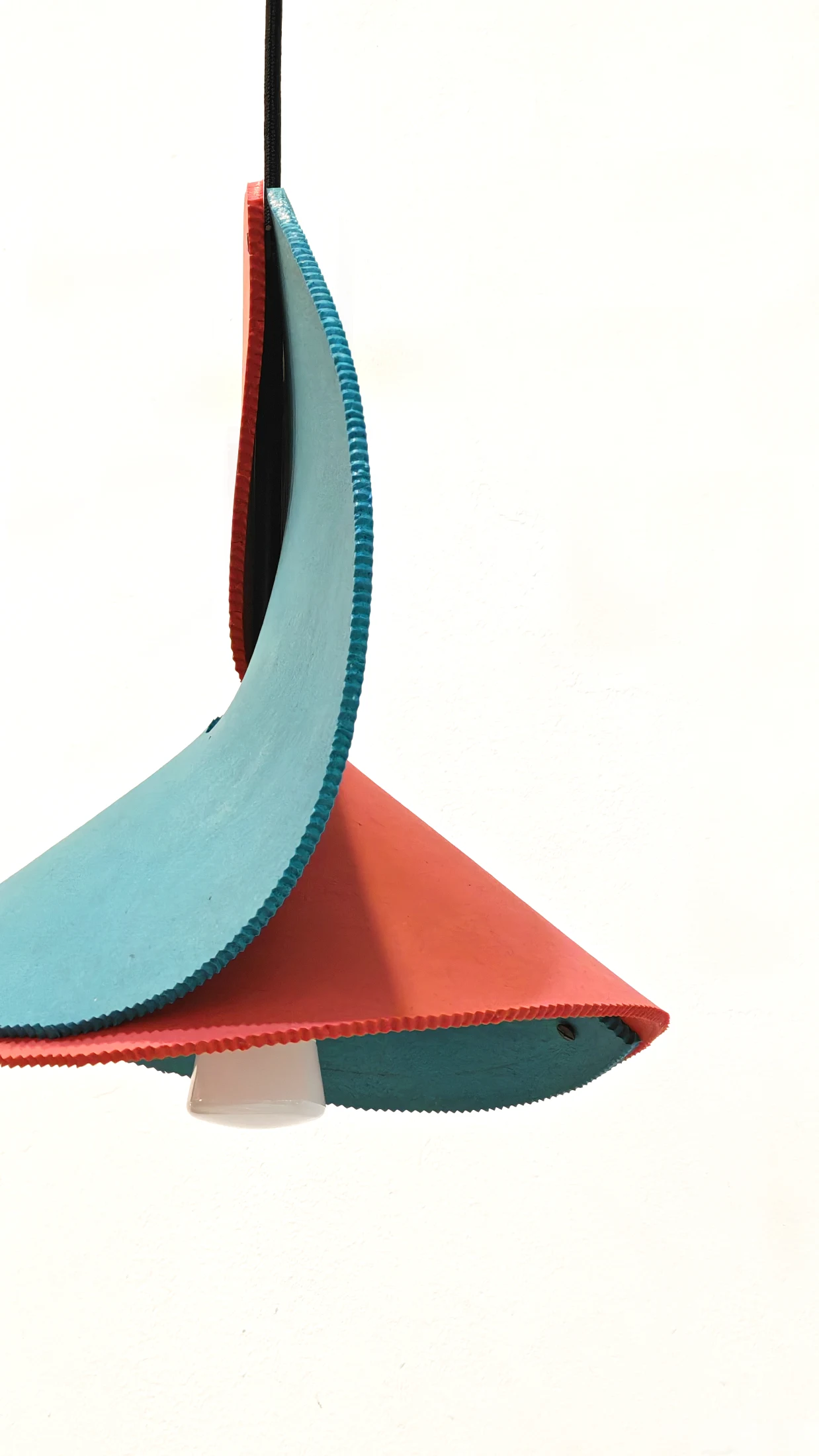
I was experimenting with a new material – recycled nitrile gloves. I was commissioned to explore this material for a lighting product, specifically a table light. From this project, I saw the potential to adapt it to some of my earlier ideas using paper folding.

This is not your first time working with recycled materials though…

That's right. I've worked with recycled plastic strips in weaving workshops. It's a joy to create colour collages using recycled plastic and the sheets are ready after heat pressing. Soft plastics offer flexibility in achieving different thicknesses – from thin to card-like by layering the sheets. They are very pliable to work with, similar to paper. Rubber, on the other hand, is also pliable, but it requires some form of interlocking to hold its shape, as it cannot be folded in the same way. With the right tools, the material can be 'tamed' to achieve the desired outcome though. I do love the different possibilities rubber offers, it's water-repellent and, most importantly, it can be recycled again using the same process.

Is this an area of design that particularly interests you?

Absolutely. Finding ways to adopt waste materials into everyday objects and design applications gives me the opportunity to share the possibilities of reusing waste. Through design, I hope to help elevate recycled materials, while also raising awareness around waste reduction and the importance of recycling.

I understand you were originally a graphic designer. Do you feel your current practice is strongly influenced by your graphic design background?

Yes, being a graphic designer influenced much of this development process. And because I don't know how to use 3D software (yes, even up till today), I tend to think of the simplest way to create three-dimensional objects by hand, mostly with paper cutting and folding.

We love the playfulness and originality of the Fold Light and its flat-pack potential. Will they be available for sale?

I had a lot of fun exploring the Fold Light series. Every day I was eager to discover what new forms it could develop into. And it was the simplest formation that stood out as the final version. The flat pack design came later, during the production and assembly stage, which became an added advantage – especially for the international market.

I am currently working closely with the fabricator to finalise the material finishing, as well as looking out for collaborators on the production and distribution of the Fold Light. I'm also exploring other materials besides rubber, as the Fold Light design concept is adaptable to a range of different materials.

(Air)Just by E Ian Siew

How did your shift from designing medical devices to designing lighting and furniture come about?

The transition was actually quite natural. It was all driven by the material itself. With Auxobrace, I was approaching inflatables strictly from the lens of an engineer. I understood air at a technical level where I was calculating pressure and constraints for rehabilitation. But during the countless hours spent prototyping, I began to see something else. I realised that air wasn't just a clinical tool; it had a unique character. I became fascinated by the way air creates tension and structure, and, as a designer, I wanted to move beyond just solving a medical problem and instead find a way to express that structural 'magic' to a wider audience. In this context, household objects were the perfect medium.

What is it that appeals to you in working with … air?

To me, air is a fascinating medium because it is the very foundation of our existence. It is the invisible conduit for our senses. It carries sound, smell and temperature, acting as the medium through which we perceive and establish a relationship with our environment. It protects us, surrounds us and literally flows through us.

I find this abundance inspiring and in my work, I am essentially regulating atmospheric pressure to transform this invisible gas into tangible, rigid structures. From a design perspective, the material properties are just as compelling. Pressurised inflatables offer an incredible rigidity-to-weight ratio that you cannot find in traditional solid materials. They allow me to create objects that are voluminous and strong in form, yet lightweight and transient. This creates so many new opportunities for structural creation that simply aren't possible with standard furniture materials.

What inspires the forms of your (AIR)JUST designs?

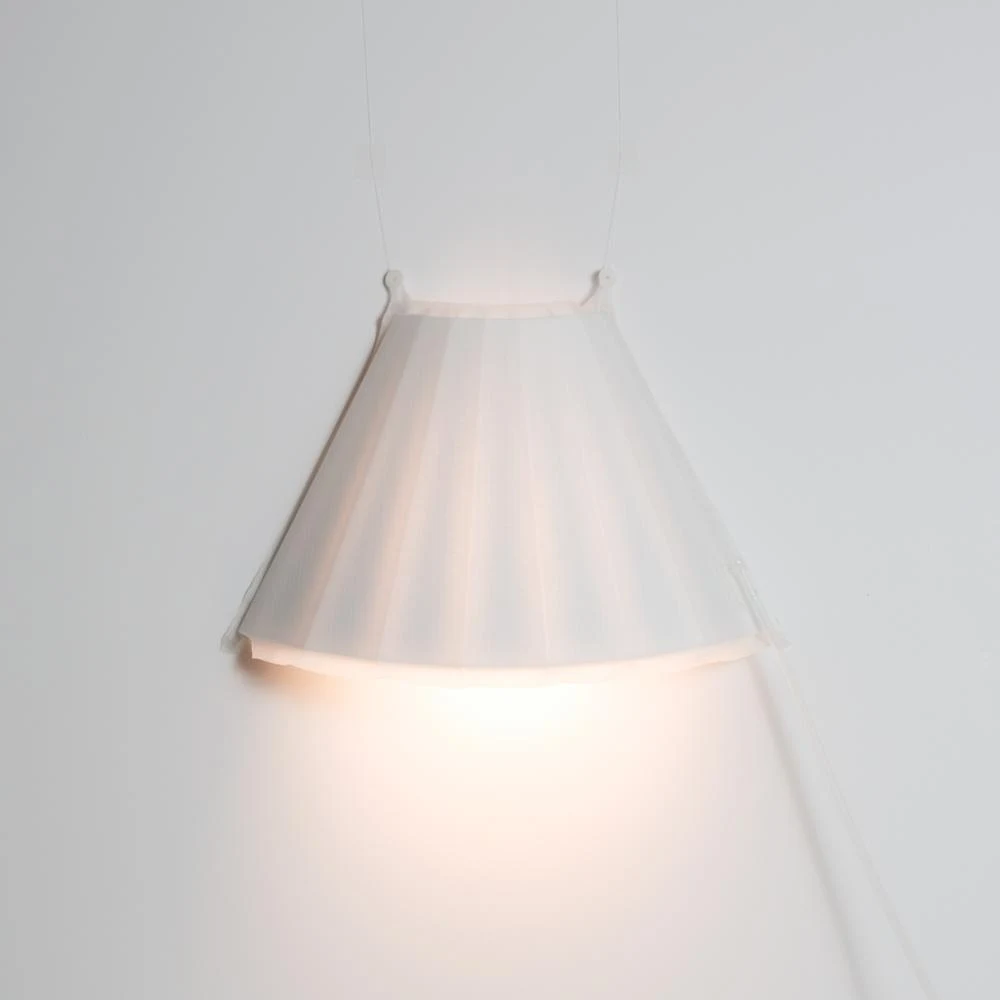
I deliberately choose simple geometries because I want the focus to be on the interaction rather than the intricacy of the shape itself. If the form is too complex, it distracts from the physics at play. For (Air)ssembly, the bladder is a basic oval paired with 'quiet' solid components – a round rim and three legs. This simplicity allows the user to witness the real phenomenon: how pressurised air creates enough outward force to generate friction and hold the joinery together. It is the same with (Air)just. It consists of a simple tube-like bladder and a V-stand with a cutout. The form is minimal so that the focus remains on how the bladder nestles into the hole to secure itself. For Lumin(Air), the shapes are simple 2D outlines. This was a functional choice to achieve that specific morphing action where the object emerges from a flat wall into a 3D form.

Aesthetically, I am heavily inspired by the Radical Design era of the 1960s. I love the space age and pop culture aesthetics seen in works like the Blow Armchair by Zanotta or Quasar Khanh's aerospace collection. That era focused on inflatables as standalone objects and the twist I want to present is that air doesn't have to work alone. I use inflatables in tandem with other solid materials to realise an object. This mirrors my view that air is not just an isolated material, but something that constantly interacts with our environment and our ability to live and breathe.

Something else that really appeals to us about your designs is that they must be so light and easy to ship. Was this front of mind for you when designing?

Absolutely. That is the inherent beauty of designing with air. I don't have to overthink the logistics of shipping because I'm only transporting the 'skin' and the 'bones'. The main volume of the furniture is sourced right in the user's living room.

What I love most is that it requires no tools other than the user themselves. Each piece comes with a simple hand pump, so the assembly becomes this direct, physical interaction. You just pump until the bladder is rigid, and the object takes shape.

It allows for a universality that is really freeing. It doesn't matter where you are in the world; the air is there, and the system works. (Unless, of course, you are on top of Mount Everest or deep underwater where the atmospheric pressure changes things, but that is a topic for another day!)

Your colour palette is very simple. Deliberately so?

It's a very conscious choice. I try to stick to a strict monochrome palette for now. I use white for the inflatable bladder and black for the remaining rigid geometry.

The goal is to highlight the form without distraction. I want to preserve that distinct, bulbous quality that inflatables naturally have and by keeping the colours plain, the physical details like creases and tension lines become much more obvious. It gives the object a certain character. It feels 'alive' because those creases and bulges shift and change slightly with every use. The simple palette acts as a canvas to capture those fleeting moments of tension.

Do you have plans to make your lamps or stool commercially available?

I'm currently exploring the best options and materials to make these designs commercially viable, with a specific focus on the (Air)just lamp. It's a process of refining the production to ensure consistency and durability. In the meantime, I am taking a more personal approach. I am open to small batch orders through direct message, and will always be happy to discuss the work with interested parties to help bring a piece of this phenomena into people's homes.

BEORI REST+ by Eric Tiau / BEORI

What inspired the form of the BEORI REST+?

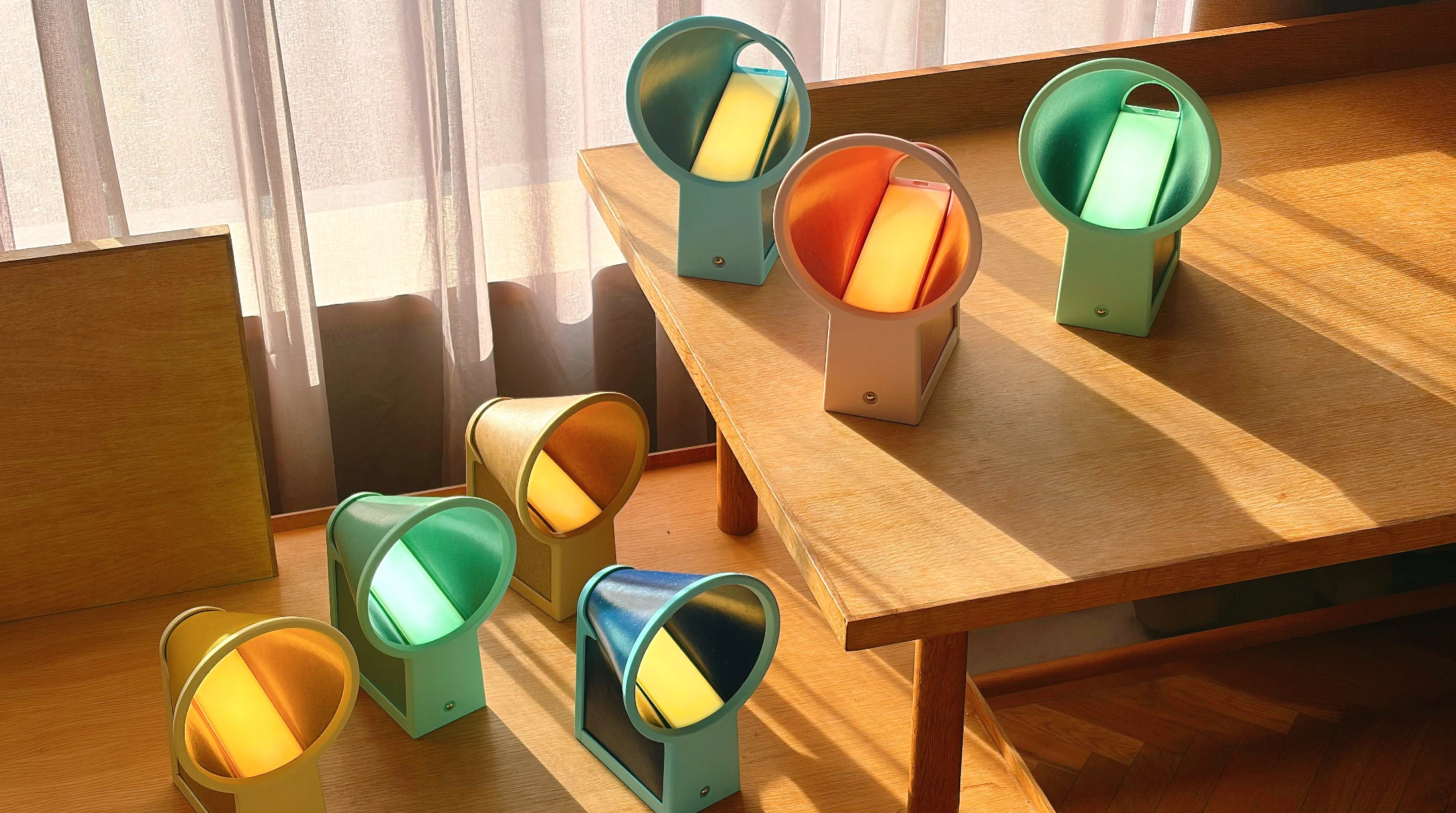
A balance between geometric clarity and organic softness. It’s intentionally modest and human-scaled, allowing it to sit comfortably in smaller spaces. The lamp is built using a snap-and-build system, without any screws or glue. This allows for easy assembly and disassembly, supporting both thoughtful sustainable production and future adaptability. Unlike many ambient lamps that project light upward or downward, BEORI REST+ directs light forward. This creates a candle-like glow.

What inspired the colour palette?

Malaysia’s rich mix of cultures and natural landscapes shaped our sensitivity to colour. The palette blends this cultural richness with natural, easy-going colours that adapt well to different interiors.

What did you learn while working with your patented Beyon Rubber material?

We learned that imperfection can be a strength. Beyon Rubber naturally carries subtle variations in texture and colour, giving each lamp a quiet individuality. The material’s softness works beautifully with warm light too.

What’s your favourite feature of the BEORI REST+ lamp?

Its ability to feel present without being distracting. When it’s on, it quietly changes the mood of a space.

Do you plan to expand the range? What’s next?

Yes. The BEORI REST+ currently comes in more than 10 colour variations, and we recently introduced the BEORI REST Mini. Both will continue to explore connections with culture and art to create distinct design identities. Looking ahead, future pieces will continue to explore light, rest, and emotional wellbeing, especially within compact living environments. Our focus remains on supporting everyday rituals, not adding complexity.

Writing:
Writing:
Elizabeth Price
Photography:
Photography:
Back to Top
Arrow UpArrow Up
Top
Arrow UpArrow Up
The After shot of the Floorplan
Before
before
after
After
Businesses featured in this project
No items found.
Products featured in this project
No items found.
Magazine Current IssueMagazine Current Issue
Writing:
Writing:
Elizabeth Price
Photography:
Photography:
Back to Top
Arrow UpArrow Up